Skip to main content
Introduction to Chemistry
My Course
Learn
Exam Prep
AI Tutor
Study Guides
Flashcards
Explore
Try the app
My Course
Learn
Exam Prep
AI Tutor
Study Guides
Flashcards
Explore
Try the app
Back
Balancing Redox Reactions: Basic Solutions definitions
You can tap to flip the card.
Redox Reaction
You can tap to flip the card.
👆
Redox Reaction
A chemical process involving simultaneous oxidation and reduction, where electrons are transferred between species.
Track progress
Control buttons has been changed to "navigation" mode.
1/12
Related flashcards
Related practice
Recommended videos
Balancing Redox Reactions: Basic Solutions quiz
Balancing Redox Reactions: Basic Solutions
15 Terms
Balancing Redox Reactions: Basic Solutions
16. Oxidation and Reduction
5 problems
Topic
Galvanic Cell (Simplified)
16. Oxidation and Reduction
5 problems
Topic
16. Oxidation and Reduction
6 topics
15 problems
Chapter
Guided course
08:25
Balancing Redox Reactions: Basic Solutions Example 1
5292
views
28
rank
Guided course
01:04
Balancing Redox Reactions: Basic Solutions
5752
views
19
rank
Terms in this set (12)
Hide definitions
Redox Reaction
A chemical process involving simultaneous oxidation and reduction, where electrons are transferred between species.
Basic Solution
An aqueous environment characterized by a higher concentration of hydroxide ions compared to hydrogen ions.
Acidic Solution
A solution with a greater concentration of hydrogen ions than hydroxide ions, often used as a medium for certain chemical reactions.
Hydroxide Ion
A negatively charged ion, symbolized as OH-, commonly present in basic solutions and crucial for balancing reactions in such media.
Step 7
The final adjustment in balancing redox reactions under basic conditions, ensuring all elements and charges are properly accounted for.
Electron Transfer
The movement of electrons from one chemical species to another, central to oxidation-reduction processes.
Oxidation
A process where a species loses electrons, increasing its oxidation state during a chemical reaction.
Reduction
A process where a species gains electrons, resulting in a decrease in its oxidation state.
Balancing
The methodical process of ensuring the number of atoms and charges are equal on both sides of a chemical equation.
Example Question
A practice problem provided to illustrate the application of balancing techniques in a specific chemical context.
Oxidation State
A numerical value representing the hypothetical charge an atom would have if all bonds to it were completely ionic.
Aqueous Environment
A setting where water acts as the solvent, influencing the behavior and interactions of dissolved species.
 BackBack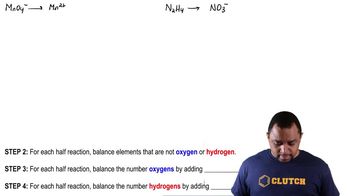
 08:25
08:25