Skip to main content
Introduction to Chemistry
My Course
Learn
Exam Prep
AI Tutor
Study Guides
Flashcards
Explore
Try the app
My Course
Learn
Exam Prep
AI Tutor
Study Guides
Flashcards
Explore
Try the app
Back
Balancing Redox Reactions: Basic Solutions quiz
You can tap to flip the card.
What is the main difference between balancing redox reactions in acidic and basic solutions?
You can tap to flip the card.
👆
What is the main difference between balancing redox reactions in acidic and basic solutions?
Balancing in basic solutions requires all the steps used in acidic solutions plus one additional step at the end.
Track progress
Control buttons has been changed to "navigation" mode.
1/15
Related flashcards
Related practice
Recommended videos
Balancing Redox Reactions: Basic Solutions definitions
Balancing Redox Reactions: Basic Solutions
12 Terms
Balancing Redox Reactions: Basic Solutions
16. Oxidation and Reduction
5 problems
Topic
Galvanic Cell (Simplified)
16. Oxidation and Reduction
5 problems
Topic
16. Oxidation and Reduction
6 topics
15 problems
Chapter
Guided course
08:25
Balancing Redox Reactions: Basic Solutions Example 1
5292
views
28
rank
Guided course
01:04
Balancing Redox Reactions: Basic Solutions
5752
views
19
rank
Terms in this set (15)
Hide definitions
What is the main difference between balancing redox reactions in acidic and basic solutions?
Balancing in basic solutions requires all the steps used in acidic solutions plus one additional step at the end.
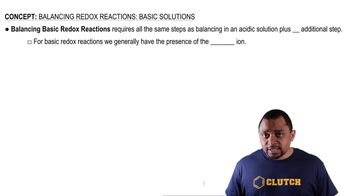
What ion is typically present in basic redox reactions?
The hydroxide ion (OH-) is typically present in basic redox reactions.
Why is it recommended to review balancing redox reactions in acidic solutions before learning about basic solutions?
Because the steps for balancing in basic solutions build on those used for acidic solutions, with only one extra step added.
What is the charge of the hydroxide ion?
The hydroxide ion has a charge of minus one (-1).
What is the additional step called when balancing redox reactions in basic solutions?
The additional step is referred to as Step 7.
At what point in the balancing process does the unique step for basic solutions occur?
The unique step for basic solutions occurs at the end, after all acidic solution steps are completed.
What should you do if you have not mastered balancing redox reactions in acidic solutions?
You should review the videos or materials on balancing redox reactions in acidic solutions first.
What is the chemical formula for the hydroxide ion?
The chemical formula for the hydroxide ion is OH-.
How many total steps are there when balancing redox reactions in basic solutions?
There are seven steps in total when balancing redox reactions in basic solutions.
What is the purpose of Step 7 in balancing redox reactions in basic solutions?
Step 7 ensures the reaction is properly balanced for basic conditions by accounting for hydroxide ions.
Is the process for balancing redox reactions in basic solutions completely different from acidic solutions?
No, it is almost the same except for the final additional step.
What should you expect to see in the next video after this lesson?
You should expect to see an example question for practice.
What is the main ion used to balance redox reactions in acidic solutions?
The main ion used is the hydrogen ion (H+), though this is not explicitly stated in the transcript.
What is the significance of mastering the steps for acidic solutions before moving to basic solutions?
Mastering the acidic solution steps makes it easier to learn the basic solution method, since only one extra step is added.
What is the abbreviation for hydroxide ion?
The abbreviation for hydroxide ion is OH-.
 BackBack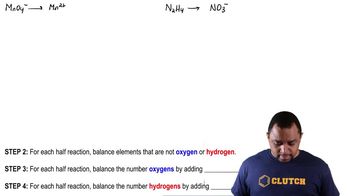
 08:25
08:25