Skip to main content
Introduction to Chemistry
My Course
Learn
Exam Prep
AI Tutor
Study Guides
Flashcards
Explore
Try the app
My Course
Learn
Exam Prep
AI Tutor
Study Guides
Flashcards
Explore
Try the app
Back
Boiling Point Elevation definitions
You can tap to flip the card.
Boiling Point Elevation
You can tap to flip the card.
👆
Boiling Point Elevation
Phenomenon where adding a solute to a solvent causes an increase in the solvent's boiling point.
Track progress
Control buttons has been changed to "navigation" mode.
1/13
Related flashcards
Related practice
Recommended videos
Boiling Point Elevation quiz
Boiling Point Elevation
15 Terms
Boiling Point Elevation
13. Solutions
5 problems
Topic
Freezing Point Depression
13. Solutions
5 problems
Topic
13. Solutions - Part 1 of 2
12 topics
35 problems
Chapter
13. Solutions - Part 2 of 2
2 topics
6 problems
Chapter
Guided course
03:05
Boiling Point Elevation Concept 1
3667
views
4
rank
Guided course
01:54
Boiling Point Elevation Example 1
3695
views
2
rank
Terms in this set (13)
Hide definitions
Boiling Point Elevation
Phenomenon where adding a solute to a solvent causes an increase in the solvent's boiling point.
Normal Boiling Point
Temperature at which a pure solvent transitions to vapor before any solute is added.
Boiling Point of Solution
Temperature at which a solvent containing dissolved solute transitions to vapor.
Solute
Substance dissolved in a solvent, responsible for altering the boiling point of the mixture.
Solvent
Primary liquid in which a solute is dissolved, determining the initial boiling point.
Delta Tb
Symbol representing the change in boiling point due to the presence of a solute.
van't Hoff Factor
Number indicating how many particles a solute produces in solution, affecting boiling point change.
Boiling Point Constant
Proportionality value (kb) unique to each solvent, used in calculating boiling point elevation.
Molality
Concentration unit defined as moles of solute per kilogram of solvent, used in colligative property calculations.
Colligative Properties
Physical properties of solutions that depend on solute particle quantity, not their identity.
Electrolyte
Compound that dissociates into ions in solution, increasing the van't Hoff factor above one.
Nonvolatile Compound
Substance with negligible vapor pressure, not contributing to the vapor phase above a solution.
Covalent Compound
Molecule formed by shared electrons, typically yielding a van't Hoff factor of one in solution.
 BackBack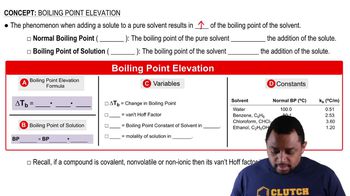
 03:05
03:05