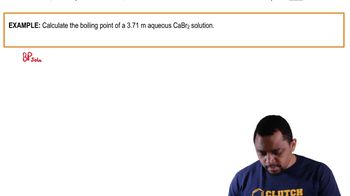
Boiling point elevation is the phenomenon where adding a solute to a pure solvent increases the boiling point of the solvent.
What happens to the boiling point of a solvent when more solute is added?
The boiling point of the solvent increases as more solute is added.
What is the normal boiling point (bp) of a solvent?
The normal boiling point is the boiling point of the pure solvent before any solute is added.
How is the boiling point of a solution (bp solution) defined?
The boiling point of a solution is the boiling point of the solvent after the addition of a solute.
What is the formula for boiling point elevation?
The formula is Δt_b = i × k_b × m, where Δt_b is the change in boiling point, i is the van't Hoff factor, k_b is the boiling point constant, and m is the molality.
What does the van't Hoff factor (i) represent in the boiling point elevation formula?
The van't Hoff factor (i) represents the number of particles into which a solute dissociates in solution.
What is the boiling point constant (k_b) and its units?
The boiling point constant (k_b) is a property of the pure solvent, with units of degrees Celsius per molality (°C/m).
How is molality (m) defined in the context of boiling point elevation?
Molality is defined as moles of solute per kilogram of solvent.
How do you calculate the boiling point of a solution?
Add the change in boiling point (Δt_b) to the normal boiling point of the pure solvent.
Name four common solvents used in boiling point elevation problems.
Water, benzene, chloroform, and ethanol are commonly used solvents.
What happens to the boiling point of water when a solute is added?
The boiling point of water increases when a solute is added.
Do you need to memorize the k_b values for common solvents?
No, you do not need to memorize the k_b values; they are usually provided in problems.
What is the van't Hoff factor (i) for a covalent, non-volatile, or non-ionic compound?
For such compounds, the van't Hoff factor (i) is typically 1.
Why does adding a solute to a solvent elevate its boiling point?
Adding a solute disrupts the solvent's ability to vaporize, requiring a higher temperature to boil.
What are the key variables needed to solve a boiling point elevation problem?
You need the van't Hoff factor (i), boiling point constant (k_b), and molality (m) of the solution.
 Back
Back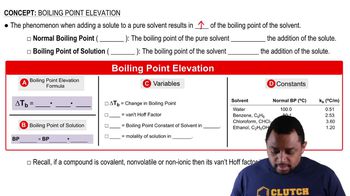
 03:05
03:05