Skip to main content
Introduction to Chemistry
My Course
Learn
Exam Prep
AI Tutor
Study Guides
Flashcards
Explore
Try the app
My Course
Learn
Exam Prep
AI Tutor
Study Guides
Flashcards
Explore
Try the app
Back
Complete Ionic Equations definitions
You can tap to flip the card.
Ionic Equation
You can tap to flip the card.
👆
Ionic Equation
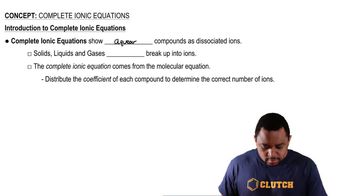
A representation where aqueous compounds are shown as their separated ions, highlighting the ionic nature of reactions.
Track progress
Control buttons has been changed to "navigation" mode.
1/13
Related flashcards
Related practice
Recommended videos
Complete Ionic Equations quiz
Complete Ionic Equations
15 Terms
Complete Ionic Equations
7. Chemical Reactions
5 problems
Topic
Gas Evolution Equations (Simplified)
7. Chemical Reactions
5 problems
Topic
7. Chemical Reactions
8 topics
24 problems
Chapter
Guided course
02:16
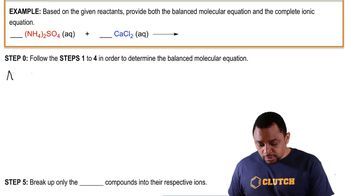
Complete Ionic Equations Example 1
8518
views
67
rank
Guided course
04:41
Complete Ionic Equations Example 2
6897
views
49
rank
Guided course
00:47
Complete Ionic Equations
8457
views
59
rank
Terms in this set (13)
Hide definitions
Ionic Equation
A representation where aqueous compounds are shown as their separated ions, highlighting the ionic nature of reactions.
Molecular Equation
A chemical equation displaying all reactants and products as compounds, including solids, liquids, and gases.
Aqueous Compound
A substance dissolved in water, capable of dissociating into ions in solution.
Solubility Rules
Guidelines used to predict whether a compound will dissolve in water to form an aqueous solution.
Coefficient
A number placed before a compound in an equation, indicating the quantity of molecules or ions involved.
Ion
An atom or group of atoms carrying a charge due to loss or gain of electrons, often present in aqueous solutions.
Net Ionic Equation
A simplified equation showing only the ions directly involved in the chemical reaction, omitting unchanged ions.
Spectator Ion
An ion present on both sides of a chemical equation that does not participate in the actual reaction.
Reactant
A starting substance in a chemical reaction, found on the left side of a chemical equation.
Product
A substance formed as a result of a chemical reaction, found on the right side of a chemical equation.
Solid
A state of matter with definite shape and volume, not dissociating into ions in chemical equations.
Liquid
A state of matter with definite volume but no fixed shape, not represented as ions in ionic equations.
Gas
A state of matter with neither definite shape nor volume, not dissociating into ions in equations.
 BackBack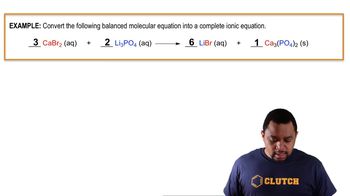
 02:16
02:16