Skip to main content
Introduction to Chemistry
My Course
Learn
Exam Prep
AI Tutor
Study Guides
Flashcards
Explore
Try the app
My Course
Learn
Exam Prep
AI Tutor
Study Guides
Flashcards
Explore
Try the app
Back
Complete Ionic Equations quiz
You can tap to flip the card.
What do complete ionic equations show about aqueous compounds?
You can tap to flip the card.
👆
What do complete ionic equations show about aqueous compounds?
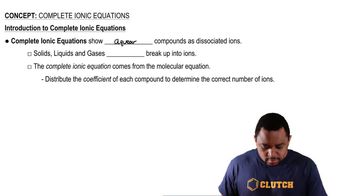
Complete ionic equations show aqueous compounds as dissociated ions.
Track progress
Control buttons has been changed to "navigation" mode.
1/15
Related flashcards
Related practice
Recommended videos
Complete Ionic Equations definitions
Complete Ionic Equations
13 Terms
Complete Ionic Equations
7. Chemical Reactions
5 problems
Topic
Gas Evolution Equations (Simplified)
7. Chemical Reactions
5 problems
Topic
7. Chemical Reactions
8 topics
24 problems
Chapter
Guided course
02:16
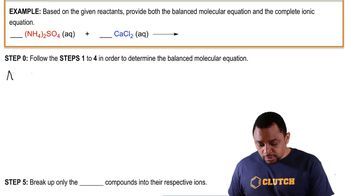
Complete Ionic Equations Example 1
8526
views
67
rank
Guided course
04:41
Complete Ionic Equations Example 2
6904
views
49
rank
Guided course
00:47
Complete Ionic Equations
8462
views
59
rank
Terms in this set (15)
Hide definitions
What do complete ionic equations show about aqueous compounds?
Complete ionic equations show aqueous compounds as dissociated ions.
How are solids, liquids, and gases represented in molecular equations?
Solids, liquids, and gases are included in molecular equations but do not dissociate into ions.
Which type of compounds dissociate into ions in ionic equations?
Only aqueous compounds dissociate into ions in ionic equations.
What rules help determine if a compound is aqueous?
The solubility rules help determine if a compound is aqueous.
From which equation is the complete ionic equation derived?
The complete ionic equation is derived from the molecular equation.
Why must you distribute the coefficient in a molecular equation when writing a complete ionic equation?
You must distribute the coefficient to each compound to determine the correct number of ions.
What is the purpose of a net ionic equation?
A net ionic equation shows only the ions participating in the chemical reaction.
What are spectator ions?
Spectator ions are ions that appear on both sides of the equation but do not participate in the reaction.
How are spectator ions treated in net ionic equations?
Spectator ions are removed from net ionic equations.
What is the sequence of equations to reach a net ionic equation?
You start with a molecular equation, then write the complete ionic equation, and finally the net ionic equation.
What distinguishes a molecular equation from a complete ionic equation?
A molecular equation shows compounds as whole units, while a complete ionic equation shows aqueous compounds as ions.
Why do solids, liquids, and gases not break up into ions in ionic equations?
Solids, liquids, and gases do not dissociate because they are not soluble in water.
What information does a complete ionic equation provide that a molecular equation does not?
A complete ionic equation provides the actual ions present in solution, not just the compounds.
What is the main focus of a net ionic equation?
The main focus is on the ions that directly participate in the chemical reaction.
Why is understanding the progression from molecular to net ionic equation important?
It helps understand chemical reactions at the ionic level and identify the reacting species.
 BackBack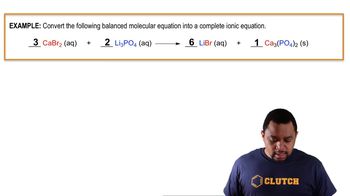
 02:16
02:16