Skip to main content
Introduction to Chemistry
My Course
Learn
Exam Prep
AI Tutor
Study Guides
Flashcards
Explore
Try the app
My Course
Learn
Exam Prep
AI Tutor
Study Guides
Flashcards
Explore
Try the app
Back
Density definitions
You can tap to flip the card.
Density
You can tap to flip the card.
👆
Density
A ratio expressing how much matter exists within a specific amount of space, calculated by dividing mass by volume.
Track progress
Control buttons has been changed to "navigation" mode.
1/13
Related flashcards
Related practice
Recommended videos
Density quiz #1
Density
10 Terms
Density
2. Measurement and Problem Solving
5 problems
Topic
Density of Non-Geometric Objects
2. Measurement and Problem Solving
3 problems
Topic
2. Measurement and Problem Solving
10 topics
27 problems
Chapter
Guided course
01:56
Density
13926
views
125
rank
1
comments
Guided course
05:30
Density Example 1
11874
views
104
rank
Terms in this set (13)
Hide definitions
Density
A ratio expressing how much matter exists within a specific amount of space, calculated by dividing mass by volume.
Mass
A measure of the amount of matter present in a substance, commonly expressed in grams for density calculations.
Volume
A measure of the space occupied by a substance, often given in milliliters, cubic centimeters, or liters.
Grams
A metric unit used to quantify the amount of matter, serving as the standard mass unit in density measurements.
Milliliters
A metric unit for measuring liquid volume, interchangeable with cubic centimeters in density calculations for solids and liquids.
Cubic Centimeters
A metric unit for measuring volume, exactly equal to one milliliter, often used for solids and liquids.
Liters
A metric unit for measuring larger volumes, especially for gases, equivalent to one cubic decimeter.
Cubic Decimeters
A metric unit for volume, equal to one liter, commonly used for expressing the volume of gases.
Solids
A phase of matter characterized by higher density, typically measured using grams and milliliters or cubic centimeters.
Liquids
A phase of matter with density values higher than gases, measured in grams per milliliter or grams per cubic centimeter.
Gases
A phase of matter with much lower density, measured in grams per liter or grams per cubic decimeter.
Conversion Factors
Numerical relationships that allow switching between units, such as 1 milliliter equaling 1 cubic centimeter.
Formula
A mathematical expression, such as mass divided by volume, used to calculate a specific property like density.
 BackBack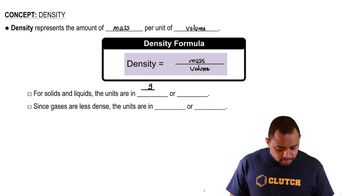
 01:56
01:56