Skip to main content
Introduction to Chemistry
My Course
Learn
Exam Prep
AI Tutor
Study Guides
Flashcards
Explore
Try the app
My Course
Learn
Exam Prep
AI Tutor
Study Guides
Flashcards
Explore
Try the app
Back
Intermolecular Forces (Simplified) definitions
You can tap to flip the card.
Intermolecular Forces
You can tap to flip the card.
👆
Intermolecular Forces
Electrostatic attractions between molecules that influence physical properties like boiling and melting points.
Track progress
Control buttons has been changed to "navigation" mode.
1/15
Related flashcards
Related practice
Recommended videos
Intermolecular Forces (Simplified) quiz #1
Intermolecular Forces (Simplified)
10 Terms
Intermolecular Forces (Simplified)
12. Liquids, Solids, and Intermolecular Forces
5 problems
Topic
Intermolecular Forces and Physical Properties
12. Liquids, Solids, and Intermolecular Forces
5 problems
Topic
12. Liquids, Solids, and Intermolecular Forces
4 topics
12 problems
Chapter
Guided course
06:36
Intermolecular Forces (Simplified) Concept 2
2805
views
18
rank
Guided course
01:54
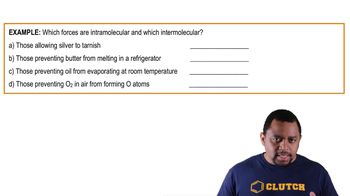
Intermolecular Forces (Simplified) Example 1
857
views
18
rank
Guided course
02:25
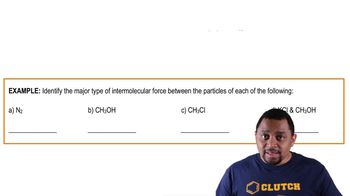
Intermolecular Forces (Simplified) Example 2
2601
views
13
rank
1
comments
Terms in this set (15)
Hide definitions
Intermolecular Forces
Electrostatic attractions between molecules that influence physical properties like boiling and melting points.
Intramolecular Forces
Strong attractions within a molecule that hold atoms together, determining chemical properties and bond types.
Ion-Dipole
Strongest attraction between an ion and a polar molecule, crucial in dissolving ionic compounds in water.
Hydrogen Bonding
Special attraction between hydrogen and fluorine, oxygen, or nitrogen, significantly affecting water's properties.
Dipole-Dipole
Attraction between polar molecules due to partial positive and negative charges aligning with each other.
London Dispersion Forces
Weak, temporary attractions from momentary dipoles in all molecules, especially significant in nonpolar substances.
Polarity
Uneven distribution of electron density in a molecule, leading to partial positive and negative regions.
Electronegativity
Tendency of an atom to attract electrons in a bond, creating partial charges and influencing molecular interactions.
Aqueous Solution
Mixture where a substance is dissolved in water, allowing ions to interact with water molecules.
Solvation
Process where solvent molecules surround and interact with solute particles, stabilizing them in solution.
Partial Charge
Slight positive or negative character on atoms within a molecule due to unequal electron sharing.
Van der Waals Forces
General term for weak attractions, including London dispersion, present in all molecular interactions.
Covalent Bond
Strong connection formed by sharing electrons between atoms within a molecule, influencing chemical structure.
Ionic Compound
Substance composed of positive and negative ions held together by strong electrostatic attractions.
Physical Properties
Characteristics like boiling point and melting point, determined by the strength of attractions between molecules.
 BackBack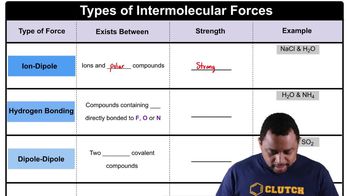
 06:36
06:36