Skip to main content
Introduction to Chemistry
My Course
Learn
Exam Prep
AI Tutor
Study Guides
Flashcards
Explore
Try the app
My Course
Learn
Exam Prep
AI Tutor
Study Guides
Flashcards
Explore
Try the app
Back
Molality quiz
You can tap to flip the card.
What does ionic molality or osmolality measure in a solution?
You can tap to flip the card.
👆
What does ionic molality or osmolality measure in a solution?
It measures the molality of dissolved ions within a solution.
Track progress
Control buttons has been changed to "navigation" mode.
1/15
Related flashcards
Related practice
Recommended videos
Molality definitions
Molality
13 Terms
Molality
13. Solutions
5 problems
Topic
The Colligative Properties
13. Solutions
5 problems
Topic
13. Solutions - Part 1 of 2
12 topics
35 problems
Chapter
13. Solutions - Part 2 of 2
2 topics
6 problems
Chapter
Guided course
00:56
Osmolality
3266
views
2
rank
Guided course
04:19
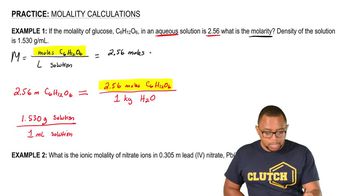
Molality Calculations Example 1
3131
views
Guided course
01:14
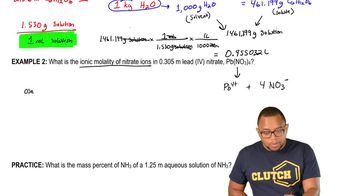
Molality Calculations Example 2
3517
views
1
rank
Terms in this set (15)
Hide definitions
What does ionic molality or osmolality measure in a solution?
It measures the molality of dissolved ions within a solution.
How many ions does sodium chloride dissociate into when dissolved in water?
Sodium chloride dissociates into 2 ions: sodium ion and chloride ion.
What is the formula for calculating osmolality?
Osmolality is calculated by multiplying the number of dissociated ions by the molality of the compound.
If you have 0.30 molal sodium chloride, what is the osmolality?
The osmolality is 0.60, since 2 ions are produced and 2 × 0.30 = 0.60.
Why is it important to consider the number of ions when discussing osmolality?
Because osmolality depends on the total number of dissolved ions, not just the compound's molality.
What is the difference between molality and osmolality?
Molality measures moles of solute per kilogram of solvent, while osmolality measures moles of dissolved ions per kilogram of solvent.
What would be the osmolality of a 0.50 molal solution of a compound that dissociates into 3 ions?
The osmolality would be 1.50, since 3 × 0.50 = 1.50.
What is the osmolality of a 1.0 molal solution of a compound that does not dissociate?
The osmolality is 1.0, since only one particle is produced per formula unit.
How do you determine the number of ions for osmolality calculations?
Count the total number of ions the compound dissociates into when dissolved.
What is the osmolality of a 0.20 molal solution of calcium chloride (CaCl2), which dissociates into 3 ions?
The osmolality is 0.60, since 3 × 0.20 = 0.60.
If a compound dissociates into 4 ions, how does this affect its osmolality compared to a compound that dissociates into 2 ions at the same molality?
The compound that dissociates into 4 ions will have twice the osmolality of the one that dissociates into 2 ions at the same molality.
What units are used for osmolality?
Osmolality is measured in osmoles per kilogram (osmol/kg) of solvent.
Why is sodium chloride a good example for explaining osmolality?
Because it dissociates completely into two ions, making calculations straightforward.
What happens to osmolality if the molality of the solution is doubled?
The osmolality also doubles, since it is directly proportional to molality.
What should you always consider when calculating osmolality for any ionic compound?
Always consider the number of ions the compound dissociates into in solution.
 BackBack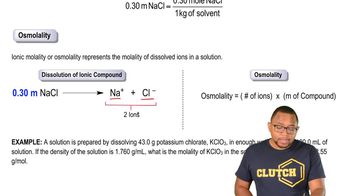
 00:56
00:56