Skip to main content
Introduction to Chemistry
My Course
Learn
Exam Prep
AI Tutor
Study Guides
Flashcards
Explore
Try the app
My Course
Learn
Exam Prep
AI Tutor
Study Guides
Flashcards
Explore
Try the app
Back
Naming Ionic Compounds definitions
You can tap to flip the card.
Ionic Compound
You can tap to flip the card.
👆
Ionic Compound
A substance formed from the electrostatic attraction between a positive ion and a negative ion.
Track progress
Control buttons has been changed to "navigation" mode.
1/15
Related flashcards
Related practice
Recommended videos
Naming Ionic Compounds quiz #1
Naming Ionic Compounds
14 Terms
Naming Ionic Compounds
5. Molecules and Compounds
5 problems
Topic
Writing Formula Units of Ionic Compounds
5. Molecules and Compounds
5 problems
Topic
5. Molecules and Compounds
11 topics
32 problems
Chapter
Guided course
01:52
Naming Ionic Compounds
11789
views
89
rank
Guided course
01:01
Naming Ionic Compounds Example 1
11351
views
91
rank
Guided course
02:11
Naming Ionic Compounds
15719
views
144
rank
Terms in this set (15)
Hide definitions
Ionic Compound
A substance formed from the electrostatic attraction between a positive ion and a negative ion.
Cation
A positively charged ion, often a metal or the ammonium ion, written first in a compound's name.
Anion
A negatively charged ion, typically a nonmetal or a polyatomic ion, written second in a compound's name.
Polyatomic Ion
A charged group of covalently bonded atoms acting as a single ion in compounds.
Ammonium
A polyatomic ion with the formula NH4+ and a positive charge, unique among nonmetal-based ions.
Roman Numeral
A notation used in compound names to indicate the specific positive charge of a metal with multiple possible charges.
Base Name
The unchanged portion at the start of a nonmetal's name, used before adding the 'ide' suffix in compound names.
Suffix
An ending added to the base name of a nonmetal, such as 'ide', to form the anion's name in a compound.
Transition Metal
A metal element that can have more than one possible positive charge, often requiring a Roman numeral in naming.
Main Group Element
An element from groups 1A to 8A, usually with a single predictable charge in ionic compounds.
Halogen
A group 7A nonmetal element, such as chlorine or bromine, often forming anions in ionic compounds.
Charge
The electrical property of an ion, positive for cations and negative for anions, crucial for compound formation.
Phosphate
A polyatomic ion with a negative charge, retaining its full name when part of an ionic compound.
Nitrate
A polyatomic ion with a negative charge, keeping its name unchanged in compound nomenclature.
Carbonate
A polyatomic ion with a negative charge, named as such in ionic compounds without modification.
 BackBack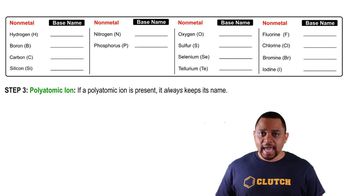
 01:52
01:52