Skip to main content
Introduction to Chemistry
My Course
Learn
Exam Prep
AI Tutor
Study Guides
Flashcards
Explore
Try the app
My Course
Learn
Exam Prep
AI Tutor
Study Guides
Flashcards
Explore
Try the app
Back
Scientific Notation definitions
1 student found this helpful
You can tap to flip the card.
Scientific Notation
You can tap to flip the card.
👆
Scientific Notation
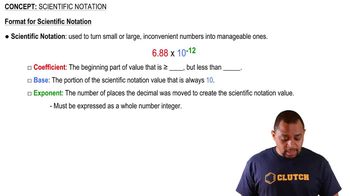
A method for expressing very large or small numbers using a coefficient, a base of 10, and an exponent.
Track progress
Control buttons has been changed to "navigation" mode.
1/13
Related flashcards
Related practice
Recommended videos
Scientific Notation quiz
Scientific Notation
15 Terms
Scientific Notation
2. Measurement and Problem Solving
5 problems
Topic
SI Units (Simplified)
2. Measurement and Problem Solving
5 problems
Topic
2. Measurement and Problem Solving
10 topics
27 problems
Chapter
Guided course
02:50
Scientific Notation
12838
views
218
rank
Guided course
01:41
Scientific Notation
20796
views
339
rank
Guided course
01:53
Scientific Notation Example 1
15750
views
313
rank
Terms in this set (13)
Hide definitions
Scientific Notation
A method for expressing very large or small numbers using a coefficient, a base of 10, and an exponent.
Coefficient
A value between 1 and 10 that represents the significant digits in a scientific notation expression.
Base
A constant value of 10 used as the foundation for expressing numbers in scientific notation.
Exponent
A whole number indicating how many places the decimal point is moved to convert between notations.
Standard Notation
The conventional way of writing numbers without exponents or powers of ten.
Decimal Point
A symbol used to separate the whole number part from the fractional part in a number.
Positive Exponent
A value that increases the coefficient by moving the decimal point to the right in scientific notation.
Negative Exponent
A value that decreases the coefficient by moving the decimal point to the left in scientific notation.
Whole Number
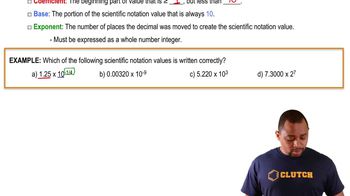
A non-fractional, non-decimal integer required for the exponent in scientific notation.
Power
Another term for exponent, indicating the number of times the base is multiplied by itself.
Significant Figures
Digits in a number that contribute to its precision, which help simplify scientific notation.
Conversion
The process of changing a number between scientific and standard notation by adjusting the decimal point and exponent.
Integer
A whole number, positive or negative, used as the exponent in scientific notation.
 BackBack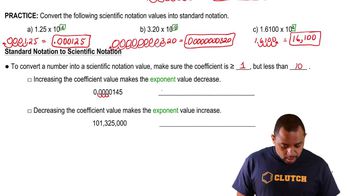
 02:50
02:50