Skip to main content
Introduction to Chemistry
My Course
Learn
Exam Prep
AI Tutor
Study Guides
Flashcards
Explore
Try the app
My Course
Learn
Exam Prep
AI Tutor
Study Guides
Flashcards
Explore
Try the app
Back
Solubility: Temperature Effect definitions
You can tap to flip the card.
Solubility
You can tap to flip the card.
👆
Solubility
Indicates the maximum quantity of a substance that can dissolve in a solvent under specific conditions.
Track progress
Control buttons has been changed to "navigation" mode.
1/14
Related flashcards
Related practice
Recommended videos
Solubility: Temperature Effect quiz
Solubility: Temperature Effect
15 Terms
Solubility: Temperature Effect
13. Solutions
5 problems
Topic
Intro to Henry's Law
13. Solutions
5 problems
Topic
13. Solutions - Part 1 of 2
12 topics
35 problems
Chapter
13. Solutions - Part 2 of 2
2 topics
6 problems
Chapter
Guided course
01:29
Solubility: Temperature Effect Example 1
3096
views
8
rank
1
comments
Guided course
04:38
Solubility: Temperature Effect Concept 1
3340
views
11
rank
Terms in this set (14)
Hide definitions
Solubility
Indicates the maximum quantity of a substance that can dissolve in a solvent under specific conditions.
Concentration
Represents the amount of dissolved substance present in a given volume of solution.
Molarity
Expresses the number of moles of dissolved substance per liter of solution.
Solute
Refers to the substance being dissolved within a liquid to form a solution.
Solvent
Describes the liquid in which another substance is dissolved to create a solution.
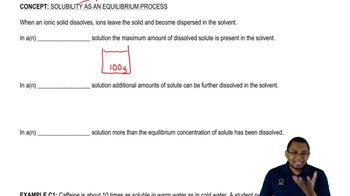
Saturated Solution
Contains the maximum possible amount of dissolved substance, with any excess remaining undissolved.
Unsaturated Solution
Has not reached its dissolving limit and can accommodate more dissolved substance.
Supersaturated Solution
Holds more dissolved substance than normally possible, typically achieved by heating and is unstable.
Equilibrium Concentration
The specific amount of dissolved substance where no more can dissolve under current conditions.
Precipitate
Solid material that forms and separates from solution when excess dissolved substance recrystallizes.
Recrystallization
Process where dissolved material reforms as solid crystals, often upon cooling a supersaturated solution.
Threshold
The upper limit of dissolved substance a solution can hold before excess remains undissolved.
Instability
Describes the tendency of a solution with excess dissolved substance to revert to a stable state by forming solids.
Heat
Energy input required to dissolve more substance than normally possible, enabling creation of unstable solutions.
 BackBack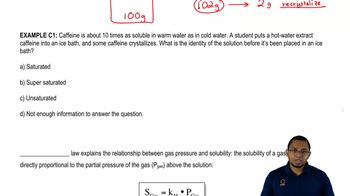
 01:29
01:29