Skip to main content
Introduction to Chemistry
My Course
Learn
Exam Prep
AI Tutor
Study Guides
Flashcards
Explore
Try the app
My Course
Learn
Exam Prep
AI Tutor
Study Guides
Flashcards
Explore
Try the app
Back
Solution Stoichiometry quiz
You can tap to flip the card.
What two new variables are commonly included in solution stoichiometry calculations?
You can tap to flip the card.
👆
What two new variables are commonly included in solution stoichiometry calculations?
Volume and molarity are commonly included in solution stoichiometry calculations.
Track progress
Control buttons has been changed to "navigation" mode.
1/15
Related flashcards
Related practice
Recommended videos
Solution Stoichiometry definitions
Solution Stoichiometry
15 Terms
Solution Stoichiometry
13. Solutions
5 problems
Topic
Molality
13. Solutions
5 problems
Topic
13. Solutions - Part 1 of 2
12 topics
35 problems
Chapter
13. Solutions - Part 2 of 2
2 topics
6 problems
Chapter
Guided course
03:10
Solution Stoichiometry
9218
views
44
rank
Guided course
03:11
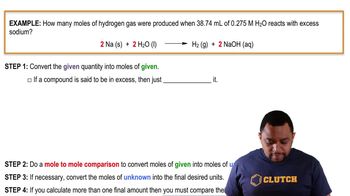
Solution Stoichiometry Example 1
7829
views
35
rank
Terms in this set (15)
Hide definitions
What two new variables are commonly included in solution stoichiometry calculations?
Volume and molarity are commonly included in solution stoichiometry calculations.
How do you convert a given volume in milliliters to liters?
Divide the volume in milliliters by 1000 to convert it to liters.
What is the formula to calculate moles from volume and molarity?
Moles = Liters × Molarity.
In the stoichiometric chart, what does the left side typically represent?
The left side of the stoichiometric chart typically represents the given information.
What does the word 'of' between two numbers indicate in solution stoichiometry?
The word 'of' indicates that you should multiply the two numbers.
What is the purpose of the 'jump' in the stoichiometric chart?
The 'jump' is used to convert from moles of the given substance to moles of the unknown substance using the balanced equation.
How do you determine the relationship between reactants and products in solution stoichiometry?
You use the coefficients from the balanced chemical equation to determine the mole-to-mole relationship.
What is the final step when calculating the mass of a product in solution stoichiometry?
The final step is to convert the moles of the product to grams.
In the example provided, what is the unknown that needs to be found?
The unknown is the grams of hydrogen gas (H2) produced.
Why is it important to understand basic stoichiometry before learning solution stoichiometry?
Understanding basic stoichiometry is important because solution stoichiometry builds on those foundational concepts.
What information is typically given in a solution stoichiometry problem?
You are typically given the volume and molarity of a solution.
What does a balanced chemical equation provide for stoichiometric calculations?
A balanced chemical equation provides the coefficients needed for mole-to-mole conversions.
What is produced when sodium solid reacts with water according to the example?
Hydrogen gas and sodium hydroxide are produced.
What should you do if you are unfamiliar with the stoichiometric chart?
You should review previous videos or materials on basic stoichiometry.
What is the main adaptation in the stoichiometric chart for solution stoichiometry?
The main adaptation is including volume and molarity as possible given information to calculate moles.
 BackBack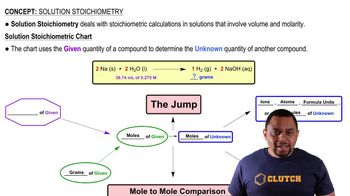
 03:10
03:10