Skip to main content
Introduction to Chemistry
My Course
Learn
Exam Prep
AI Tutor
Study Guides
Flashcards
Explore
Try the app
My Course
Learn
Exam Prep
AI Tutor
Study Guides
Flashcards
Explore
Try the app
Back
Solutions quiz
You can tap to flip the card.
What is a solution in chemistry?
You can tap to flip the card.
👆
What is a solution in chemistry?
A solution is a homogeneous mixture made up of two or more components that form a uniform composition.
Track progress
Control buttons has been changed to "navigation" mode.
1/15
Related flashcards
Related practice
Recommended videos
Solutions definitions
Solutions
14 Terms
Solutions
13. Solutions
5 problems
Topic
Solubility and Intermolecular Forces
13. Solutions
5 problems
Topic
13. Solutions - Part 1 of 2
12 topics
35 problems
Chapter
13. Solutions - Part 2 of 2
2 topics
6 problems
Chapter
Guided course
01:16
Solutions Example 2
10438
views
241
rank
Guided course
02:38
Solutions
12240
views
121
rank
Guided course
00:42
Solutions Example 1
12730
views
183
rank
Terms in this set (15)
Hide definitions
What is a solution in chemistry?
A solution is a homogeneous mixture made up of two or more components that form a uniform composition.
What is the solute in a solution?
The solute is the smaller portion of the solution that is dissolved within the solvent.
What is the solvent in a solution?
The solvent is the part of the solution present in the larger amount and is capable of dissolving other substances.
How is concentration defined in the context of solutions?
Concentration is a measurement of the amount of solute present in a given solution.
What does it mean for a mixture to have a uniform composition?
A uniform composition means everything is mixed perfectly together and you cannot distinguish different parts.
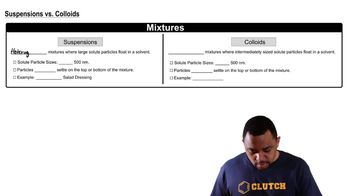
What is a suspension?
A suspension is a heterogeneous mixture with large solute particles that can float and may eventually settle.
What is a colloid?
A colloid is a homogeneous mixture with intermediate-sized particles that remain suspended and do not settle.
How do the particle sizes in suspensions compare to those in colloids?
Suspension particles are larger than 500 nanometers, while colloid particles are less than 500 nanometers.
Why do suspension particles eventually settle?
Suspension particles are larger, so they eventually settle due to gravity, depending on the density of the solvent.
Do colloid particles settle over time?
No, colloid particles do not settle; they remain suspended within the solvent.
Give an example of a suspension.
Italian salad dressing is an example of a suspension because you can see particles floating in the liquid.
Give an example of a colloid.
Milk is an example of a colloid, with fat and protein particles suspended throughout the liquid.
What happens when a solute dissolves in a solvent?
When a solute dissolves in a solvent, they form a homogeneous solution where the solute is evenly distributed.
How can you visually distinguish a suspension from a solution?
In a suspension, you can see the particles floating or settling, while in a solution, everything looks uniform.
What are the three main types of mixtures discussed in this lesson?
The three main types are solutions, suspensions, and colloids.
 BackBack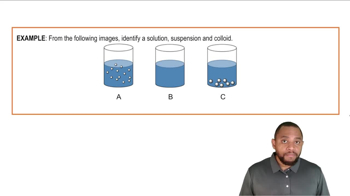
 01:16
01:16