Skip to main content
Introduction to Chemistry
My Course
Learn
Exam Prep
AI Tutor
Study Guides
Flashcards
Explore
Try the app
My Course
Learn
Exam Prep
AI Tutor
Study Guides
Flashcards
Explore
Try the app
Back
The Electron Configuration: Exceptions (Simplified) definitions
You can tap to flip the card.
Electron Configuration
You can tap to flip the card.
👆
Electron Configuration
Arrangement of electrons in atomic orbitals, often following specific patterns but with notable exceptions for certain elements.
Track progress
Control buttons has been changed to "navigation" mode.
1/14
Related flashcards
Related practice
Recommended videos
The Electron Configuration: Exceptions (Simplified) quiz #1
The Electron Configuration: Exceptions (Simplified)
10 Terms
The Electron Configuration: Exceptions (Simplified)
9. Electrons in Atoms and the Periodic Table
5 problems
Topic
Electron Arrangements
9. Electrons in Atoms and the Periodic Table
5 problems
Topic
9. Electrons in Atoms and the Periodic Table - Part 3 of 4
12 topics
36 problems
Chapter
Guided course
01:15
The Electron Configuration: Exceptions (Simplified) Concept 2
8008
views
40
rank
Guided course
01:24
The Electron Configuration: Exceptions (Simplified) Example 1
7653
views
45
rank
Guided course
00:56
The Electron Configuration: Exceptions (Simplified) Concept 1
4551
views
9
rank
Terms in this set (14)
Hide definitions
Electron Configuration
Arrangement of electrons in atomic orbitals, often following specific patterns but with notable exceptions for certain elements.
d Subshell
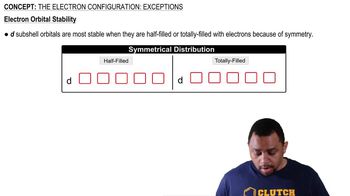
Set of five orbitals within an energy level, capable of holding up to ten electrons, crucial for transition metal chemistry.
Half-Filled Orbital
State where each orbital in a subshell contains one electron, maximizing symmetry and stability according to Hund's rule.
Fully Filled Orbital
Condition where all orbitals in a subshell are occupied by paired electrons, resulting in enhanced atomic stability.
Hund's Rule
Principle stating that electrons occupy degenerate orbitals singly before pairing, promoting maximum unpaired electrons.
Degenerate Orbitals
Orbitals within the same subshell that possess identical energy levels, allowing flexible electron arrangements.
s Orbital
Spherical region around the nucleus, holding up to two electrons, often involved in electron promotion for stability.
Electron Promotion
Process where an electron moves from a lower-energy orbital to a higher one, often to achieve greater subshell stability.
Transition Metals
Elements in the d-block of the periodic table, frequently exhibiting exceptions in their electron configurations.
Chromium
Element with atomic number 24, known for its unique electron arrangement due to a half-filled d subshell.
Copper
Element that achieves extra stability by fully filling its d subshell, resulting in an atypical electron configuration.
Stability
Tendency of an atom to reach a lower energy state, often by achieving half-filled or fully filled subshells.
Periodic Table
Tabular arrangement of elements, highlighting trends and exceptions in electron configurations, especially among d-block elements.
Neutral Element
Atom with equal numbers of protons and electrons, often referenced when discussing standard electron configurations.
 BackBack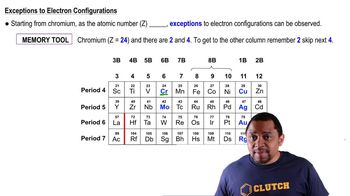
 01:15
01:15