Skip to main content
Anatomy & Physiology
Il mio corso
Impara
Preparazione agli esami
AI Tutor
Guide di studio
Soluzioni per libri di testo
Flashcard
Esplora
Prova l'app
Il mio corso
Impara
Preparazione agli esami
AI Tutor
Guide di studio
Soluzioni per libri di testo
Flashcard
Esplora
Prova l'app
Indietro
Anatomy & Physiology: Articulations and Joint Movements
Puoi toccare per girare la carta.
What are joints or articulations?
Puoi toccare per girare la carta.
👆
What are joints or articulations?
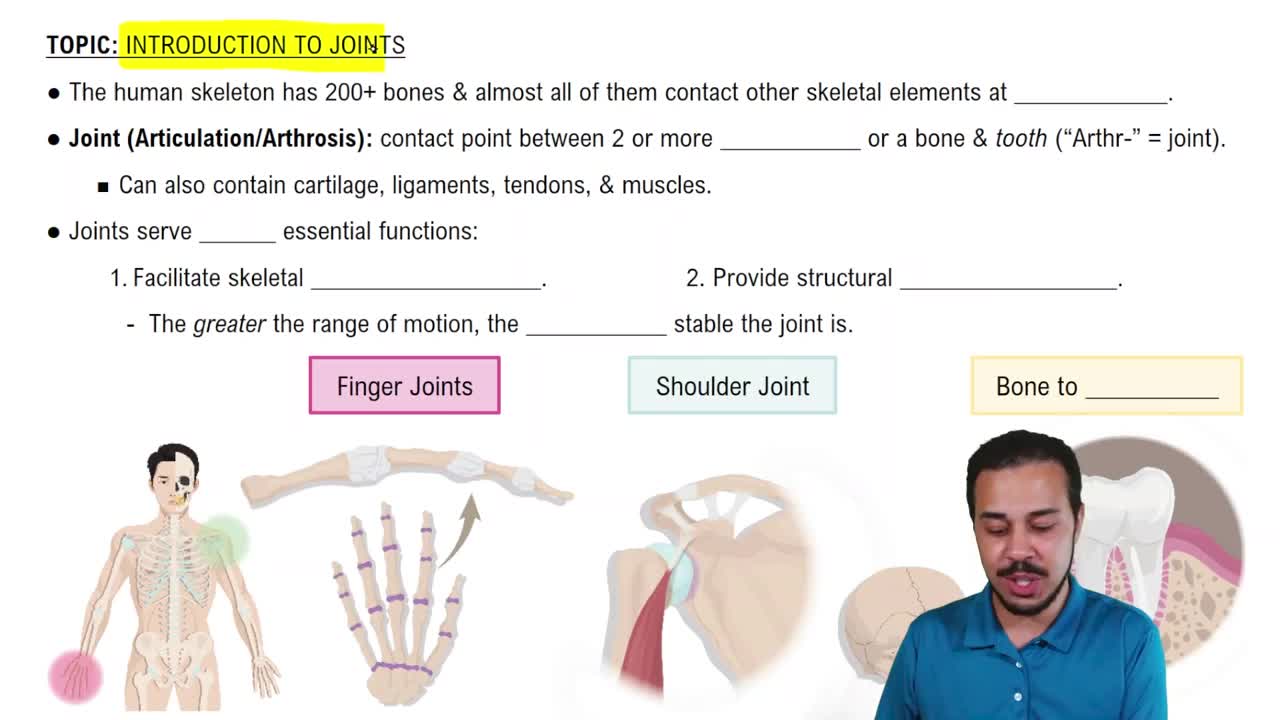
Connections between bones that may or may not permit movement, usually held together by cartilage, fluid, or dense connective tissues.
Avanzamenti del tracciato
I pulsanti di controllo sono stati cambiati in modalità "navigazione".
1/27
Video consigliati
VideoThumbView.guidedCourse
04:06
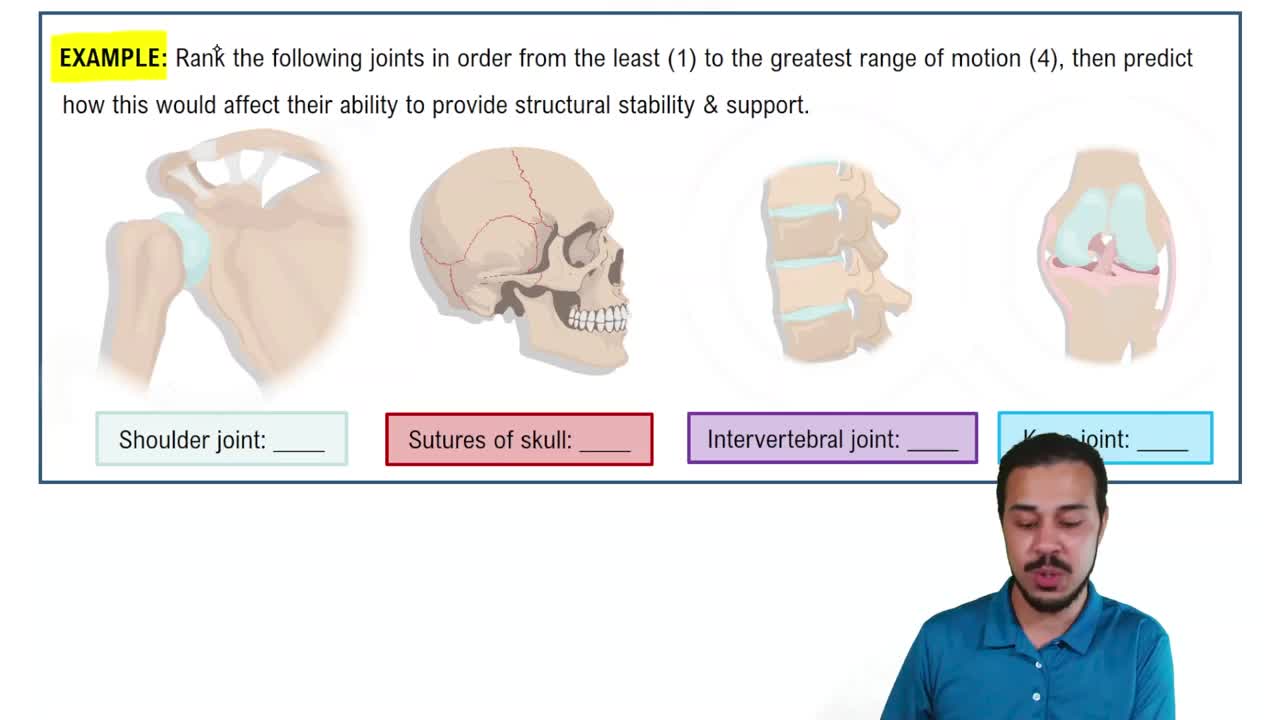
Introduction to Joints Example 1
12005
views
270
rank
VideoThumbView.guidedCourse
05:29
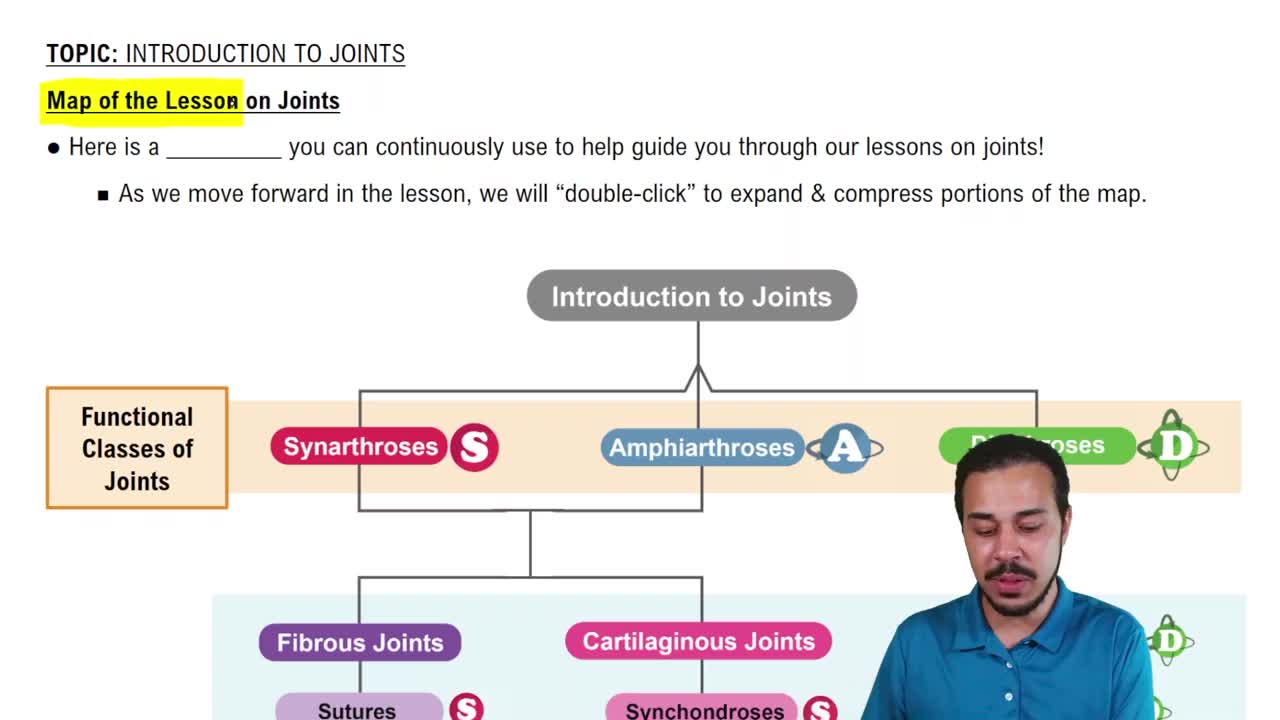
Map of the Lesson on Joints
12537
views
265
rank
1
comments
VideoThumbView.guidedCourse
05:39
Introduction to Joints
16816
views
433
rank
Termini in questo insieme (27)
Nascondere definizioni
What are joints or articulations?
Connections between bones that may or may not permit movement, usually held together by cartilage, fluid, or dense connective tissues.
How are joints functionally classified?
By the amount of movement they allow: immovable (synarthroses), slightly movable (amphiarthroses), and freely movable (diarthroses).
Where are immovable or slightly movable joints mostly found?
In the axial skeleton.
Where are freely movable joints more common?
In the appendicular skeleton.
What is a synarthrosis?
An immovable joint, such as sutures in the skull or gomphosis between a tooth and alveolar bone.
What is a gomphosis?
A joint between a tooth and the alveolar fossa of the maxillae or mandible, held by periodontal ligaments.
What is a synchondrosis?
A joint where hyaline cartilage separates the ends of bones.
What is a synostosis?
A joint where bones fuse together to form one bone.
What defines an amphiarthrosis?
A slightly movable joint, such as syndesmosis (bones connected by long ligaments) or symphysis (bones connected by fibrocartilage).
What are diarthroses?
Freely movable synovial joints typically found at the ends of long bones in limbs.
Name the six basic characteristics of synovial joints.
Joint capsule, articular cartilages, joint cavity with synovial fluid, synovial membrane, accessory structures, sensory nerves and blood vessels.
What are the three functions of synovial fluid?
Lubricates articular cartilage surfaces, nourishes chondrocytes, and acts as a shock absorber.
What are the main types of joint movements?
Linear movements, angular movements, rotation, and special movements.
Give examples of special movements at the ankle.
Eversion/inversion and dorsiflexion/plantar flexion.
What special movements occur in the vertebral column?
Lateral flexion, anterior flexion (bending forward), extension (bending backward), and rotation.
What is opposition in thumb movement?
Movement of the pollex (thumb) to touch the fingertips, allowing grasping.
Define protraction and retraction.
Protraction is anterior movement in the horizontal plane; retraction is posterior movement in the horizontal plane.
Define elevation and depression in joint movement.
Elevation is movement cranially (upward); depression is movement caudally (downward).
What are plane joints and their movement type?
Nonaxial joints allowing gliding movements.
What movements do hinge joints allow?
Flexion and extension.
What type of movement do pivot joints allow?
Rotational movements.
What movements do condylar joints allow?
Flexion/extension and abduction/adduction.
What are saddle joints and their movement capabilities?
Biaxial joints that allow flexion, extension, abduction, adduction, and circumduction.
What characterizes ball and socket joints?
Triaxial joints allowing movement in multiple planes including rotation.
What is rheumatism?
Pain and stiffness affecting the skeletal or muscular system.
What is arthritis?
A group of rheumatic diseases affecting synovial joints.
How are the skeletal and muscular systems related?
They are structurally and functionally interdependent, forming the musculoskeletal system.
 IndietroIndietro
 04:06