Soft spots on an infant's skull where cranial bones have not yet fused.
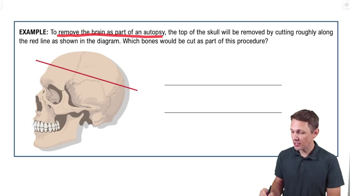
Coronal suture
The cranial suture that separates the frontal bone from the parietal bones.
Sagittal suture
The cranial suture that separates the two parietal bones along the midline of the skull.
Squamous suture
The cranial suture between the temporal bone and the parietal bone.
Lambdoid suture
The cranial suture that separates the occipital bone from the parietal bones.
Anterior cranial fossa
The front depression in the floor of the cranial base that supports the frontal lobes of the brain.
Middle cranial fossa
The central depression in the cranial base that houses the temporal lobes of the brain.
Posterior cranial fossa
The rear depression in the cranial base that supports the cerebellum and brainstem.
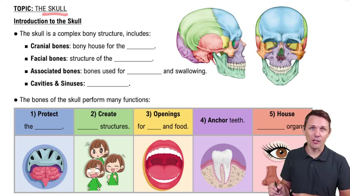
Frontal bone
A single cranial bone forming the forehead and containing frontal sinuses.
Parietal bones
Two cranial bones forming the superior and lateral aspects of the skull.
Temporal bones
Paired bones on the sides of the skull containing the mandibular fossa, external and internal acoustic meatus, zygomatic process, mastoid and styloid processes.
Occipital bone
Single bone forming the back and base of the skull, featuring occipital condyles, external occipital protuberance, and foramen magnum.
Sphenoid bone
A single butterfly-shaped bone in the middle of the skull with the sella turcica and sphenoid sinus.
Ethmoid bone
A single bone located between the eyes with the cribriform plate, olfactory foramina, perpendicular plate, crista galli, and ethmoid sinus.
Nasal bones
Paired bones forming the bridge of the nose.
Lacrimal bones
Small paired bones forming part of the medial orbit with a lacrimal fossa for tear ducts.
Maxillary bones
Paired bones forming the upper jaw, containing the palatine process and maxillary sinuses.
Zygomatic bones
Paired cheekbones with a temporal process that forms part of the zygomatic arch.
Mandible
The single lower jaw bone with the ramus, angle, condyle, and coronoid process.
Zygomatic arch
Composite structure formed by the temporal process of the zygomatic bone and the zygomatic process of the temporal bone.
Nasal septum
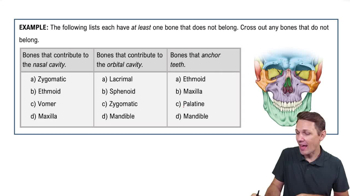
Structure dividing the nasal cavity, formed by the perpendicular plate of the ethmoid bone and the vomer.
Orbit of eye
Bony cavity formed by several skull bones that houses the eyeball.
Oral hard palate
The bony roof of the mouth formed by the maxillae and palatine bones.
Foramen magnum
Large opening in the occipital bone allowing passage of the spinal cord.
Superior orbital fissure
Opening in the sphenoid bone transmitting nerves and vessels to the orbit.
Optic canal
Opening in the sphenoid bone for the optic nerve to pass to the eye.
Foramen ovale
Opening in the sphenoid bone transmitting the mandibular nerve.
Carotid canal
Passage in the temporal bone for the internal carotid artery.
Jugular foramen
Large opening between the temporal and occipital bones for the jugular vein and cranial nerves.
 Indietro
 2:12