Skip to main content
Anatomy & Physiology
Il mio corso
Impara
Preparazione agli esami
AI Tutor
Guide di studio
Soluzioni per libri di testo
Flashcard
Esplora
Prova l'app
Il mio corso
Impara
Preparazione agli esami
AI Tutor
Guide di studio
Soluzioni per libri di testo
Flashcard
Esplora
Prova l'app
Indietro
Anatomy & Physiology: Basic Chemistry and Matter
Puoi toccare per girare la carta.
What are the three main subatomic particles of an atom?
Puoi toccare per girare la carta.
👆
What are the three main subatomic particles of an atom?
Protons
(positive charge),
Neutrons
(neutral), and
Electrons
(negative charge).
Avanzamenti del tracciato
I pulsanti di controllo sono stati cambiati in modalità "navigazione".
1/22
Video consigliati
VideoThumbView.guidedCourse
02:13
Atoms- Smallest Unit of Matter Example 1
30331
views
790
rank
VideoThumbView.guidedCourse
03:51
Atoms- Smallest Unit of Matter Example 3
19730
views
424
rank
VideoThumbView.guidedCourse
09:44
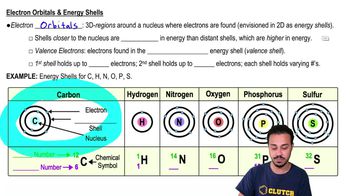
Electron Orbitals & Energy Shells
27452
views
588
rank
5
comments
Termini in questo insieme (22)
Nascondere definizioni
What are the three main subatomic particles of an atom?
Protons
(positive charge),
Neutrons
(neutral), and
Electrons
(negative charge).
What determines the mass of an atom?
The number of
protons
and
neutrons
in the nucleus.
Define an element in chemistry.
A pure substance made of atoms of only one kind that cannot be broken down into simpler substances.
What is an ionic bond?
A chemical bond formed by the electrical attraction between
cations
(positive ions) and
anions
(negative ions) due to electron transfer.
What is the difference between cations and anions?
Cations
have a positive charge (lose electrons),
Anions
have a negative charge (gain electrons).
How do ionic compounds behave in water?
They dissolve and their component ions separate into
anions
and
cations
.
What defines a molecule?
A chemical structure consisting of atoms held together by
shared electrons
(covalent bonds).
What is a covalent bond?
A bond where atoms share electrons to complete their valence shells.
Describe the three states of matter.
Solid:
definite shape and volume.
Liquid:
definite volume, shape of container.
Gas:
no definite shape or volume, compressible.
What is kinetic energy?
Energy of motion that can be transferred to do work.
What is potential energy?
Stored energy with the potential to do work, often due to position or chemical structure.
What is a decomposition (catabolic) reaction?
A chemical reaction where a complex molecule breaks down into simpler substances, releasing energy.
What is anabolism?
The process of building larger molecules from smaller ones, requiring energy input.
What is activation energy?
The minimum energy required to start a chemical reaction by allowing reactants to reach the transition state.
What role do enzymes play in chemical reactions?
They act as catalysts that lower activation energy, speeding up reactions without being consumed.
What does the pH scale measure?
The acidity or basicity of a solution, ranging from 0 (acidic) to 14 (basic), with 7 being neutral.
What is ATP and its function?
Adenosine Triphosphate
is the main energy currency of the cell, providing energy for processes like muscle contraction and chemical synthesis.
Name key cell organelles and their functions.
Nucleus (control center), Mitochondria (energy production), Ribosomes (protein synthesis), ER (protein/lipid synthesis), Golgi Apparatus (modifies/packages proteins), Lysosomes (waste breakdown).
What is the difference between freely permeable and selectively permeable membranes?
Freely permeable membranes allow almost any substance to pass; selectively permeable membranes regulate passage using proteins.
What is diffusion?
The passive movement of molecules from an area of higher concentration to lower concentration until equilibrium is reached.
What is osmosis?
The passive diffusion of water across a semipermeable membrane from low to high solute concentration.
Describe isotonic, hypotonic, and hypertonic solutions effects on cells.
Isotonic:
no net water movement.
Hypotonic:
water enters cell, may burst.
Hypertonic:
water leaves cell, cell shrinks.
 IndietroIndietro
 02:13
02:13