Skip to main content
Anatomy & Physiology
Il mio corso
Impara
Preparazione agli esami
AI Tutor
Guide di studio
Soluzioni per libri di testo
Flashcard
Esplora
Prova l'app
Il mio corso
Impara
Preparazione agli esami
AI Tutor
Guide di studio
Soluzioni per libri di testo
Flashcard
Esplora
Prova l'app
Indietro
Anatomy & Physiology: Blood and Blood Types - Lab exam 1
Puoi toccare per girare la carta.
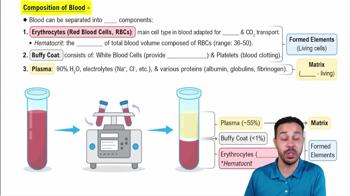
What are the main components of blood?
Puoi toccare per girare la carta.
👆
What are the main components of blood?
Formed elements
(erythrocytes, leukocytes, platelets) and
plasma
.
Avanzamenti del tracciato
I pulsanti di controllo sono stati cambiati in modalità "navigazione".
1/25
Video consigliati
VideoThumbView.guidedCourse
2:36
Introduction to Blood Example 1
11388
views
334
rank
VideoThumbView.guidedCourse
7:49
Composition of Blood
11930
views
337
rank
VideoThumbView.guidedCourse
1:55
Introduction to Blood Example 2
9399
views
225
rank
Termini in questo insieme (25)
Nascondere definizioni
What are the main components of blood?
Formed elements
(erythrocytes, leukocytes, platelets) and
plasma
.
What is the primary function of erythrocytes?
To transport respiratory gases, mainly oxygen and carbon dioxide.
What role do leukocytes play in the body?
They defend the body against pathogens as part of the immune system.
What is the function of platelets?
To help clot blood and prevent blood loss from damaged vessels.
What is plasma composed of?
92% water, 7% plasma proteins (albumins, globulins, fibrinogen), and 1% other solutes.
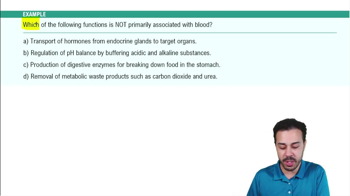
List the general functions of blood.
Transportation
(oxygen, CO2, nutrients, hormones, waste),
regulation
(body temp, pH, fluid balance), and
protection
(clotting, immune defense).
What is the normal pH range of blood?
Between 7.35 and 7.45.
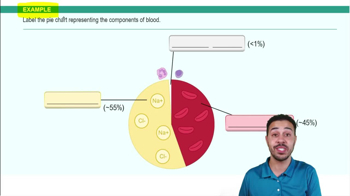
What percentage of whole blood is plasma?
Approximately 55%.
What is the 'buffy coat' in centrifuged blood?
A thin layer containing leukocytes and platelets, less than 1% of whole blood.
What is the normal range of erythrocytes per cubic millimeter?
4.2 to 6.2 million.
Name the five types of leukocytes.
Neutrophils, eosinophils, basophils, monocytes, and lymphocytes.
Which leukocytes are classified as granulocytes?
Neutrophils, eosinophils, and basophils.
Which leukocytes are classified as agranulocytes?
Monocytes and lymphocytes.
Describe the nucleus of a neutrophil.
Has 3 to 7 lobes.
What distinguishes eosinophils under a microscope?
Cytoplasmic granules stain red; nucleus is bilobed.
What is unique about basophil nuclei?
The nucleus is S-shaped and cytoplasmic granules stain dark purple.
Describe the nucleus of lymphocytes.
Spherical nucleus with thin rim of cytoplasm.
What is the shape of a monocyte nucleus?
U-shaped.
What antigens and antibodies are present in blood type A?
A antigen on red cells; anti-B antibodies in plasma.
Which blood type is the universal donor?
Type O, because it has no A or B antigens.
Which blood type is the universal recipient?
Type AB, because it has both A and B antigens and no antibodies.
What determines Rh positive or negative blood type?
Presence (Rh positive) or absence (Rh negative) of surface antigen D on erythrocytes.
Can Rh negative individuals receive Rh positive blood safely?
No, unless previously exposed to Rh positive blood, they may develop anti-D antibodies.
Which blood types can a person with A+ donate to?
A+ and AB+.
Which blood types can a person with O- receive from?
Only O- blood.
 IndietroIndietro
 2:36