 Indietro
Anatomy & Physiology: Body Cavities, Directional Terms, and Planes
 3:20

Termini in questo insieme (20)
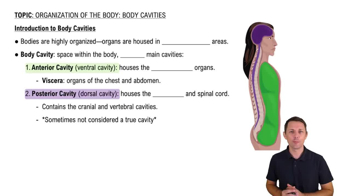
The ventral cavity and dorsal cavity are the main body cavities. The ventral cavity includes the thoracic and abdominopelvic cavities, while the dorsal cavity includes the cranial and spinal cavities.
The dorsal cavity is located along the back of the body and contains the cranial cavity (housing the brain) and the spinal cavity (housing the spinal cord).
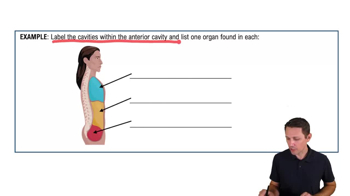
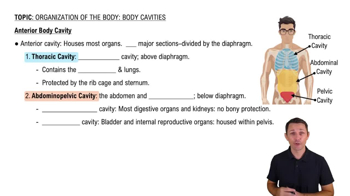
The ventral cavity contains the thoracic cavity (heart and lungs) and the abdominopelvic cavity (digestive organs, reproductive organs, and urinary organs).
Directional terms describe the location of one body part relative to another, such as anterior, posterior, superior, inferior, medial, and lateral.
Anterior means toward the front of the body or body part.
Posterior means toward the back of the body or body part.
Superior means above or higher in position relative to another part.
Inferior means below or lower in position relative to another part.
Medial means toward the midline of the body; lateral means away from the midline.
The anatomical position is the standard reference posture: standing upright, facing forward, arms at sides, palms facing forward.
The sagittal plane divides the body into left and right, the frontal (coronal) plane divides into front and back, and the transverse plane divides into top and bottom.
The sagittal plane divides the body into left and right parts; a midsagittal plane divides it equally.
The frontal (coronal) plane divides the body into anterior (front) and posterior (back) sections.
The transverse plane divides the body into superior (upper) and inferior (lower) parts.
The axial region includes the head, neck, and trunk; the appendicular region includes the limbs.
Proximal means closer to the point of attachment or origin, usually used for limbs.
Distal means farther from the point of attachment or origin, usually used for limbs.
Body cavities protect internal organs, allow organ movement, and provide space for growth.
The serous membranes line the ventral cavities, including the pleura (lungs), pericardium (heart), and peritoneum (abdominopelvic organs).
Directional terms provide a clear, standardized way to describe locations and relationships of body parts in medical communication.