 Indietro
Anatomy & Physiology: Bones Part 1 - Skeleton Divisions and Bone Markings
 4:50

Termini in questo insieme (22)
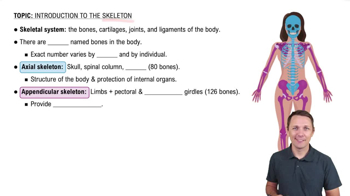
The part of the skeleton that includes the skull, vertebral column, and rib cage.
The part of the skeleton that includes the limbs and girdles (shoulder and pelvic girdles).
A projection or outgrowth of bone that serves as an attachment point for muscles, tendons, or ligaments.
A branch or extension of a bone, often forming an angle with the main body.
A tubular passage or tunnel through a bone.
A narrow, slit-like opening in a bone.
A soft spot on an infant's skull where the bones have not yet fused.
A round or oval opening through a bone that allows passage of blood vessels or nerves.
A shallow depression or hollow in a bone.
A long, narrow depression on a bone surface, often for a tendon or blood vessel.
A cavity or hollow space within a bone, often filled with air.
A rounded articular projection that forms a joint with another bone.
A prominent ridge or elongated projection on a bone.
A small, flat, smooth surface on a bone, usually where it articulates with another bone.
A projection located above a condyle, often serving as a muscle attachment site.
The rounded, usually proximal end of a bone that fits into a joint.
A narrow ridge of bone, less prominent than a crest.
A smooth, grooved articular process shaped like a pulley.
A sharp, slender projection from a bone, often vertebrae.
A very large, blunt projection found only on the femur for muscle attachment.
A small, rounded projection on a bone for muscle or ligament attachment.
A large, rounded, roughened projection on a bone for muscle attachment.