Skip to main content
Anatomy & Physiology
Il mio corso
Impara
Preparazione agli esami
AI Tutor
Guide di studio
Soluzioni per libri di testo
Flashcard
Esplora
Prova l'app
Il mio corso
Impara
Preparazione agli esami
AI Tutor
Guide di studio
Soluzioni per libri di testo
Flashcard
Esplora
Prova l'app
Indietro
Anatomy & Physiology: Cardiac Physiology and ECG
Puoi toccare per girare la carta.
What is the role of the cardioacceleratory center in heart function?
Puoi toccare per girare la carta.
👆
What is the role of the cardioacceleratory center in heart function?
The
cardioacceleratory center
increases both heart rate and force by stimulating the SA and AV nodes and heart muscle.
Avanzamenti del tracciato
I pulsanti di controllo sono stati cambiati in modalità "navigazione".
1/21
Video consigliati
6:13
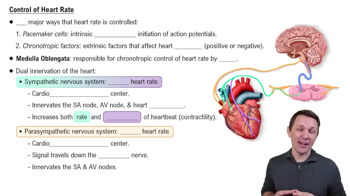
Control of Heart Rate
8072
views
167
rank
1
comments
8:41
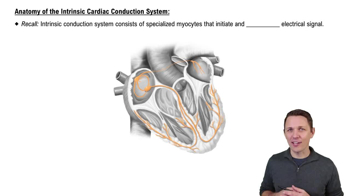
Anatomy of the Intrinsic Cardiac Conduction System
13766
views
338
rank
3
comments
3:42
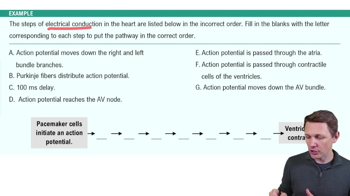
Electrical Conduction System of the Heart Example 2
7574
views
186
rank
Termini in questo insieme (21)
Nascondere definizioni
What is the role of the cardioacceleratory center in heart function?
The
cardioacceleratory center
increases both heart rate and force by stimulating the SA and AV nodes and heart muscle.
How does the cardioinhibitory center affect the heart?
The
cardioinhibitory center
decreases heart rate by inhibiting the SA and AV nodes via the vagus nerves.
What is the significance of the long action potential in contractile cardiac muscle cells?
The long action potential and contraction ensure
sustained contraction
for efficient ejection of blood from the heart.
What does the P wave represent on an ECG?
The
P wave
represents depolarization of the SA node and atria.
What electrical events are represented by the QRS complex on an ECG?
The
QRS complex
represents atrial repolarization and ventricular depolarization.
What does the T wave on an ECG indicate?
The
T wave
indicates ventricular repolarization.
Define the P-R interval on an ECG.
The
P-R interval
is the time from the beginning of atrial excitation to the beginning of ventricular excitation.
What is the cardiac cycle?
The
cardiac cycle
is the blood flow through the heart during one complete heartbeat, involving pressure and volume changes.
What is systole and diastole?
Systole
is the period of heart contraction, and
diastole
is the period of heart relaxation.
What causes the 'lub' and 'dup' heart sounds?
'Lub' is caused by closing of AV valves at ventricular systole start; 'dup' is caused by closing of semilunar valves at ventricular diastole start.
How is cardiac output (CO) calculated?
Cardiac output
= Heart rate × Stroke volume (CO = HR × SV).
What is stroke volume (SV)?
Stroke volume is the amount of blood pumped out of each ventricle during a heartbeat, calculated as SV = EDV - ESV.
Define end-diastolic volume (EDV) and end-systolic volume (ESV).
EDV is the blood volume in ventricles at end of diastole; ESV is blood remaining in ventricles after systole.
Which hormones regulate heart rate chemically?
Acetylcholine (via vagus nerve) slows heart rate; epinephrine and thyroxine increase heart rate.
Why is ion balance important for heart function?
Intracellular and extracellular ion concentrations must be maintained for normal heart function; imbalances can be dangerous.
What causes the plateau phase in the cardiac muscle action potential?
The plateau phase is due to Ca
2+
influx through slow Ca
2+
channels, keeping the cell depolarized while K
+
channels are closed.
What happens during repolarization of cardiac muscle cells?
Repolarization occurs when Ca
2+
channels close and K
+
channels open, allowing K
+
to exit and restore membrane potential.
What is the absolute refractory period in cardiac muscle?
The absolute refractory period is the time during which cardiac muscle cannot be re-excited, ensuring proper contraction and relaxation cycles.
What is a normal sinus rhythm on an ECG?
A normal sinus rhythm shows regular P waves followed by QRS complexes, indicating normal SA node function.
What characterizes junctional rhythm on an ECG?
Junctional rhythm occurs when the SA node is nonfunctional; P waves are absent and the AV node paces the heart at 40–60 beats per minute.
What is ventricular fibrillation?
Ventricular fibrillation is chaotic, disorganized electrical activity causing ineffective ventricular contractions and is life-threatening.
 IndietroIndietro
 6:13