Indietro

Anatomy & Physiology: Cardiovascular System Study Guide

I pulsanti di controllo sono stati cambiati in modalità "navigazione".
1/30
  • Location of the heart within the body

    The heart is located in the mediastinum, between the lungs, behind the sternum, and above the diaphragm.
  • Name the four chambers of the heart

    The heart has two atria (right and left) and two ventricles (right and left).
  • Function of heart valves

    Heart valves prevent backflow of blood and ensure unidirectional flow through the heart chambers.
  • Role of chordae tendineae and papillary muscles

    Chordae tendineae anchor the valves to papillary muscles, preventing valve prolapse during ventricular contraction.
  • Fetal heart structures and their adult remnants

    Fetal structures include the foramen ovale (becomes fossa ovalis) and ductus arteriosus (becomes ligamentum arteriosum).
  • Major vessels associated with the heart

    Great vessels include the aorta, superior and inferior vena cava, pulmonary arteries, and pulmonary veins.
  • Coronary arteries supply which parts of the heart?

    Coronary arteries supply oxygenated blood to the myocardium, including the left and right ventricles and atria.
  • Function of the coronary sinus

    The coronary sinus collects deoxygenated blood from the myocardium and drains it into the right atrium.
  • Layers of the heart wall

    The heart wall consists of the epicardium (outer), myocardium (muscle layer), and endocardium (inner lining).
  • Difference between heart muscle and skeletal muscle

    Heart muscle is involuntary, striated, and connected by intercalated discs allowing synchronized contraction; skeletal muscle is voluntary.
  • Pathway of electrical conduction in the heart

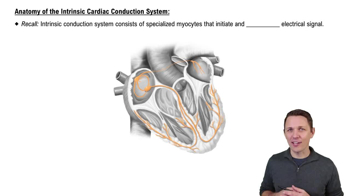
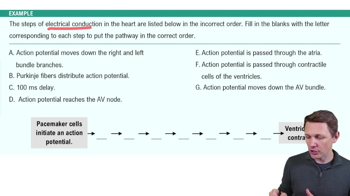
    SA node → AV node → AV bundle (Bundle of His) → bundle branches → Purkinje fibers.
  • Role of pacemaker cells in the heart

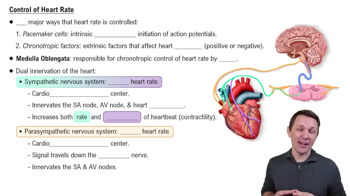
    Pacemaker cells generate spontaneous action potentials to initiate and regulate heartbeats.
  • What does the P wave represent on an ECG?

    The P wave represents atrial depolarization, leading to atrial contraction.
  • Events during the cardiac cycle

    Includes atrial systole, ventricular systole, and diastole with valves opening and closing accordingly.
  • Cause of the first and second heart sounds

    First sound (lub) is from AV valve closure; second sound (dub) is from semilunar valve closure.
  • Formula for cardiac output

    Cardiac Output = Stroke Volume × Heart Rate \(CO = SV \times HR\)
  • Factors affecting stroke volume

    Preload, contractility, and afterload influence stroke volume.
  • Difference between normal, tachycardia, and bradycardia

    Normal heart rate: 60-100 bpm; tachycardia: >100 bpm; bradycardia: <60 bpm.
  • Mechanisms of blood flow in vessels

    Blood flows due to pressure gradients; veins use valves and muscle contractions to return blood to the heart.
  • Layers of blood vessel walls

    Tunica intima (inner), tunica media (middle), and tunica externa (outer).
  • Differences between arteries and veins

    Arteries have thicker walls and higher pressure; veins have valves and larger lumens.
  • Types of capillaries

    Continuous, fenestrated, and sinusoidal capillaries differ in permeability.
  • Hydrostatic vs osmotic pressure in capillaries

    Hydrostatic pressure pushes fluid out; osmotic pressure pulls fluid in.
  • What is a portal system?

    A portal system is a blood flow pathway where blood passes through two capillary beds before returning to the heart.
  • Definition of anastomoses

    Anastomoses are connections between blood vessels that provide alternate pathways for blood flow.
  • Difference between systolic and diastolic pressure

    Systolic pressure is during ventricular contraction; diastolic is during ventricular relaxation.
  • What are Korotkoff sounds?

    Sounds heard when measuring blood pressure, caused by turbulent blood flow in compressed arteries.
  • Factors influencing blood pressure

    Peripheral resistance, cardiac output, and blood volume affect blood pressure.
  • Hormonal control of blood pressure

    Includes renin-angiotensin-aldosterone system and hormones like ADH and epinephrine.
  • Definition of hemopoiesis

    Hemopoiesis is the production of blood cells, primarily occurring in bone marrow.