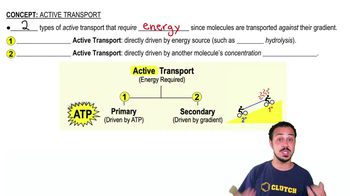
What are the two types of active membrane transport processes?
Active transport and vesicular transport, both requiring ATP to move solutes across the plasma membrane.
What is the main function of the sodium-potassium pump?
It pumps 3 Na+ ions out and 2 K+ ions into the cell against their concentration gradients, maintaining electrochemical gradients essential for nerve and muscle function.
Why does the sodium-potassium pump move 3 Na+ out for every 2 K+ in?
Because it moves more positive charges out than in, it creates a small voltage making the cell interior more negative, a process called electrogenic.
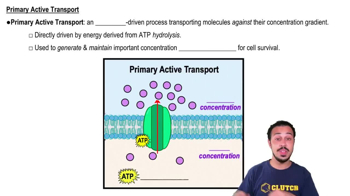
What distinguishes primary active transport from secondary active transport?
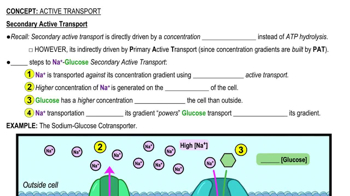
Primary active transport uses ATP directly to pump solutes, while secondary active transport uses energy stored in ionic gradients created by primary transport.
What are the two types of secondary active transport systems?
Symport (two substances move in the same direction) and antiport (substances move in opposite directions).
What is vesicular transport and what are its main types?
Transport of large particles or fluids via vesicles; includes endocytosis, exocytosis, transcytosis, and vesicular trafficking.
Name the three types of endocytosis.
Pinocytosis (fluid-phase), phagocytosis (engulfing large particles), and receptor-mediated endocytosis (specific uptake via coated pits).
What is the glycocalyx and its role in cell interaction?
A glycoprotein and glycolipid covering that acts as molecular Velcro for cell adhesion, migration, signaling, and mechanical sensing.
What are cell adhesion molecules (CAMs)?
Glycoproteins like cadherins and integrins that anchor cells to each other and the extracellular matrix, and transmit signals.
What is the role of plasma membrane receptors?
They bind ligands such as hormones and neurotransmitters, triggering intracellular signal transduction pathways.
What are the main components of the cytoplasm?
Cytosol (gel-like fluid), cytoplasmic organelles (e.g., mitochondria, ER), and inclusions (insoluble molecules like glycogen).
What is the function of mitochondria?
Known as the cell's power plant, they produce most ATP via aerobic respiration and contain their own DNA and RNA.
What is the difference between free and membrane-bound ribosomes?
Free ribosomes synthesize soluble proteins for the cytosol; membrane-bound ribosomes make proteins for membranes or export.
What are the two types of endoplasmic reticulum and their functions?
Rough ER synthesizes proteins for secretion or membranes; Smooth ER synthesizes lipids, detoxifies chemicals, and stores calcium.
What is the role of the Golgi apparatus?
It modifies, concentrates, and packages proteins and lipids from the ER for secretion or delivery to other organelles.
What are lysosomes and their function?
Membranous sacs with digestive enzymes that break down bacteria, toxins, damaged organelles, and cellular debris.
What are peroxisomes and their main enzymes?
Organelles containing oxidases and catalases that detoxify harmful substances and neutralize free radicals.
What are the three main cytoskeletal elements?
Microfilaments (actin, cell motility), intermediate filaments (structural support), and microtubules (shape and organelle movement).
What is the centrosome and its function?
The cell center near the nucleus that organizes microtubules and forms the mitotic spindle during cell division.
 Indietro
 06:57