Skip to main content
Anatomy & Physiology
Il mio corso
Impara
Preparazione agli esami
AI Tutor
Guide di studio
Soluzioni per libri di testo
Flashcard
Esplora
Prova l'app
Il mio corso
Impara
Preparazione agli esami
AI Tutor
Guide di studio
Soluzioni per libri di testo
Flashcard
Esplora
Prova l'app
Indietro
Anatomy & Physiology: Cell Structure and Membrane Transport
Puoi toccare per girare la carta.
What is the primary composition of the plasma membrane?
Puoi toccare per girare la carta.
👆
What is the primary composition of the plasma membrane?
The plasma membrane is primarily composed of
phospholipids
, along with cholesterol and proteins.
Avanzamenti del tracciato
I pulsanti di controllo sono stati cambiati in modalità "navigazione".
1/20
Video consigliati
VideoThumbView.guidedCourse
03:45
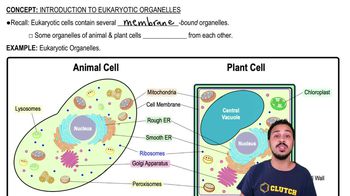
Introduction to Eukaryotic Organelles
30565
views
554
rank
VideoThumbView.guidedCourse
05:32
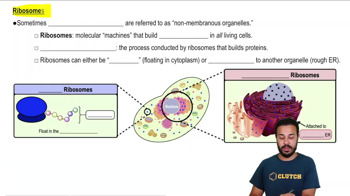
Ribosomes
25614
views
414
rank
VideoThumbView.guidedCourse
02:04
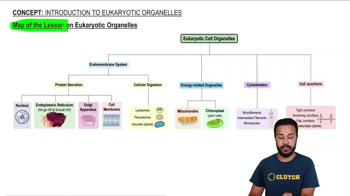
Map of the Lesson on Eukaryotic Organelles
22373
views
293
rank
Termini in questo insieme (20)
Nascondere definizioni
What is the primary composition of the plasma membrane?
The plasma membrane is primarily composed of
phospholipids
, along with cholesterol and proteins.
What is the fluid mosaic model of the plasma membrane?
The fluid mosaic model describes the plasma membrane as a
fluid phospholipid bilayer
with embedded proteins that move laterally.
Name three main functions of membrane proteins.
Channels
for substances,
carriers
for transport, and
receptors
for signal recognition.
What is diffusion?
Diffusion is the movement of solutes from an area of
high concentration to low concentration
without energy.
What is osmosis?
Osmosis is the diffusion of
water
across a selectively permeable membrane from low to high solute concentration.
Define tonicity and its effect on cells.
Tonicity describes the effect of a solution on cell volume:
isotonic
(no change),
hypertonic
(cell shrinks),
hypotonic
(cell swells).
What is the difference between simple diffusion and facilitated diffusion?
Simple diffusion passes molecules directly through the membrane; facilitated diffusion uses
protein channels or carriers
.
What is active transport?
Active transport moves solutes against their concentration gradient using
ATP energy
.
Describe the Na+/K+ pump function.
The Na+/K+ pump uses ATP to move
3 Na+ out
and
2 K+ into
the cell, creating an electrochemical gradient.
What are organelles?
Organelles are specialized structures within the cell that perform distinct functions, such as mitochondria and ribosomes.
What is the function of mitochondria?
Mitochondria produce
ATP
through cellular respiration and have their own DNA.
What role do ribosomes play in the cell?
Ribosomes synthesize
proteins
by translating mRNA.
What is the cytoskeleton?
The cytoskeleton is a network of protein filaments that provide
structural support
and aid in cell movement.
What is the difference between chromatin and chromosomes?
Chromatin is the
loosely packed DNA
in the nucleus during interphase; chromosomes are
condensed DNA
during cell division.
What is receptor-mediated endocytosis?
A process where cells internalize molecules by binding them to receptors, forming vesicles for transport inside the cell.
What is exocytosis?
Exocytosis is the process of vesicles fusing with the plasma membrane to
release substances
outside the cell.
What is the role of enzymes in the plasma membrane?
Membrane enzymes catalyze
chemical reactions
at the membrane surface.
How do carrier proteins function?
Carrier proteins bind specific substances and change shape to
transport them across
the membrane.
What is secondary active transport?
Secondary active transport uses the energy from one molecule moving down its gradient to
drive another molecule
against its gradient.
What is the significance of cholesterol in the plasma membrane?
Cholesterol stabilizes the membrane by
maintaining fluidity
and preventing it from becoming too rigid or too fluid.
 IndietroIndietro
 03:45