 Indietro
Anatomy & Physiology: Cell Structure, Membrane Potential, and Protein Synthesis
 07:53

Termini in questo insieme (29)
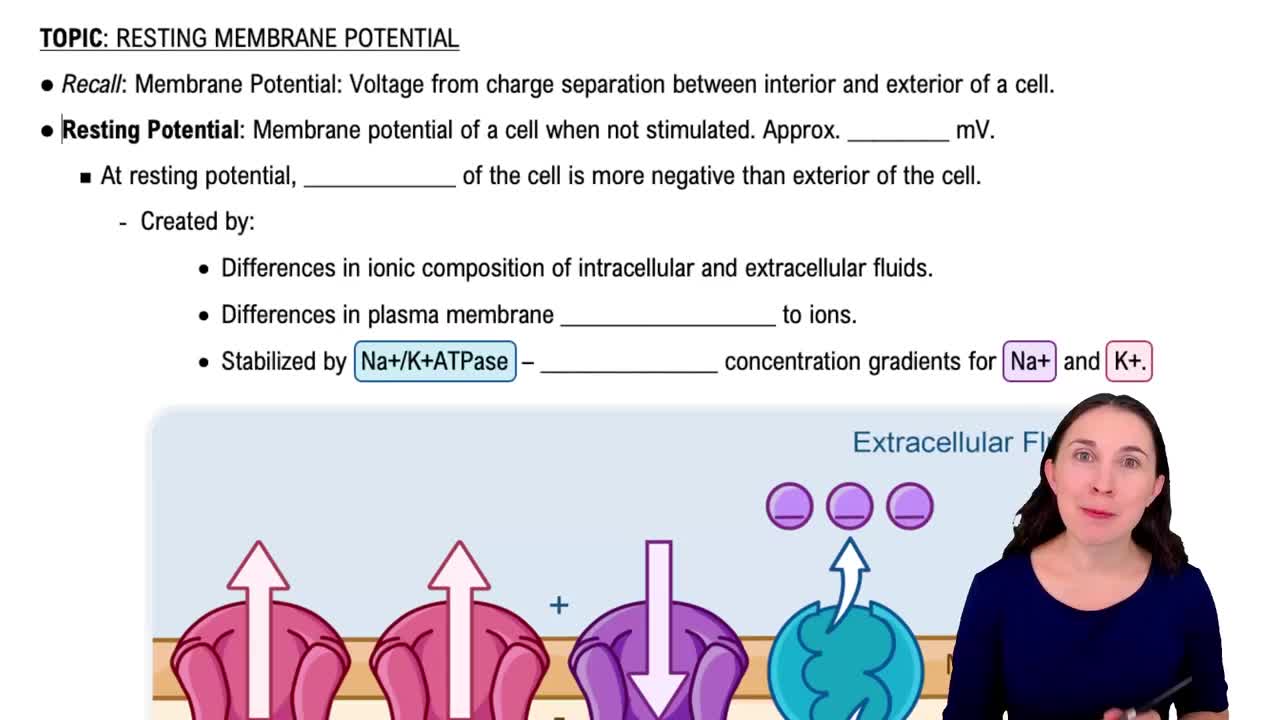
Resting membrane potential is the electrical potential energy produced by the separation of oppositely charged particles across the plasma membrane in all cells, typically ranging from –50 to –100 mV.
Potassium (K+) diffuses out of the cell through leakage channels, making the inside of the cell more negative and establishing the RMP around –90 mV.
Na+ is attracted to the negative interior of the cell and can raise the RMP to about –70 mV, but the membrane is more permeable to K+, so K+ has the primary influence.
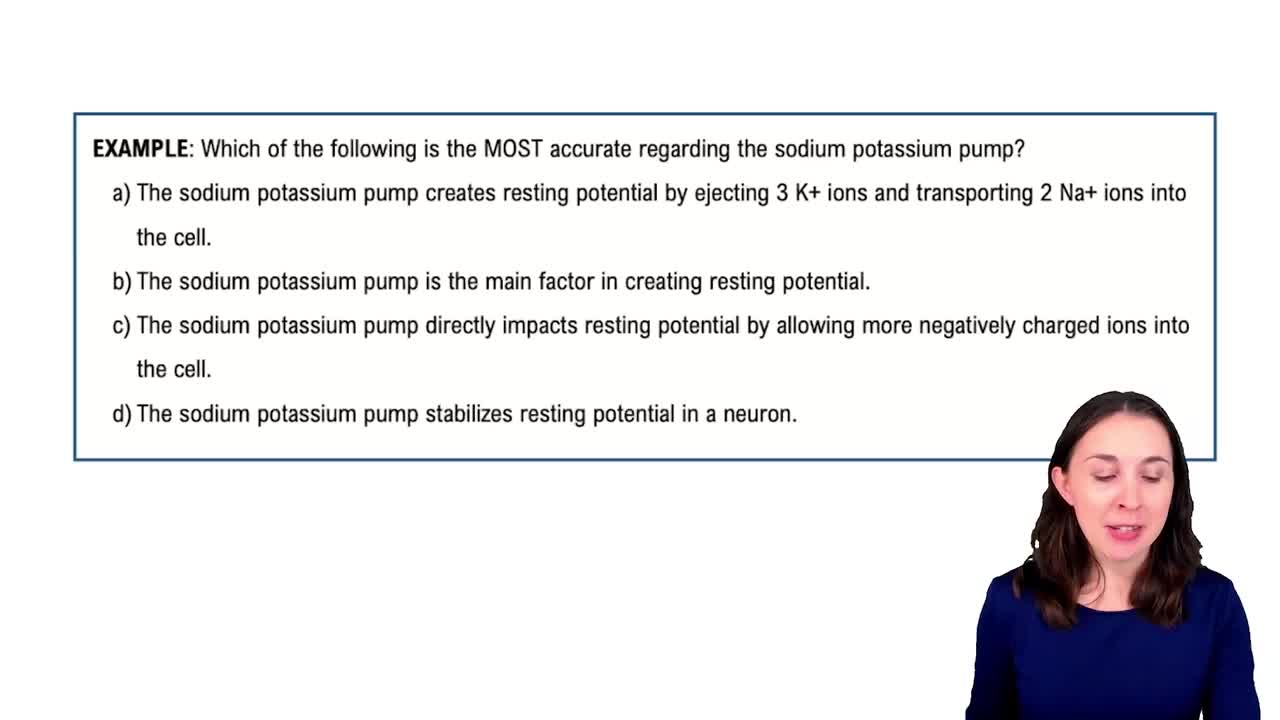
The Na+-K+ pump actively ejects 3 Na+ ions out and brings 2 K+ ions in, maintaining the electrochemical gradients and steady state of the resting membrane potential.
Rough ER has ribosomes and synthesizes proteins; Smooth ER synthesizes lipids, absorbs and transports lipids, and stores/releases calcium.
Mitochondria produce most of the cell's ATP via aerobic respiration and have their own DNA, RNA, and ribosomes.
Ribosomes are nonmembranous organelles that synthesize proteins; they exist as free ribosomes in the cytosol or membrane-bound on the rough ER.
The Golgi apparatus modifies, concentrates, and packages proteins and lipids received from the rough ER for transport or secretion.
Lysosomes are membranous sacs containing digestive enzymes that degrade bacteria, viruses, toxins, and nonfunctional organelles.
The cytoskeleton is a network of protein rods that provide structural support, aid in cell movement, and organize cell components.
The centrosome is the microtubule organizing center near the nucleus; centrioles help organize microtubules and form the bases of cilia and flagella.
Microvilli are fingerlike projections of the plasma membrane that increase the cell's surface area for absorption.
The nucleus contains the nuclear envelope, nucleoli (for rRNA synthesis), and chromatin (DNA, RNA, and proteins).
Chromatin is DNA wrapped around histone proteins forming nucleosomes; condensed chromatin forms chromosomes during cell division.
Interphase (cell growth and DNA replication) and mitotic phase (cell division including mitosis and cytokinesis).
1. Prophase, 2. Metaphase, 3. Anaphase, 4. Telophase – stages ensuring equal DNA distribution to daughter cells.
Chromatin condenses into chromosomes, centrosomes move to poles, nuclear envelope breaks down, and spindle fibers attach to chromosomes.
Chromosomes align at the cell's equator along the metaphase plate, preparing for separation.
Sister chromatids separate at centromeres and are pulled toward opposite poles of the cell.
Chromosomes uncoil into chromatin, nuclear envelopes reform, nucleoli reappear, and the spindle disappears.
Cytokinesis is the division of the cytoplasm, where a contractile ring pinches the cell into two daughter cells.
Go signals include surface-to-volume ratio and growth factors; stop signals include contact inhibition and space availability.
DNA holds the genetic code for proteins, with genes specifying amino acid sequences via triplet codes.
RNA uses uracil instead of thymine and ribose sugar instead of deoxyribose; it acts as a messenger and translator of DNA code.
mRNA carries the code from DNA, rRNA forms ribosomes, and tRNA delivers amino acids for protein assembly.
Transcription copies DNA to mRNA; translation decodes mRNA to assemble amino acids into polypeptides.
DNA base sequence is copied into complementary mRNA, which then leaves the nucleus for protein synthesis.
mRNA codons are read by ribosomes, and tRNA brings corresponding amino acids to form a polypeptide chain.
Proteins synthesized on rough ER ribosomes are enclosed in vesicles and sent to the Golgi apparatus for modification and packaging.