 Indietro
Anatomy & Physiology: Central Nervous System and Endocrine Overview
 0:50

Termini in questo insieme (35)
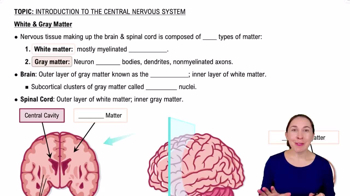
Gray matter contains neuron cell bodies, dendrites, and unmyelinated axons.
White matter consists mainly of myelinated axons forming tracts that connect different CNS regions.
Tracts are bundles of myelinated axons in the CNS that carry specific types of information between brain and spinal cord regions.
Nuclei are clusters of neuron cell bodies within the CNS that serve as processing centers.
CSF is a clear fluid that cushions the brain and spinal cord, providing protection and nutrient transport.
CSF is produced by the choroid plexus in the brain ventricles.
The BBB is a selective barrier formed by endothelial cells and astrocytes that protects the brain by restricting substance passage from blood to CNS.
The BBB protects the brain from toxins and pathogens while allowing essential nutrients to pass.
Endothelial cells with tight junctions and astrocyte end-feet form the blood-brain barrier.
Small, lipid-soluble molecules and gases can cross; most large or hydrophilic molecules cannot.
It is reduced in areas like the hypothalamus to allow hormone sensing and regulation.
Dorsal roots carry sensory (afferent) information from peripheral receptors to the spinal cord.
Ventral roots carry motor (efferent) information from the spinal cord to muscles and glands.
Dorsal horns process sensory input, ventral horns contain motor neurons, and lateral horns contain autonomic neurons.
Ascending tracts carry sensory information to the brain; descending tracts carry motor commands from the brain to the body.
Pyramids contain motor tracts where most fibers cross (decussate) to control voluntary movement.
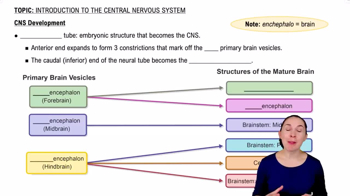
The pons relays signals between the cerebrum and cerebellum; the midbrain controls eye movement and auditory/visual processing.
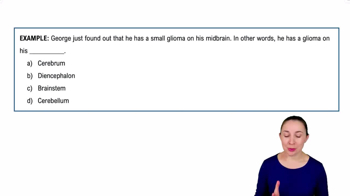
The cerebellum coordinates voluntary movement, balance, and posture.
The thalamus acts as a relay center for sensory information going to the cerebral cortex.
The hypothalamus regulates homeostasis, controls the autonomic nervous system, and links the nervous and endocrine systems.
Tropic hormones stimulate other endocrine glands to release hormones.
Their target is other endocrine glands.
The pineal gland secretes melatonin, regulating circadian rhythms.
The pituitary has an anterior lobe (adenohypophysis) and a posterior lobe (neurohypophysis).
Growth hormone, prolactin, thyroid-stimulating hormone, adrenocorticotropic hormone, follicle-stimulating hormone, luteinizing hormone, melanocyte-stimulating hormone, and endorphins.
Thyroid-stimulating hormone, adrenocorticotropic hormone, follicle-stimulating hormone, and luteinizing hormone are tropic.
Hypertrophy is the increase in size of an organ or tissue due to cell enlargement.
Atrophy is the decrease in size of an organ or tissue due to cell shrinkage or loss.
Oxytocin and antidiuretic hormone (ADH).
The primary motor cortex is located in the frontal lobe and controls voluntary movement.
Located in the parietal lobe, it processes sensory information from the body.
Located in the occipital lobe, it processes visual information.
Located in the temporal lobe, it processes auditory information.
Located in the temporal lobe, it processes smell information.
Located in the insula and parietal lobe, it processes taste information.