 Indietro
Anatomy & Physiology: Central Nervous System and Peripheral Nervous System
 0:50

Termini in questo insieme (29)
Consists of the brain and spinal cord.
Evolutionary development of the rostral (anterior) portion of CNS, resulting in increased neurons and highest level reached in human brain.
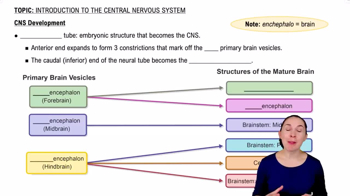
Three vesicles formed from anterior neural tube: prosencephalon (forebrain), mesencephalon (midbrain), and rhombencephalon (hindbrain).
Derived from primary vesicles: forebrain → telencephalon and diencephalon; midbrain remains undivided; hindbrain → metencephalon and myelencephalon.
Formed from telencephalon; largest part of brain, accounting for 83% of brain mass.
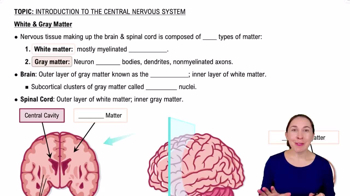
Gray matter: neuron cell bodies and nonmyelinated neurons; white matter: myelinated and nonmyelinated axons.
Fluid-filled chambers continuous with central canal of spinal cord, filled with cerebrospinal fluid (CSF), lined by ependymal cells.
Longitudinal fissure separates hemispheres; central sulcus separates frontal and parietal lobes; lateral sulcus outlines temporal lobe.
Site of conscious mind: awareness, sensory perception, voluntary motor initiation, communication, memory, and understanding.
Located in precentral gyrus of frontal lobe; controls precise, skilled voluntary movements via pyramidal cells.
Motor speech area usually in left hemisphere; directs muscles for speech production and planning voluntary motor activities.
Located in postcentral gyrus of parietal lobe; receives general sensory input from skin and proprioceptors; capable of spatial discrimination.
Relay station for sensory information to cortex; mediates sensation, motor activities, cortical arousal, learning, and memory.
Main visceral control center vital for homeostasis; regulates autonomic nervous system, emotions, body temperature, hunger, thirst, sleep-wake cycles, and endocrine functions.
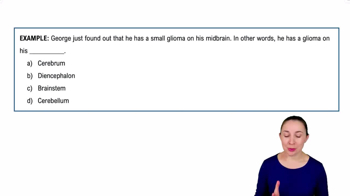
Includes midbrain, pons, and medulla oblongata; controls automatic survival behaviors and contains nuclei for 10 of 12 cranial nerves.
Coordinates precise skeletal muscle movements and balance; processes input from cortex, brain stem, and sensory receptors.
Includes structures in medial cerebral hemispheres and diencephalon; involved in emotion, memory, and motivation.
Maintains consciousness and alertness by sending impulses to cerebral cortex; filters out repetitive or weak stimuli.
Twelve pairs of nerves associated with brain; numbered I to XII; functions include sensory, motor, or both.
Includes mechanoreceptors (touch, pressure), thermoreceptors (temperature), photoreceptors (light), chemoreceptors (chemicals), and nociceptors (pain).
Phasic receptors adapt quickly to stimuli; tonic receptors adapt slowly or not at all (e.g., nociceptors).
Gray matter is central with dorsal and ventral horns; white matter surrounds gray matter and is divided into dorsal, lateral, and ventral columns.
Three-neuron chains transmitting sensory information to brain: first order (receptor to spinal cord), second order (spinal cord to thalamus), third order (thalamus to cortex).
Two types: direct (pyramidal) pathways for fast, skilled movements; indirect pathways for posture, balance, and coarse movements.
Possible if soma intact; involves Wallerian degeneration, macrophage cleanup, axon growth through regeneration tube, and remyelination.
Selective barrier formed by tight junctions of capillary endothelium, basal lamina, and astrocyte feet; protects brain from harmful substances.
Provides buoyancy, protection, nourishment, and chemical signaling for CNS; produced by choroid plexus and circulated through ventricles.
Includes NREM (4 stages with increasing depth) and REM sleep; REM characterized by active brain, muscle paralysis, and dreaming.
Ischemia causes brain tissue death; symptoms include paralysis and speech deficits; treated with tissue plasminogen activator (TPA).