Skip to main content
Anatomy & Physiology
Il mio corso
Impara
Preparazione agli esami
AI Tutor
Guide di studio
Soluzioni per libri di testo
Flashcard
Esplora
Prova l'app
Il mio corso
Impara
Preparazione agli esami
AI Tutor
Guide di studio
Soluzioni per libri di testo
Flashcard
Esplora
Prova l'app
Indietro
Anatomy & Physiology: Chemical Bonds and Water Properties Part 2
Puoi toccare per girare la carta.
Types of covalent bonds
Puoi toccare per girare la carta.
👆
Types of covalent bonds
Polar
and
Nonpolar
covalent bonds.
Avanzamenti del tracciato
I pulsanti di controllo sono stati cambiati in modalità "navigazione".
1/19
Video consigliati
VideoThumbView.guidedCourse
04:28
Covalent Bonds
28641
views
553
rank
1
comments
VideoThumbView.guidedCourse
06:59
Polar Covalent Bonds
22734
views
378
rank
2
comments
VideoThumbView.guidedCourse
05:58
Nonpolar Covalent Bonds
23840
views
433
rank
Termini in questo insieme (19)
Nascondere definizioni
Types of covalent bonds
Polar
and
Nonpolar
covalent bonds.
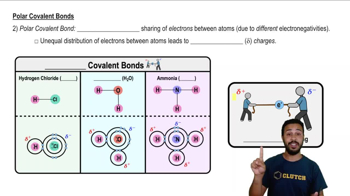
Polar covalent bond
One atom has greater attraction (electronegativity) for electrons than the other, e.g. O-H, N-H, S-H, O-C.
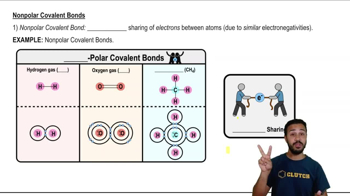
Nonpolar covalent bond
Atoms equally share electrons, e.g. H-H, C-H.
Hydrogen bond
Between H in one polar covalent bond and another atom (e.g. O or N) in another molecule; directional and weakest bond, e.g. H\(_2\)O.
Types of compounds
Inorganic
compounds lack C and H;
Organic
compounds contain C and H.
Water as a universal solvent
Water dissolves ions or polar solutes forming aqueous solutions due to its polarity.
Hydrophilic molecules
Polar molecules that dissolve easily in water.
Hydrophobic molecules
Non-polar molecules that do not dissolve in water.
Cohesion in water
Attraction between water (H\(_2\)O) molecules.
Adhesion in water
Attraction between water molecules and other types of molecules.
High heat capacity of water
Water requires a lot of heat to raise its temperature, helping moderate local climate.
High heat of vaporization of water
Water needs a lot of heat to evaporate, producing a cooling effect.
Water expands when it crystallizes
Water expands upon freezing, making ice less dense than liquid water.
pH definition
Measure of acidity based on H\(^+\) concentration; pH scale ranges from 0 to 14.
pH of pure water
Ionization is rare; [H\(^+\)] = 10\(^{-7}\); pH = 7.
Acidic pH range
pH less than 7 indicates high H\(^+\) concentration.
Basic pH range
pH greater than 7 indicates low H\(^+\) concentration.
Neutral pH
pH equal to 7, indicating balanced H\(^+\) concentration.
Buffers
Compounds that resist pH change and minimize pH disturbance in living cells.
 IndietroIndietro
 04:28