A tissue is a group of cells with similar structure and function.
What are the four main types of tissues?
The four main tissue types are epithelial, connective, nervous, and muscle tissues.
What are the two criteria used to classify epithelial tissue?
Epithelial tissue is classified by arrangement (simple or stratified) and cell shape (squamous, cuboidal, columnar).
Describe simple squamous epithelium.
Simple squamous epithelium is a single layer of flattened cells that functions in diffusion and filtration, located in air sacs of lungs and blood vessels.
What is the function and location of simple cuboidal epithelium?
Simple cuboidal epithelium consists of a single layer of cube-like cells that perform secretion and absorption, found in kidney tubules and small glands.
What characterizes simple columnar epithelium?
Simple columnar epithelium is a single layer of tall cells with oval nuclei, involved in secretion and absorption, located in the digestive tract and bronchi.
What special cell is found in simple columnar epithelium and what is its function?
The goblet cell produces and releases mucus into the lumen.
Describe pseudostratified columnar epithelium.
Pseudostratified columnar epithelium is a single layer of cells with cilia and goblet cells, functioning in secretion and mucus propulsion, located in the trachea.
What is the structure and function of stratified squamous epithelium?
Stratified squamous epithelium is a thick membrane of several cell layers that provides protection, found in the esophagus, skin, and mouth lining.
What is the difference between keratinized and nonkeratinized stratified squamous epithelium?
Keratinized has a layer of dead protective cells on the surface and is found only in skin; nonkeratinized lacks this layer and is found in esophagus, mouth, and vagina.
What is the function and location of stratified cuboidal epithelium?
Stratified cuboidal epithelium has two layers of cubelike cells, functions in protection, and is located in sweat glands.
Describe stratified columnar epithelium.
Stratified columnar epithelium consists of several cell layers, functions in protection and secretion, and is found in the urethra.
What is transitional epithelium and where is it found?
Transitional epithelium resembles both stratified squamous and cuboidal, functions to stretch and allow distension, and is located in the urinary bladder and ureters.
What are the four main types of connective tissue?
The four main types of connective tissue are proper connective tissue, cartilage, bone, and blood.
What are the main components of connective tissue?
Connective tissue components include ground substance, cell types (fibroblast, mesenchymal, adipocyte), and support fibers (elastic, collagen, reticular).
What is the function and location of areolar connective tissue?
Areolar connective tissue is a loose proper connective tissue that wraps and cushions organs, located around capillaries and organs.
Describe adipose connective tissue.
Adipose tissue is loose proper connective tissue that provides insulation and energy storage, found under skin and in breast tissue.
What is the function of dense regular connective tissue and where is it found?
Dense regular connective tissue provides mechanical stress resistance and is found in tendons and ligaments.
What specialized cell is found in cartilage and bone tissues?
Cartilage contains chondrocytes and bone contains osteocytes as specialized cells.
What is the function of hyaline cartilage and where is it located?
Hyaline cartilage cushions and supports, located at the ends of long bones, nose, and trachea.
What distinguishes elastic cartilage and where is it found?
Elastic cartilage allows flexible movement and is found in the ear.
What is the function and location of fibrocartilage?
Fibrocartilage provides shock absorption and is located between vertebrae and pubic symphysis.
What is the role of bone tissue?
Bone tissue provides support, strength, and protection and contains hematopoietic tissue for erythrocyte production.
What is the function of blood tissue?
Blood transports gases, nutrients, and wastes, and contains erythrocytes and leukocytes.
What are the three types of muscle tissue?
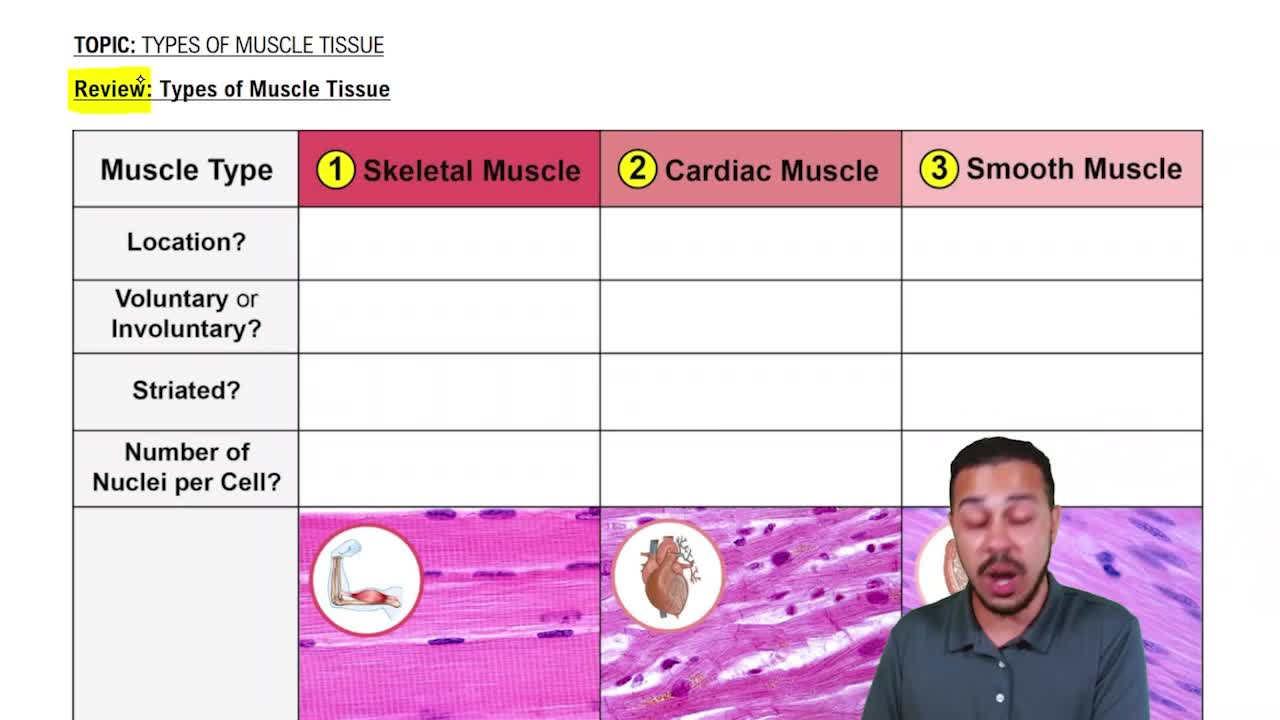
The three muscle tissue types are skeletal, cardiac, and smooth muscle.
Describe skeletal muscle tissue.
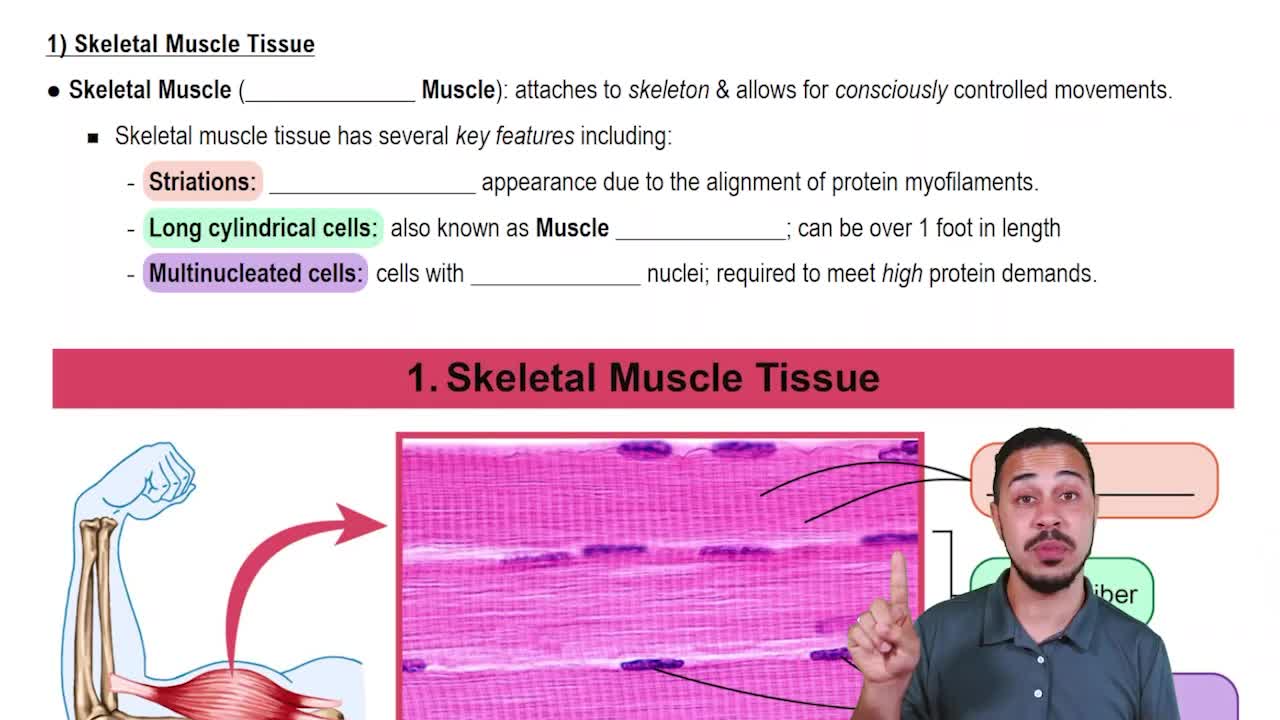
Skeletal muscle tissue has long, cylindrical, multinucleated, striated cells and functions in voluntary movement.
What are the characteristics of cardiac muscle tissue?
Cardiac muscle tissue has short, branched, uninucleated, striated cells and functions in involuntary contraction to propel blood.
Describe smooth muscle tissue.
Smooth muscle tissue has spindle-shaped, short, uninucleated, nonstriated cells and functions in involuntary movement, propelling food in hollow organs.
 Indietro
 00:36