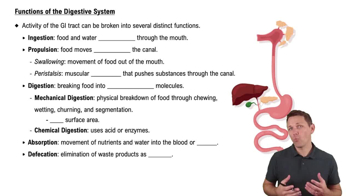
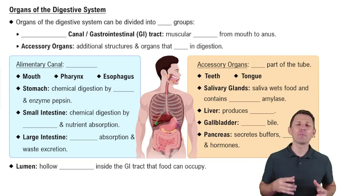
The mouth includes lips, cheeks, tongue, hard palate, and soft palate. Lips protect the entrance, the hard palate forms the anterior roof, and the soft palate forms the posterior roof and closes the nasal passage during swallowing.
Functions of intrinsic and extrinsic tongue muscles
Intrinsic muscles change tongue shape for speech and swallowing; extrinsic muscles alter tongue position for movement and food manipulation.
Three types of papillae on the tongue
Filiform (texture), fungiform (taste buds), and circumvallate (large taste buds at the back).
Three pairs of extrinsic salivary glands
Parotid, submandibular, and sublingual glands produce saliva to moisten food and begin digestion.
Functions and composition of saliva
Saliva moistens food, begins starch digestion with amylase, cleanses mouth, and contains mucus, enzymes, electrolytes, and antibacterial agents.
Control of salivation
Salivation is controlled by the autonomic nervous system; parasympathetic stimulation increases saliva, sympathetic reduces it.
Classification of teeth
Incisors (cutting), canines (tearing), premolars and molars (grinding).
Structure of tooth crown and root
Crown is covered by enamel; root is embedded in the jawbone and covered by cementum; both contain dentin and pulp.
Gomphosis joint
A fibrous joint where the tooth root is anchored into the alveolar socket by the periodontal ligament.
Structure and functions of the pharynx
A muscular tube connecting mouth to esophagus; functions in swallowing and passage of air to the larynx.
Soft palate position change during swallowing
The soft palate elevates to close the nasopharynx, preventing food from entering the nasal cavity.
 Indietro
 4:06
4:06