What is the primary function of the endocrine system?
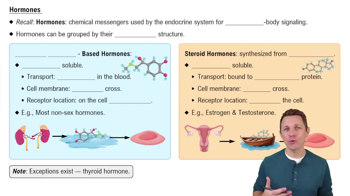
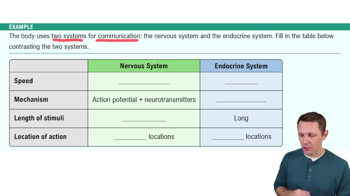
To coordinate and integrate body cell activities by releasing hormones into the blood, influencing metabolic activities with slower but longer-lasting responses than the nervous system.
Name the two main classes of hormones.
Amino acid–based hormones (amino acid derivatives, peptides, proteins) and Steroids (synthesized from cholesterol, including gonadal and adrenocortical hormones).
What are the three types of endocrine gland stimuli that trigger hormone release?
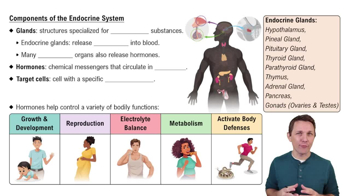
Cells that have specific receptors for a hormone and respond to it by altering membrane permeability, enzyme activity, secretory activity, or mitosis.
What is up-regulation and down-regulation of hormone receptors?
Up-regulation: target cells increase receptor numbers in response to low hormone levels. Down-regulation: target cells decrease receptors in response to high hormone levels to prevent overreaction.
Describe the hypothalamic-pituitary relationship.
The hypothalamus connects to the pituitary gland via the infundibulum; it regulates anterior pituitary hormone secretion via releasing/inhibiting hormones and stores neurohormones in the posterior pituitary.
What hormones are secreted by the posterior pituitary?
Oxytocin, which stimulates uterine contractions and milk ejection, and Antidiuretic Hormone (ADH), which promotes water reabsorption in kidneys and vasoconstriction.
List the six anterior pituitary hormones and their general functions.
Major metabolic hormone that increases basal metabolic rate, regulates tissue growth and development, and maintains blood pressure by increasing adrenergic receptors.
How does parathyroid hormone (PTH) regulate calcium levels?
PTH increases blood Ca2+ by stimulating osteoclasts to release calcium from bone, enhancing kidney reabsorption of Ca2+, and promoting vitamin D activation for intestinal absorption.
What are the three layers of the adrenal cortex and their hormone types?
Zona glomerulosa: mineralocorticoids (e.g., aldosterone); Zona fasciculata: glucocorticoids (e.g., cortisol); Zona reticularis: gonadocorticoids (weak androgens).
Describe the renin-angiotensin-aldosterone mechanism.
Low blood pressure triggers kidney cells to release renin, converting angiotensinogen to angiotensin II, which stimulates aldosterone release to increase Na+ reabsorption and blood pressure.
What are the main effects of cortisol?
Increases blood glucose via gluconeogenesis, promotes fat and protein breakdown, enhances vasoconstriction, and suppresses inflammation and immune responses.
What hormones are produced by the adrenal medulla and their effects?
Catecholamines epinephrine (80%) and norepinephrine (20%) increase heart rate, blood glucose, vasoconstriction, and redirect blood flow to vital organs during stress.
What is the function of pancreatic alpha and beta cells?
Alpha cells produce glucagon to raise blood glucose; beta cells produce insulin to lower blood glucose by promoting cellular uptake and storage.
How does insulin lower blood glucose levels?
Enhances glucose uptake into fat and muscle cells, inhibits glycogen breakdown, and prevents conversion of amino acids/fats to glucose.
What are the primary functions of blood?
Transporting oxygen, nutrients, wastes, and hormones; regulating body temperature, pH, and fluid volume; and protecting against blood loss and infection.
Describe the structure and function of erythrocytes.
Biconcave, anucleate cells filled with hemoglobin that transport oxygen and carbon dioxide efficiently due to large surface area and anaerobic ATP production.
What is hematopoiesis and where does it occur?
The formation of all blood cells from hematopoietic stem cells, occurring primarily in red bone marrow of axial skeleton and proximal limb bones.
What hormone regulates erythropoiesis and what triggers its release?
Erythropoietin (EPO), released mainly by kidneys in response to hypoxia or low oxygen levels in blood.
Name common causes of anemia.
Blood loss, insufficient RBC production (iron deficiency, pernicious anemia, renal anemia), and excessive RBC destruction (hemolytic anemia, sickle-cell anemia).
What are the main types of leukocytes and their functions?
Granulocytes (neutrophils, eosinophils, basophils) involved in phagocytosis and inflammation; Agranulocytes (lymphocytes, monocytes) involved in immunity and phagocytosis.
What is hemostasis and its three main steps?
The process to stop bleeding: 1) Vascular spasm (vasoconstriction), 2) Platelet plug formation, 3) Coagulation (fibrin clot formation).
Explain the intrinsic and extrinsic pathways of coagulation.
Intrinsic pathway is triggered by blood contact with damaged surfaces; extrinsic pathway is triggered by tissue factor from damaged tissues; both activate factor X leading to clot formation.
What is the role of thrombin in coagulation?
Converts fibrinogen to fibrin, forming the clot mesh, and activates factor XIII to stabilize and strengthen the clot.
How is clot growth limited to prevent excessive clotting?
By rapid removal/dilution of clotting factors, inhibition of activated factors, and anticoagulants like antithrombin III and heparin.
What causes hemolytic disease of the newborn?
Rh incompatibility where an Rh– mother produces antibodies against Rh+ fetal RBCs, leading to fetal RBC destruction in subsequent pregnancies.
What is the universal donor and universal recipient blood type?
Universal donor: Type O (no A or B antigens); Universal recipient: Type AB (no anti-A or anti-B antibodies).
 Indietro
 7:06