 Indietro
Anatomy & Physiology: Endocrine System Hormones and Mechanisms
 7:06
7:06
Termini in questo insieme (19)
1. Secreted by endocrine cells into the blood.
2. Transported to distant target cells.
3. Acts at low concentrations.
4. Binds to specific receptors to trigger a response.
Hormones bind to specific receptors on or in target cells, triggering intracellular signaling pathways that alter cell function or gene expression.
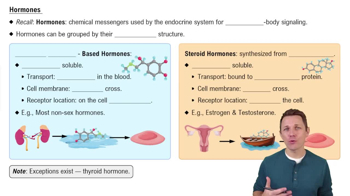
Peptide: Insulin
Steroid: Cortisol
Amine: Epinephrine
Peptide hormones are synthesized as preprohormones, stored in vesicles, and released by exocytosis.
Steroid hormones are synthesized on demand from cholesterol and diffuse out of cells without storage.
Peptide hormone receptors are on the cell surface membrane.
Steroid hormone receptors are intracellular, in the cytoplasm or nucleus.
Peptide hormones activate second messenger systems.
Steroid hormones directly modulate gene transcription.
Catecholamines: Epinephrine, norepinephrine
Thyroid hormones: T3, T4
Others: Dopamine
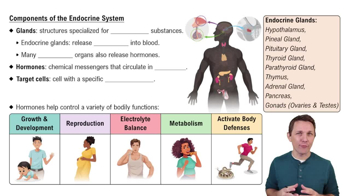
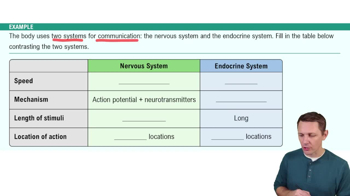
The nervous system detects stimuli and triggers endocrine responses by stimulating hormone release, integrating rapid control with hormonal regulation.
The anterior pituitary is glandular tissue that synthesizes and secretes six hormones regulated by hypothalamic releasing and inhibiting hormones.
The posterior pituitary is neural tissue that stores and releases hormones made in the hypothalamus, such as oxytocin and vasopressin.
GH: Growth effects on tissues
TSH: Thyroid gland
ACTH: Adrenal cortex
FSH: Gonads
LH: Gonads
Prolactin: Mammary glands
Hypothalamic releasing and inhibiting hormones regulate anterior pituitary secretion, e.g., TRH stimulates TSH release, somatostatin inhibits GH release.
Hormones from peripheral glands inhibit both the anterior pituitary and hypothalamus to regulate hormone levels, e.g., cortisol inhibits ACTH and CRH.
Insulin secretion is regulated by blood glucose levels (negative feedback). Parathyroid hormone secretion is regulated by blood calcium levels via negative feedback.
One hormone enhances the target organ's response to a second hormone, e.g., thyroid hormone increases the effect of epinephrine on fat breakdown.
Two hormones produce a greater combined effect than the sum of their separate effects, e.g., glucagon and epinephrine both increase blood glucose.
One hormone opposes the action of another, e.g., insulin lowers blood glucose while glucagon raises it.
Hypersecretion: Excess hormone production
Hyposecretion: Deficient hormone production
Abnormal responsiveness: Target tissue resistance
By analyzing hormone levels and feedback patterns, one can identify if a problem lies in the hypothalamus, pituitary, or peripheral gland in multi-gland pathways.