 Indietro
Anatomy & Physiology Exam Flashcards
 05:04

Termini in questo insieme (31)
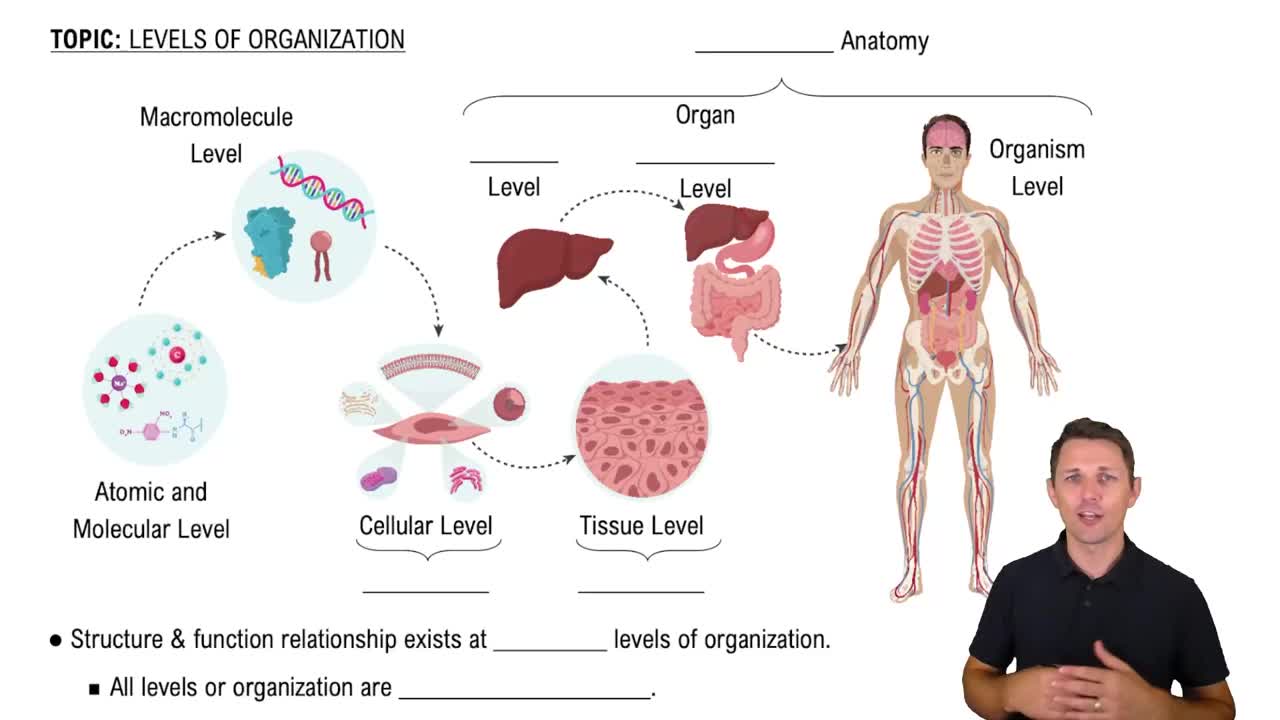
Chemical → Cellular → Tissue → Organ → Organ System → Organism.
The body's ability to maintain a relatively stable internal environment.
A response that reverses or reduces the original stimulus to maintain homeostasis.
A response that amplifies or increases the original stimulus.
Maintaining boundaries, movement, responsiveness, digestion, metabolism, excretion, reproduction, and growth.
Anything that has mass and occupies space.
The capacity to do work or cause change.
A substance that cannot be broken down into simpler substances by ordinary chemical means.
The smallest unit of an element that retains its properties.
Protons (positive), neutrons (neutral), and electrons (negative).
A bond formed when electrons are transferred, creating oppositely charged ions that attract.
A bond formed when atoms share electrons.
A weak attraction between a slightly positive hydrogen atom and a nearby electronegative atom.
Smaller substances combine to form a larger substance: A + B → AB.
A larger substance breaks down into smaller substances: AB → A + B.
Helps stabilize body temperature by absorbing heat with little temperature change.
A substance that releases H+ ions when dissolved in water.
A substance that releases OH− ions when dissolved in water.
Measures hydrogen ion concentration; 7 is neutral, below 7 acidic, above 7 basic.
Monomer: small molecular subunit; Polymer: large molecule made of repeating monomers.
Reaction that joins molecules by removing water.
Reaction that breaks molecules apart by adding water.
Quick/short-term energy.
A lipid made of one glycerol and three fatty acids.
Forms the basic structure of the plasma membrane with hydrophilic heads and hydrophobic tails.
Structure, enzymes, transport, movement, defense, signaling, and regulation.
A protein that acts as a biological catalyst by lowering activation energy.
DNA and RNA; molecules that store and transmit genetic information.
Adenosine triphosphate, the cell's main immediate energy-transfer molecule.
Movement across the membrane without ATP, down concentration gradient.
Movement of substances requiring ATP, usually against concentration gradient.