Skip to main content
Anatomy & Physiology
Il mio corso
Impara
Preparazione agli esami
AI Tutor
Guide di studio
Soluzioni per libri di testo
Flashcard
Esplora
Prova l'app
Il mio corso
Impara
Preparazione agli esami
AI Tutor
Guide di studio
Soluzioni per libri di testo
Flashcard
Esplora
Prova l'app
Indietro
Anatomy & Physiology: Eye and Vision
Puoi toccare per girare la carta.
Accessory structures of the eye
Puoi toccare per girare la carta.
👆
Accessory structures of the eye
Structures that support and protect the eye, including eyelids, eyelashes, lacrimal apparatus, and extrinsic eye muscles.
Avanzamenti del tracciato
I pulsanti di controllo sono stati cambiati in modalità "navigazione".
1/20
Video consigliati
VideoThumbView.guidedCourse
5:05
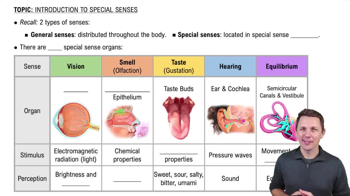
Special Senses
10305
views
266
rank
2
comments
VideoThumbView.guidedCourse
3:08
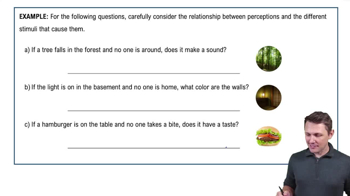
Introduction to Special Senses Example 1
6751
views
152
rank
Termini in questo insieme (20)
Nascondere definizioni
Accessory structures of the eye
Structures that support and protect the eye, including eyelids, eyelashes, lacrimal apparatus, and extrinsic eye muscles.
Aqueous humor
Clear fluid in the anterior chamber of the eye that nourishes the cornea and lens and maintains intraocular pressure.
Vitreous humor
Gel-like substance filling the posterior chamber of the eye, helping maintain its shape and optical properties.
Cornea
Transparent, curved front part of the eye that refracts light entering the eye.
Electromagnetic spectrum
Range of all types of electromagnetic radiation, with visible light being the portion detectable by the human eye.
Emmetropic eye
An eye with normal vision where light focuses directly on the retina without the need for correction.
Focal point
The point where light rays converge after passing through a lens or cornea.
Hyperopic eye
Also called farsightedness; the eye focuses light behind the retina, causing difficulty seeing close objects.
Iris
Colored part of the eye that controls the size of the pupil and thus the amount of light entering the eye.
Lacrimal apparatus
Structures involved in tear production and drainage, including lacrimal glands and ducts.
Lens
Transparent, flexible structure that changes shape to focus light on the retina.
Macula lutea and fovea centralis
Macula lutea is a yellowish area on the retina; the fovea centralis is its center with the highest concentration of cones for sharp vision.
Myopic eye
Also called nearsightedness; the eye focuses light in front of the retina, causing difficulty seeing distant objects.
Optic disc (blind spot)
Area on the retina where the optic nerve exits; lacks photoreceptors, creating a blind spot.
Photon (quanta)
A particle of light that carries energy and is detected by photoreceptors in the eye.
Photoreceptors: rods and cones
Rods detect low light and black-and-white vision; cones detect color and function best in bright light.
Pupil
The opening in the center of the iris that regulates the amount of light entering the eye.
Refraction
Bending of light as it passes through different media, such as the cornea and lens, to focus on the retina.
Sclera, choroid, retina
Sclera is the white outer layer; choroid is the vascular middle layer; retina is the innermost layer containing photoreceptors.
Visible wavelengths
Portion of the electromagnetic spectrum visible to the human eye, approximately 400–700 nanometers.
 IndietroIndietro
 5:05