 Indietro
Anatomy & Physiology: Homeostasis, Fluid Balance, and pH Regulation
 01:59

Termini in questo insieme (20)
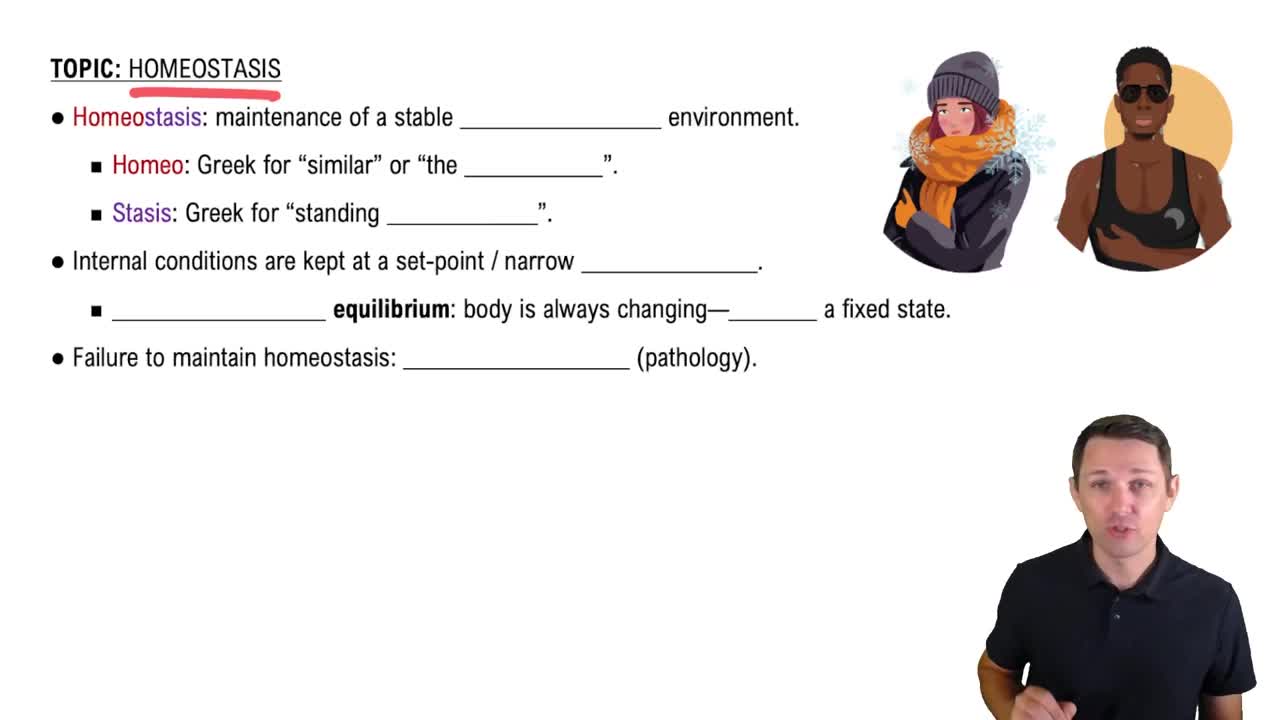
Homeostasis is the maintenance of a relatively stable internal environment despite continuous external and internal changes.
Loss of homeostatic control can lead to disease or death.
The body maintains homeostasis by being in a state of dynamic equilibrium, adjusting to changes like nutrient intake, fluid balance, and energy use.
Autoregulation is when a cell or organ system adjusts to changes in its immediate environment without external control.
Extrinsic regulation involves multiple organ systems coordinating responses, often controlled by the central nervous system.
A negative feedback loop senses a change and initiates responses to reverse it, maintaining stability.
Stimulus, receptor, control center, effector, and response.
The hypothalamus acts as the control center, receiving temperature information and sending commands to effectors like sweat glands and muscles.
Osmolytes are particles that affect osmotic pressure; they are transported across membranes to maintain fluid balance.
Electrolytes are osmolytes that dissociate into charged ions and are crucial for fluid balance, but not all osmolytes are electrolytes.
Approximately 270 milliosmolar (mOs), equivalent to 0.9% saline, with less than 0.5% variation under normal conditions.
Rapid intake of large amounts of pure water can dilute body fluids, causing hyponatremia and disrupting homeostasis, potentially leading to death.
Hyponatremia is low blood sodium, which disrupts fluid balance and can cause brain swelling, seizures, and death.
Increased osmolarity triggers release of ADH, causing kidneys to retain water and inducing thirst to restore balance.
The pH scale measures hydrogen ion concentration from 0 (acidic) to 14 (basic), with 7 being neutral.
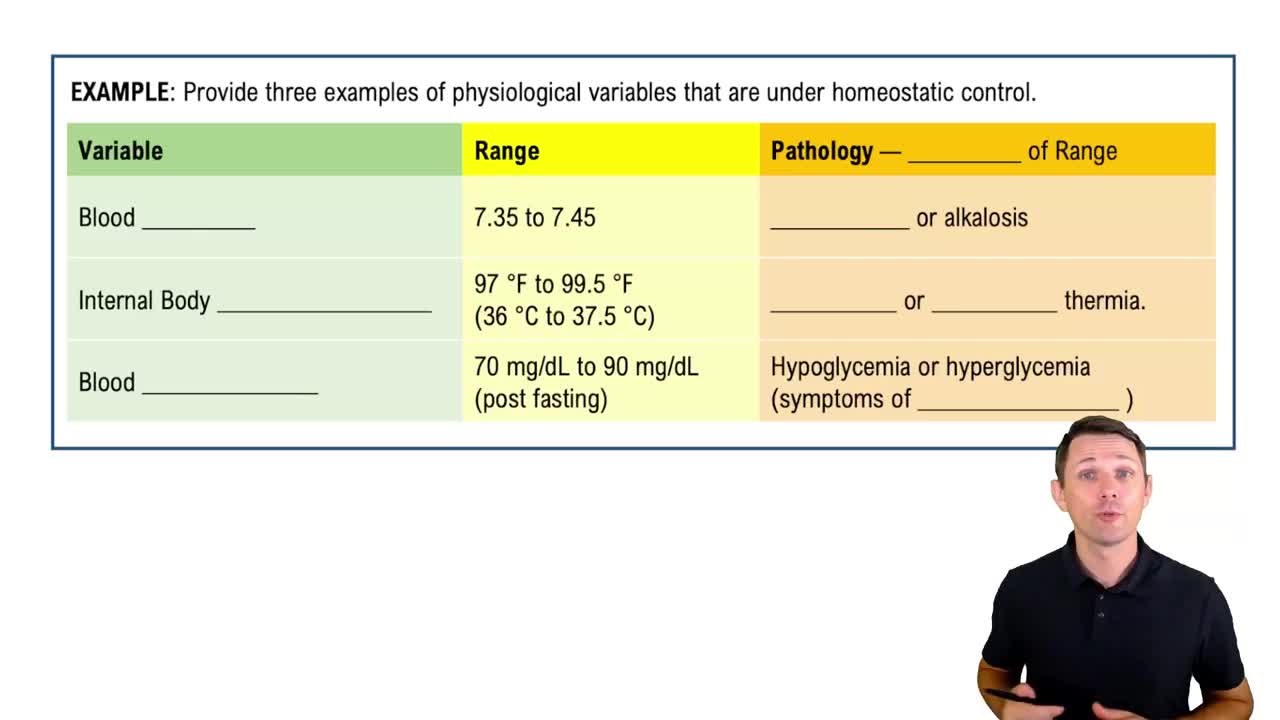
Normal blood pH ranges from 7.35 to 7.45.
Alkalemia is blood pH above normal, causing nervous system over-excitation; acidemia is blood pH below normal, causing nervous system depression.
Buffer systems minimize pH changes by neutralizing added acids or bases, maintaining blood pH stability.
Adding acid to water drastically lowers pH, but blood buffers limit pH change, showing blood's resistance to pH shifts.
The body signals thirst with as little as 1% change in osmolarity, so drinking only when thirsty helps maintain fluid and electrolyte balance.