Skip to main content
Anatomy & Physiology
Il mio corso
Impara
Preparazione agli esami
AI Tutor
Guide di studio
Soluzioni per libri di testo
Flashcard
Esplora
Prova l'app
Il mio corso
Impara
Preparazione agli esami
AI Tutor
Guide di studio
Soluzioni per libri di testo
Flashcard
Esplora
Prova l'app
Indietro
Anatomy & Physiology: Joints and Joint Function
Puoi toccare per girare la carta.
Define a joint
Puoi toccare per girare la carta.
👆
Define a joint
A
joint
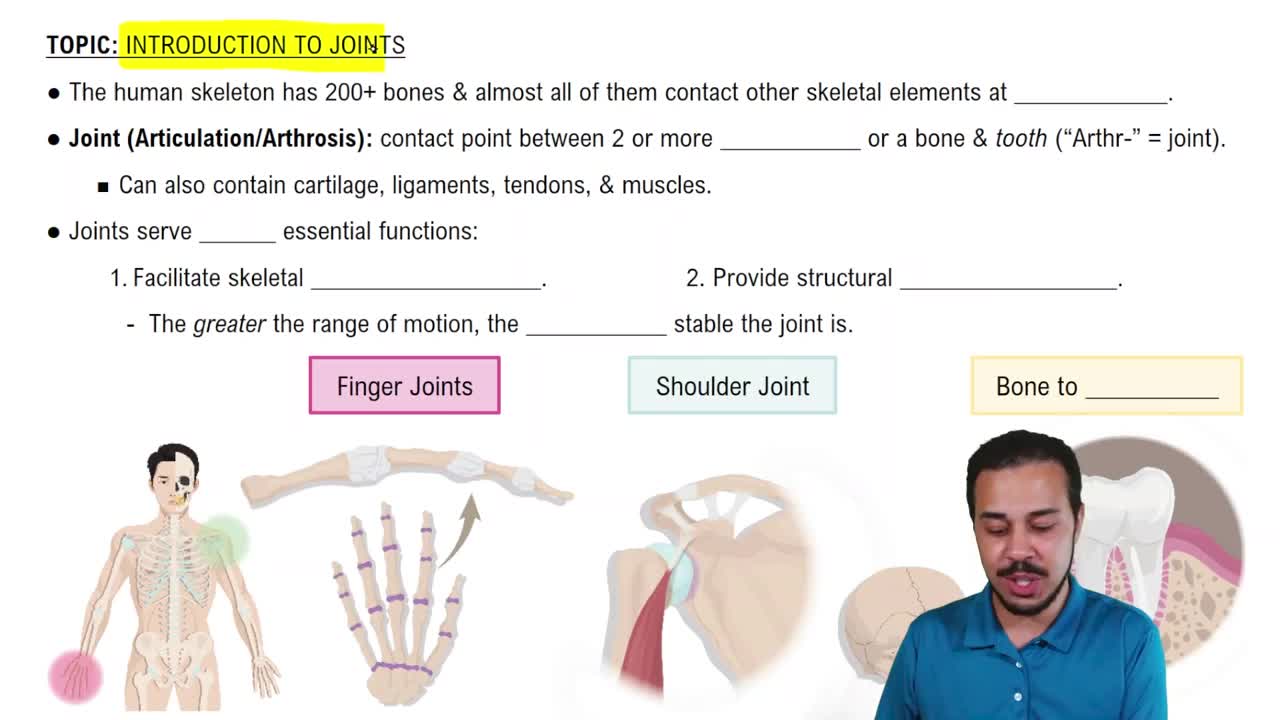
is the connection between two or more bones that allows for varying degrees of movement.
Avanzamenti del tracciato
I pulsanti di controllo sono stati cambiati in modalità "navigazione".
1/27
Video consigliati
VideoThumbView.guidedCourse
04:06
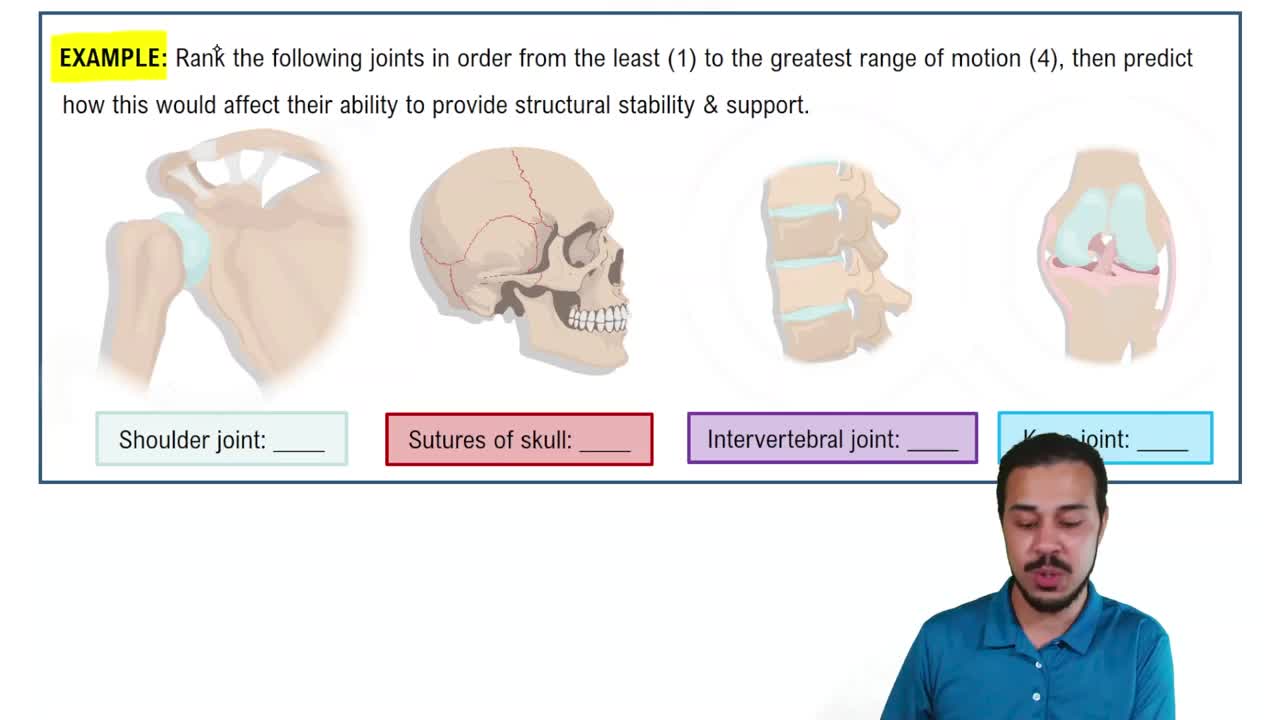
Introduction to Joints Example 1
12009
views
270
rank
VideoThumbView.guidedCourse
05:29
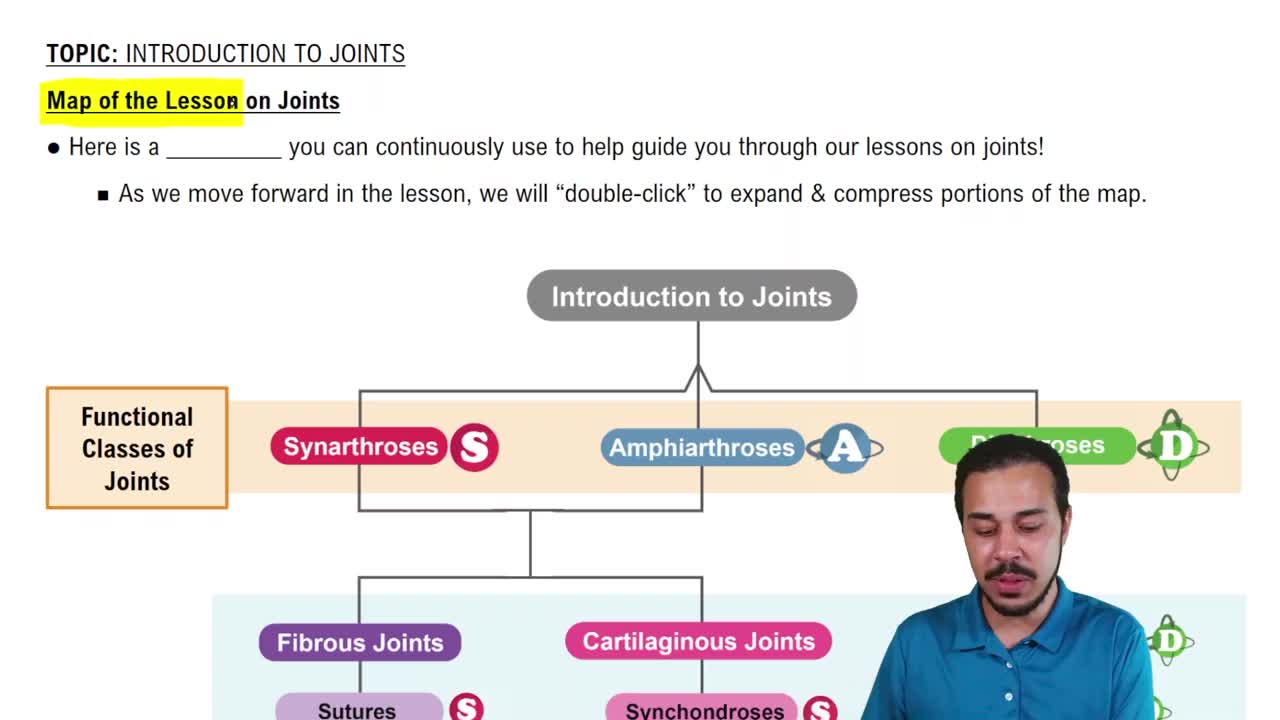
Map of the Lesson on Joints
12544
views
265
rank
1
comments
VideoThumbView.guidedCourse
05:39
Introduction to Joints
16821
views
434
rank
Termini in questo insieme (27)
Nascondere definizioni
Define a joint
A
joint
is the connection between two or more bones that allows for varying degrees of movement.
What are synarthroses joints?
Synarthroses
are immovable joints where bones are tightly connected, such as sutures in the skull.
What are amphiarthroses joints?
Amphiarthroses
are slightly movable joints, like the pubic symphysis or intervertebral discs.
What are diarthroses joints?
Diarthroses
are freely movable joints, also called synovial joints, such as the knee or shoulder.
Explain the relationship between joint mobility and stability
There is an inverse relationship: increased
mobility
usually means decreased
stability
, and vice versa.
List factors influencing joint stability
Joint stability depends on
ligament strength
,
muscle tone
,
joint capsule
integrity, and the shape of articulating surfaces.
Classify joints structurally
Joints are classified as
fibrous
,
cartilaginous
, or
synovial
based on the type of connective tissue binding bones.
Classify joints functionally
Functionally, joints are
synarthroses
(immovable),
amphiarthroses
(slightly movable), or
diarthroses
(freely movable).
Describe fibrous joints and give examples
Fibrous joints
are connected by dense connective tissue; examples include sutures of the skull and the syndesmosis between tibia and fibula.
Describe cartilaginous joints and give examples
Cartilaginous joints
are connected by cartilage; examples include synchondroses like the epiphyseal plate and symphyses like the pubic symphysis.
Describe structural characteristics of synovial joints
Synovial joints have a
joint cavity
,
articular cartilage
, a
synovial membrane
, and are enclosed by a
fibrous capsule
.
What is the function of menisci in synovial joints?
Menisci
are fibrocartilage pads that improve fit between bones, absorb shock, and stabilize the joint.
What are bursae and their function?
Bursae
are fluid-filled sacs that reduce friction between tendons, ligaments, and bones.
What are tendon sheaths?
Tendon sheaths
are tubular bursae that wrap around tendons to reduce friction during movement.
List the six types of synovial joints
The six types are
plane
,
hinge
,
pivot
,
condyloid
,
saddle
, and
ball-and-socket
joints.
Example and movement of plane joints
Plane joints
allow gliding movements; example: intercarpal joints of the wrist.
Example and movement of hinge joints
Hinge joints
allow flexion and extension; example: elbow and knee joints.
Example and movement of pivot joints
Pivot joints
allow rotational movement; example: atlantoaxial joint between C1 and C2 vertebrae.
Example and movement of condyloid joints
Condyloid joints
allow movement in two planes; example: wrist joint between radius and carpal bones.
Example and movement of saddle joints
Saddle joints
allow biaxial movement; example: carpometacarpal joint of the thumb.
Example and movement of ball-and-socket joints
Ball-and-socket joints
allow movement in all planes; example: shoulder and hip joints.
Name common body movements at joints
Common movements include
flexion
,
extension
,
abduction
,
adduction
,
rotation
, and
circumduction
.
Define the suffix –itis
The suffix
–itis
means inflammation of a tissue or structure.
Describe tendinitis
Tendinitis
is inflammation of a tendon, often caused by overuse or injury.
Describe bursitis
Bursitis
is inflammation of a bursa, causing pain and swelling near joints.
Describe arthritis
Arthritis
is inflammation of a joint, leading to pain, swelling, and reduced mobility.
Compare osteoarthritis and rheumatoid arthritis
Osteoarthritis
is caused by wear and tear of cartilage;
rheumatoid arthritis
is an autoimmune disease attacking joint tissues.
 IndietroIndietro
 04:06