Skip to main content
Anatomy & Physiology
Il mio corso
Impara
Preparazione agli esami
AI Tutor
Guide di studio
Soluzioni per libri di testo
Flashcard
Esplora
Prova l'app
Il mio corso
Impara
Preparazione agli esami
AI Tutor
Guide di studio
Soluzioni per libri di testo
Flashcard
Esplora
Prova l'app
Indietro
Anatomy & Physiology: Joints and Movements
Puoi toccare per girare la carta.
What are the two main classification schemes for joints?
Puoi toccare per girare la carta.
👆
What are the two main classification schemes for joints?
Structural (fibrous, cartilaginous, bony, synovial) and functional (synarthrosis, amphiarthrosis, diarthrosis).
Avanzamenti del tracciato
I pulsanti di controllo sono stati cambiati in modalità "navigazione".
1/25
Video consigliati
VideoThumbView.guidedCourse
04:06
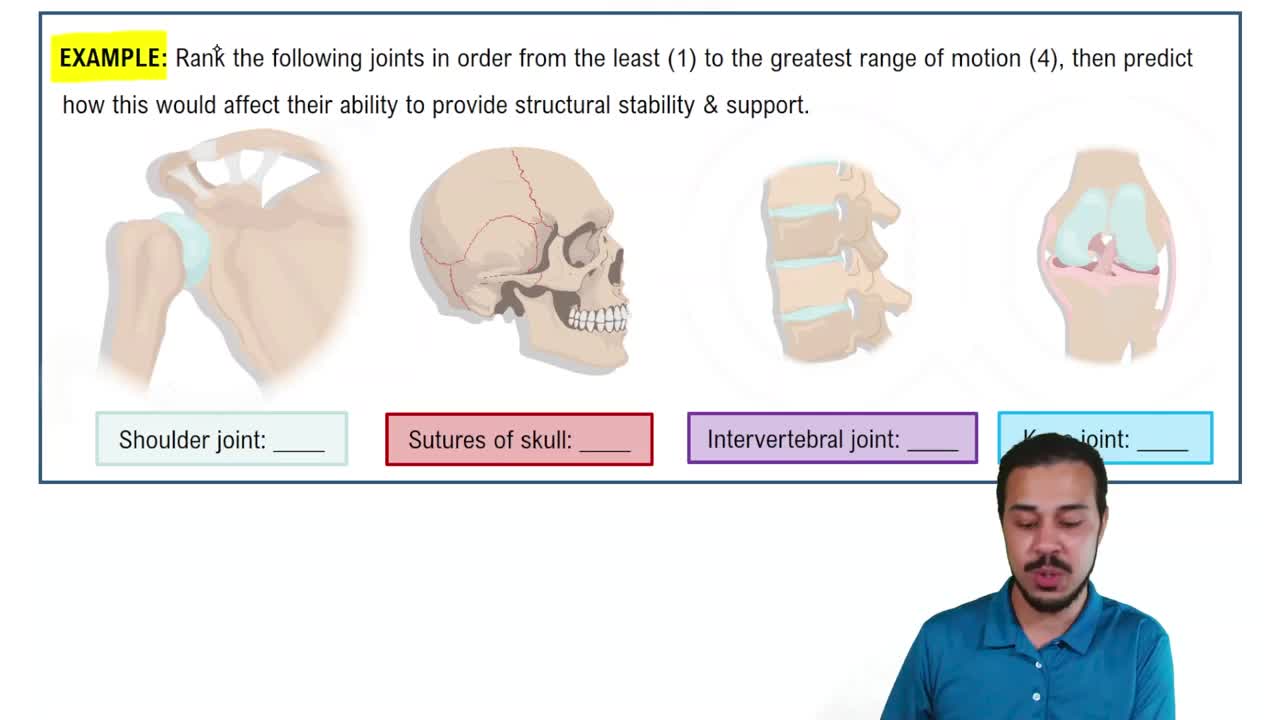
Introduction to Joints Example 1
12013
views
270
rank
VideoThumbView.guidedCourse
05:29
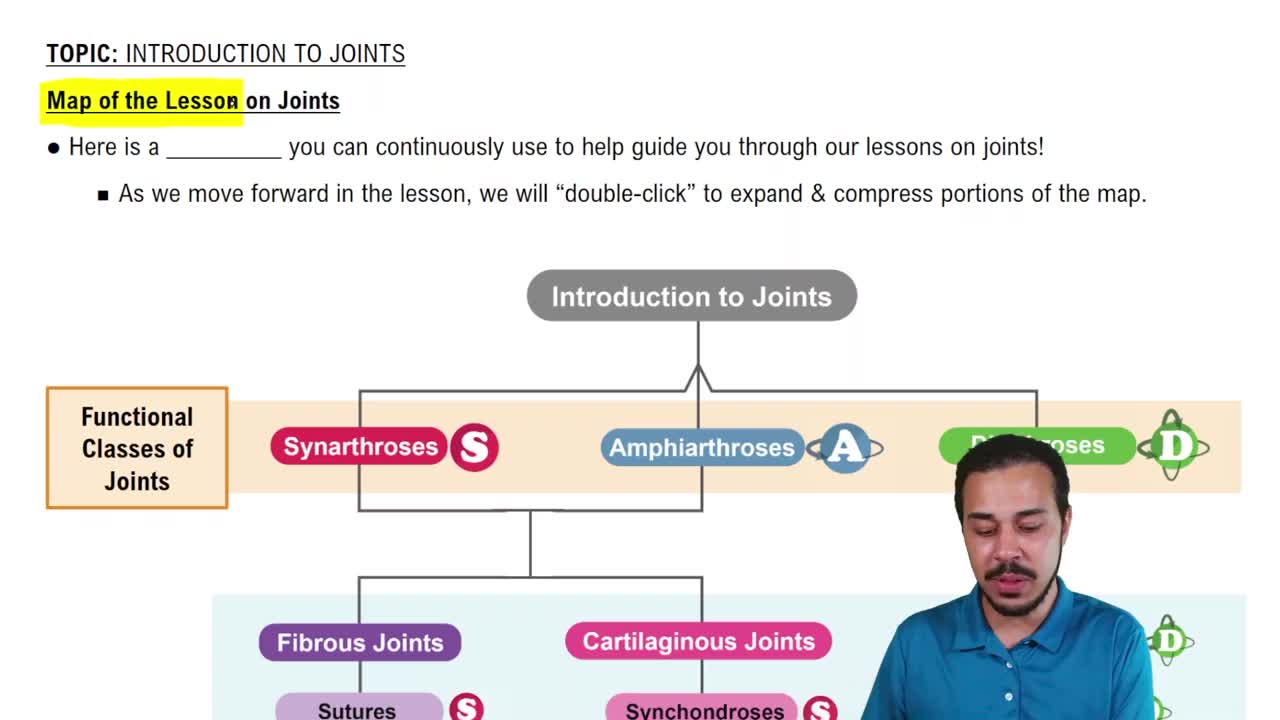
Map of the Lesson on Joints
12548
views
265
rank
1
comments
VideoThumbView.guidedCourse
05:39
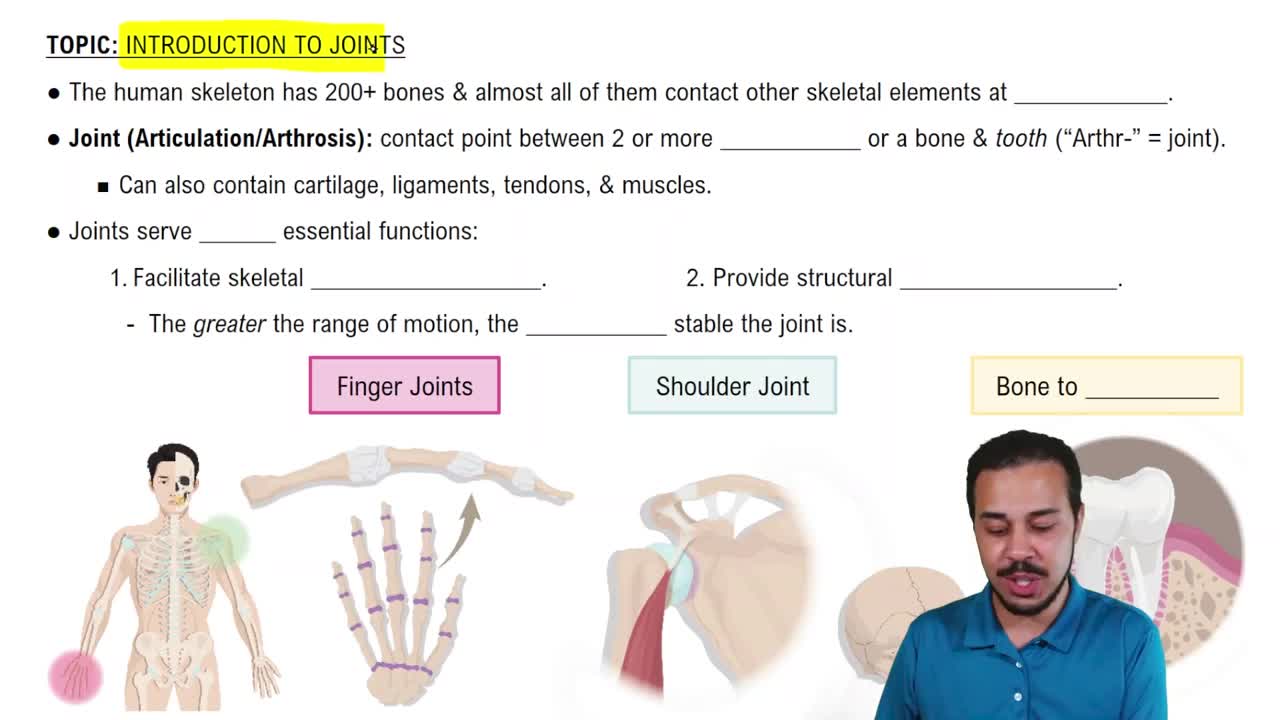
Introduction to Joints
16826
views
434
rank
Termini in questo insieme (25)
Nascondere definizioni
What are the two main classification schemes for joints?
Structural (fibrous, cartilaginous, bony, synovial) and functional (synarthrosis, amphiarthrosis, diarthrosis).
Define synarthrosis and give examples.
An immovable joint; examples include sutures, gomphosis, synchondrosis, and synostosis.
What is a gomphosis joint?
A fibrous joint that binds teeth to bony sockets via the periodontal ligament.
Describe amphiarthrosis joints and their types.
Slightly movable joints stronger than diarthrosis; types include syndesmosis (ligament connection) and symphysis (fibrocartilage connection).
What are synovial joints and their key features?
Freely movable joints with a joint capsule, synovial membrane, synovial fluid, and articular cartilage covering bone surfaces.
List the primary functions of synovial fluid.
Lubrication, nutrient distribution, and shock absorption.
Name accessory structures that stabilize synovial joints.
Cartilages (menisci), fat pads, ligaments, tendons, and bursae.
What is the function of menisci in synovial joints?
Fibrocartilage pads that improve fit between bones and stabilize the joint.
Define gliding movement with an example.
Sliding of flat bone surfaces past each other; example: between carpal bones.
Explain flexion and extension movements.
Flexion decreases the angle between bones; extension increases the angle.
What is circumduction?
A circular movement combining flexion, extension, abduction, and adduction without rotation.
Describe rotational movements and their types.
Rotation is turning around a longitudinal axis; types include medial (internal) and lateral (external) rotation.
What are pronation and supination?
Pronation rotates the forearm so the palm faces posteriorly; supination turns the palm anteriorly.
Define inversion and eversion of the foot.
Inversion twists the sole medially; eversion twists the sole laterally.
What is opposition in hand movements?
Movement of the thumb toward the palm or other fingers.
List the six types of synovial joints.
Plane, hinge, condylar, saddle, pivot, and ball-and-socket joints.
Describe the structure and function of intervertebral discs.
Discs separate vertebral bodies; anulus fibrosus is tough outer fibrocartilage, nucleus pulposus is elastic core absorbing shocks.
What causes a herniated disc?
Nucleus pulposus breaks through the anulus fibrosus, compressing spinal nerves.
Name the major ligaments stabilizing the knee joint.
Patellar ligament, popliteal ligaments, anterior and posterior cruciate ligaments, tibial and fibular collateral ligaments.
What is the glenoid labrum in the shoulder joint?
A rim of fibrocartilage that deepens the glenoid cavity and stabilizes the shoulder joint.
List the muscles of the rotator cuff.
Supraspinatus, infraspinatus, teres minor, and subscapularis.
What ligaments support the hip joint?
Iliofemoral, pubofemoral, ischiofemoral, transverse acetabular, and ligament of the femoral head.
What are common age-related joint problems?
Osteoarthritis (wear and tear), rheumatoid arthritis (autoimmune), and gouty arthritis (uric acid crystals).
How does joint immobilization affect joints?
Reduces synovial fluid flow, causing stiffness and symptoms similar to arthritis.
How do other body systems interact with the skeletal system?
Muscles attach to bones; endocrine system controls bone growth; digestive and urinary systems supply minerals.
 IndietroIndietro
 04:06