Skip to main content
Anatomy & Physiology
Il mio corso
Impara
Preparazione agli esami
AI Tutor
Guide di studio
Soluzioni per libri di testo
Flashcard
Esplora
Prova l'app
Il mio corso
Impara
Preparazione agli esami
AI Tutor
Guide di studio
Soluzioni per libri di testo
Flashcard
Esplora
Prova l'app
Indietro
Anatomy & Physiology: Joints and Movements
Puoi toccare per girare la carta.
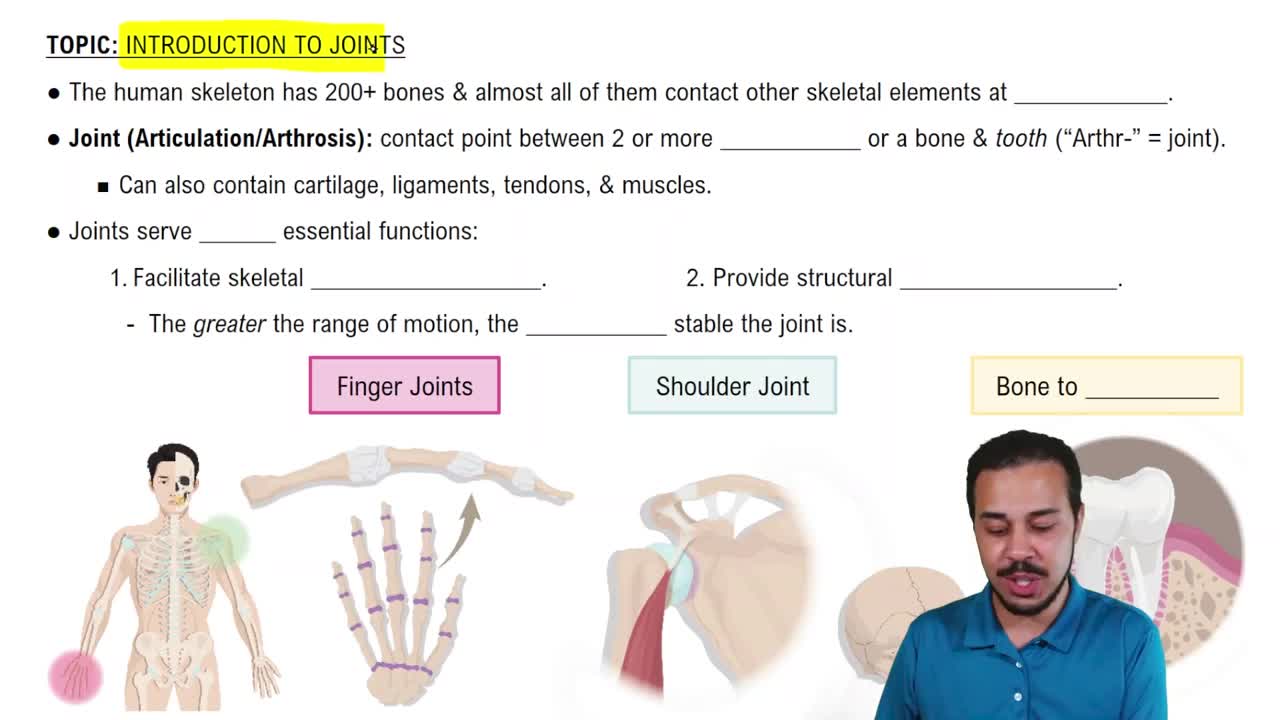
What is a joint (articulation)?
Puoi toccare per girare la carta.
👆
What is a joint (articulation)?
A joint is any place where adjacent bones or bone and cartilage come together to form a connection, allowing varying degrees of movement or stability.
Avanzamenti del tracciato
I pulsanti di controllo sono stati cambiati in modalità "navigazione".
1/29
Video consigliati
VideoThumbView.guidedCourse
04:06
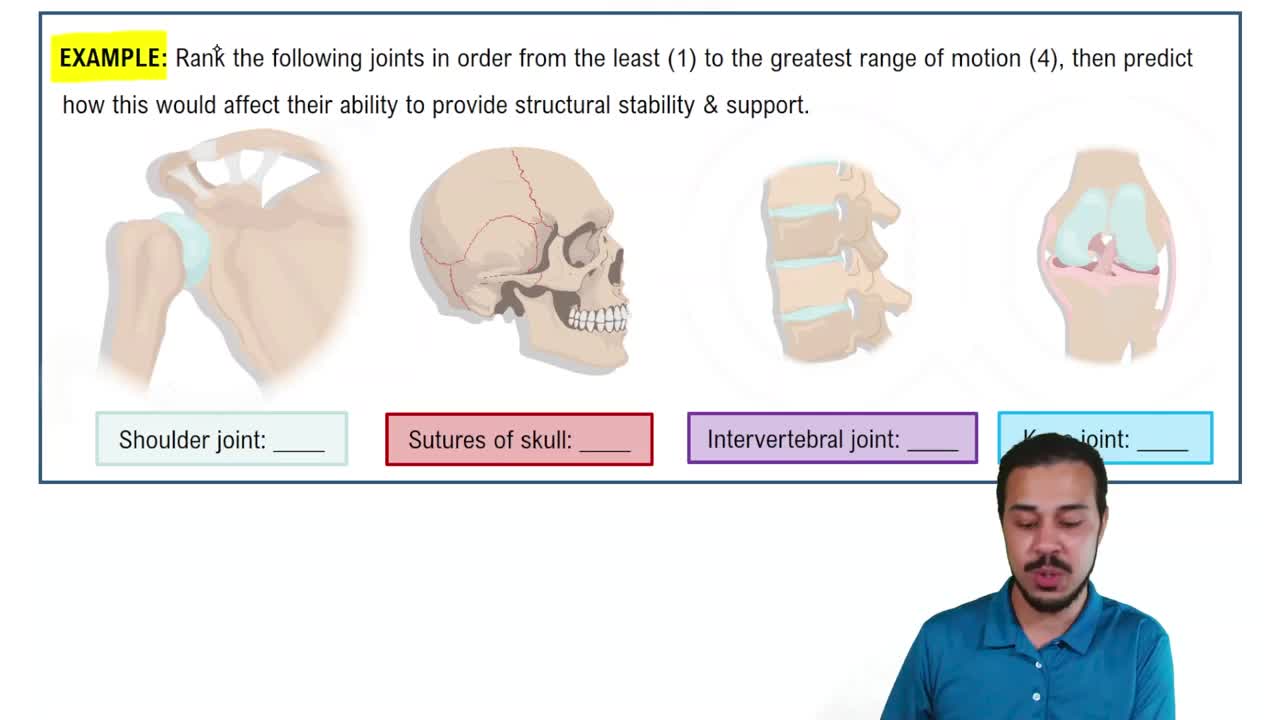
Introduction to Joints Example 1
12067
views
270
rank
VideoThumbView.guidedCourse
05:29
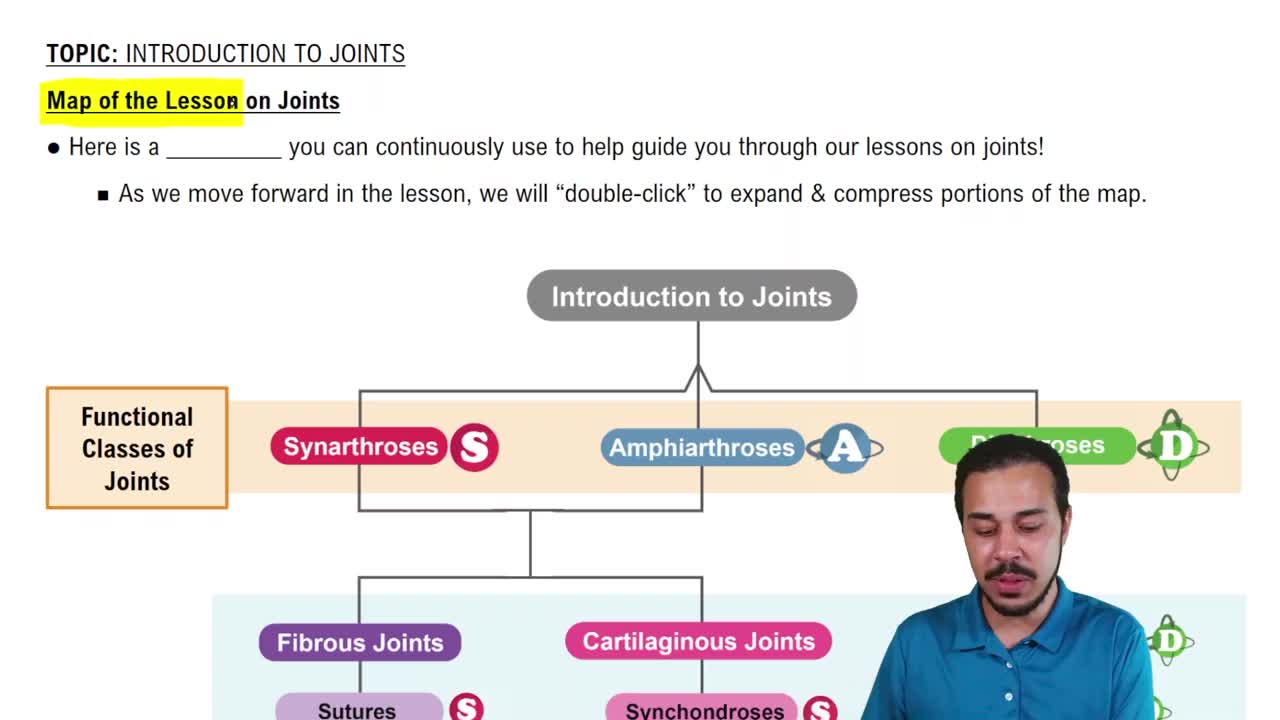
Map of the Lesson on Joints
12595
views
266
rank
1
comments
VideoThumbView.guidedCourse
05:39
Introduction to Joints
16898
views
434
rank
Termini in questo insieme (29)
Nascondere definizioni
What is a joint (articulation)?
A joint is any place where adjacent bones or bone and cartilage come together to form a connection, allowing varying degrees of movement or stability.
Functional classification of joints
Joints are classified by mobility as synarthrosis (immobile), amphiarthrosis (slightly movable), and diarthrosis (freely movable).
Structural classification of joints
Based on the material connecting bones: fibrous joints, cartilaginous joints, and synovial joints.
Characteristics of fibrous joints
Bones connected by fibrous connective tissue, no joint cavity, mostly immovable. Types: sutures, syndesmoses, gomphoses.
Characteristics of cartilaginous joints
Bones united by cartilage, no joint cavity, limited movement. Types: synchondroses (hyaline cartilage), symphyses (fibrocartilage).
Characteristics of synovial joints
Bones separated by a fluid-filled joint cavity, all diarthrotic (freely movable), include bursae and tendon sheaths.
What forms the walls of the synovial joint cavity?
The articular capsule, a fibrous connective tissue structure attached to bones outside their articulating surfaces.
Function of synovial fluid
Lubricates the joint to reduce friction and provides nourishment to avascular articular cartilage.
Difference between extrinsic and intracapsular ligaments
Extrinsic ligaments are outside the articular capsule; intracapsular ligaments are inside the capsule.
What are bursae and tendon sheaths?
Bursae are fluid-filled sacs reducing friction near joints; tendon sheaths surround tendons crossing joints to facilitate smooth movement.
Types of synovial joints
Pivot, hinge, saddle, plane, condylar, and ball-and-socket joints.
Example and movement of pivot joint
Between first and second cervical vertebrae; allows rotation around an axis.
Example and movement of hinge joint
Elbow joint; allows flexion and extension like a door hinge.
Example and movement of saddle joint
Carpometacarpal joint of the thumb; allows biaxial movement including opposition.
Example and movement of plane joint
Tarsal bones of the foot; allows limited gliding movements.
Example and movement of condylar joint
Radiocarpal joint of the wrist; allows biaxial movement including flexion, extension, abduction, and adduction.
Example and movement of ball-and-socket joint
Hip and shoulder joints; allow multiaxial movement including rotation, flexion, extension, abduction, and adduction.
Define origin and insertion in muscle attachment
Origin is the attachment to an immovable bone; insertion is the attachment to a movable bone.
Flexion vs. extension
Flexion decreases the angle between bones; extension increases the angle. Both occur in the sagittal plane.
Abduction vs. adduction
Abduction moves a limb away from the midline; adduction moves it toward the midline, occurring in the coronal plane.
What is circumduction?
A circular movement where one end of a limb remains stationary while the other describes a circle.
Medial vs. lateral rotation
Medial rotation turns the anterior surface toward the midline; lateral rotation turns it away from the midline.
Supination and pronation of the forearm
Supination: palm faces anteriorly with radius and ulna parallel; pronation: palm faces posteriorly with radius crossing ulna.
Dorsiflexion and plantar flexion
Dorsiflexion lifts the foot upward toward the shin; plantar flexion points the toes downward.
Inversion and eversion of the foot
Inversion turns the sole medially; eversion turns the sole laterally.
Protraction and retraction
Protraction moves a body part forward; retraction moves it backward, e.g., mandible or scapula.
Depression and elevation
Depression moves a body part downward; elevation moves it upward, e.g., mandible or scapula.
Opposition and reposition of the thumb
Opposition brings the thumb tip to another finger tip; reposition returns the thumb to anatomical position.
What is the 'terrible triad' knee injury?
Injury involving the tibial collateral ligament, medial meniscus, and anterior cruciate ligament, often from a lateral blow.
 IndietroIndietro
 04:06