Skip to main content
Anatomy & Physiology
Il mio corso
Impara
Preparazione agli esami
AI Tutor
Guide di studio
Soluzioni per libri di testo
Flashcard
Esplora
Prova l'app
Il mio corso
Impara
Preparazione agli esami
AI Tutor
Guide di studio
Soluzioni per libri di testo
Flashcard
Esplora
Prova l'app
Indietro
Anatomy & Physiology: Joints and Synovial Movements
Puoi toccare per girare la carta.
What are the three structural classes of joints?
Puoi toccare per girare la carta.
👆
What are the three structural classes of joints?
Fibrous
,
cartilaginous
, and
synovial
joints.
Avanzamenti del tracciato
I pulsanti di controllo sono stati cambiati in modalità "navigazione".
1/28
Video consigliati
VideoThumbView.guidedCourse
04:06
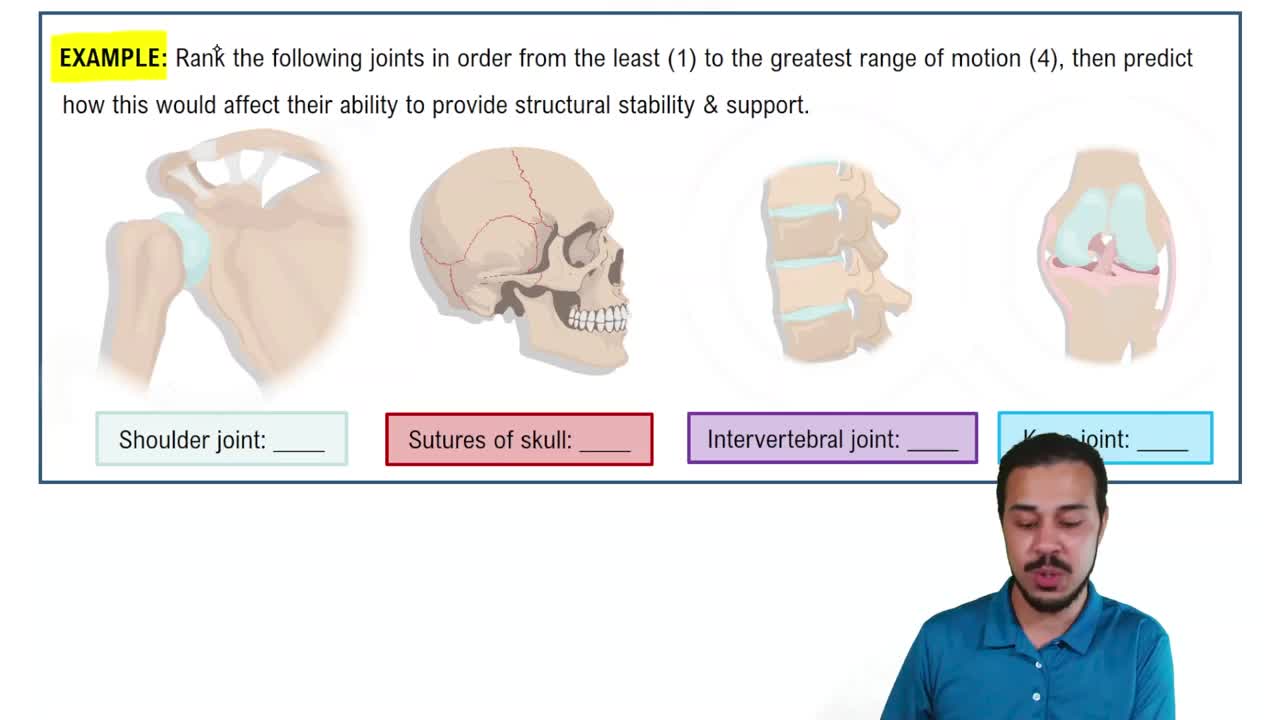
Introduction to Joints Example 1
11704
views
265
rank
VideoThumbView.guidedCourse
05:29
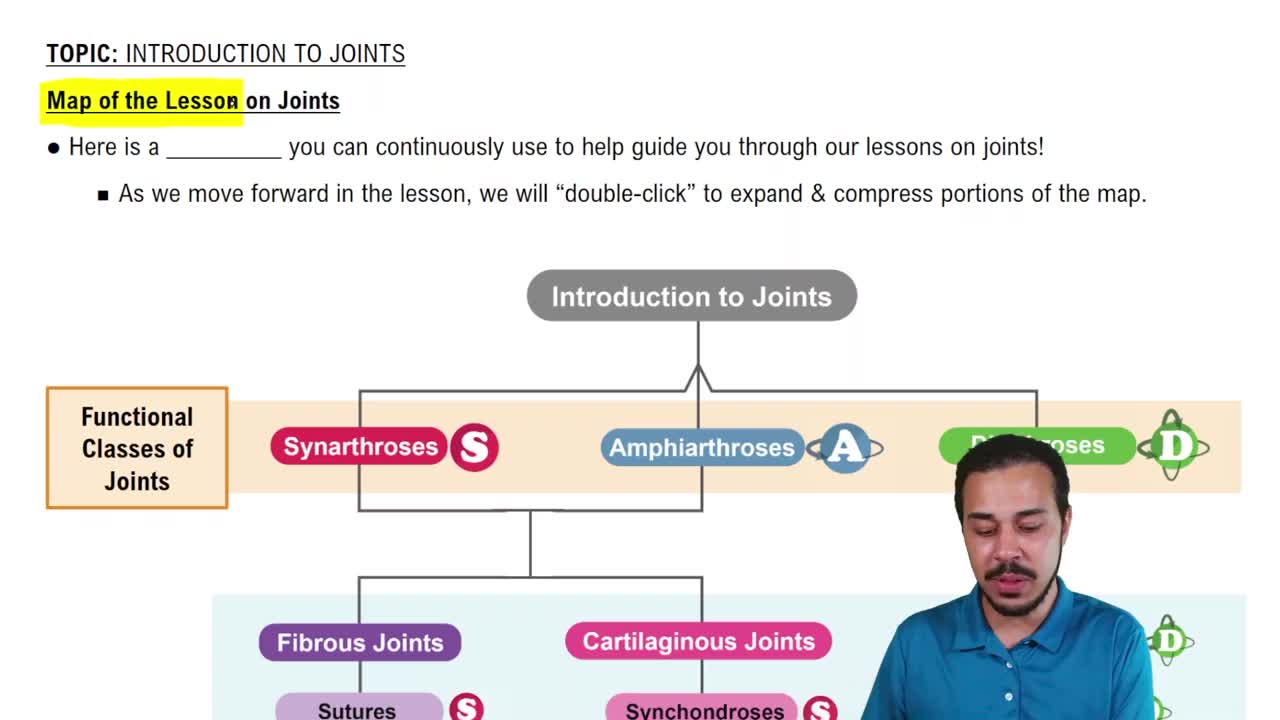
Map of the Lesson on Joints
12235
views
259
rank
1
comments
VideoThumbView.guidedCourse
05:39
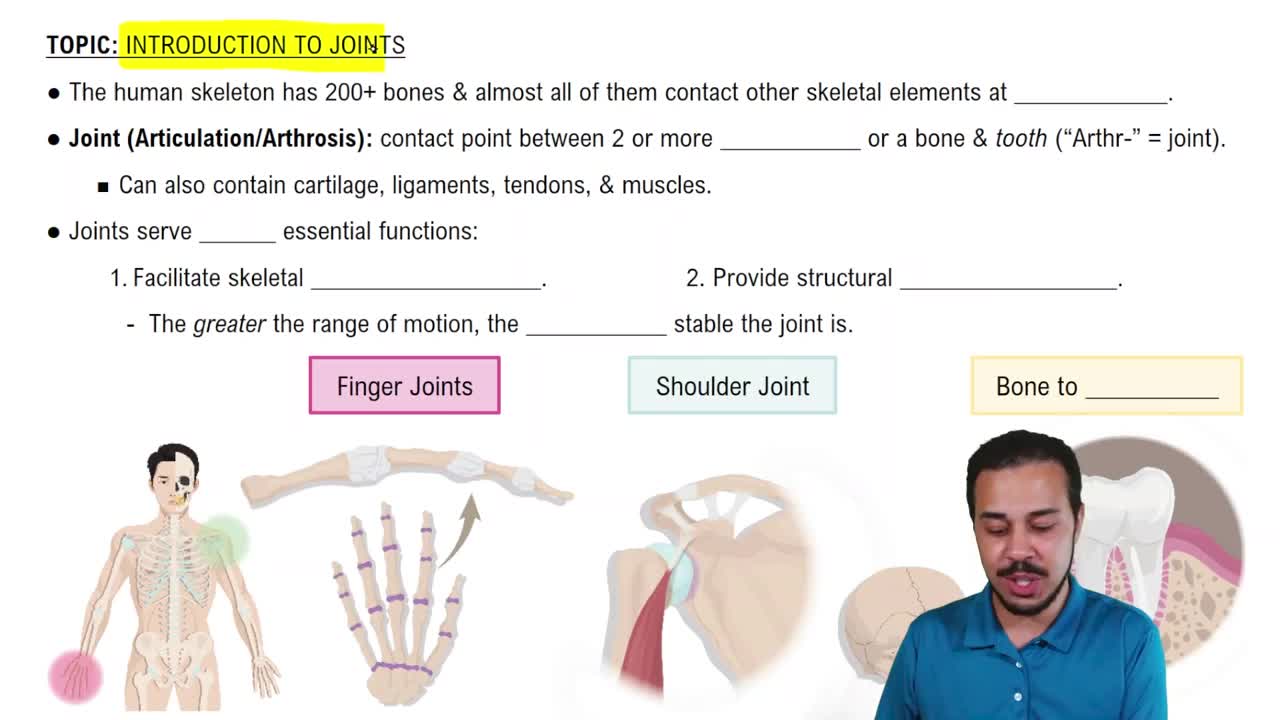
Introduction to Joints
16434
views
422
rank
Termini in questo insieme (28)
Nascondere definizioni
What are the three structural classes of joints?
Fibrous
,
cartilaginous
, and
synovial
joints.
What distinguishes synovial joints structurally?
Synovial joints have a
joint cavity
filled with synovial fluid.
What are the three functional classifications of joints based on movement?
Synarthroses
(immovable),
amphiarthroses
(slightly movable), and
diarthroses
(freely movable).
What type of joint is a suture and where is it found?
A
suture
is a fibrous joint found only between skull bones, immovable and tightly knit.
What is a syndesmosis joint?
A fibrous joint where bones are connected by ligaments; movement depends on ligament length.
What is a gomphosis?
A peg-in-socket fibrous joint; example is a tooth in its alveolar socket connected by the periodontal ligament.
What unites bones in cartilaginous joints?
Bones are united by
cartilage
, either hyaline or fibrocartilage, without a joint cavity.
What are the two types of cartilaginous joints?
Synchondroses
(hyaline cartilage, immovable) and
symphyses
(fibrocartilage, slightly movable).
What is a synchondrosis? Give an example.
A joint united by hyaline cartilage, usually immovable; example: epiphyseal plate in children.
What is a symphysis? Give an example.
A joint united by fibrocartilage allowing limited movement; examples include intervertebral discs and pubic symphysis.
Name the six distinguishing features of synovial joints.
Articular cartilage, joint cavity, articular capsule, synovial fluid, reinforcing ligaments, and sometimes bursae or tendon sheaths.
What is the function of synovial fluid?
Lubricates joint surfaces, nourishes cartilage, reduces friction, and contains phagocytic cells to clean debris.
What factors influence the stability of synovial joints?
Shape of articular surfaces, number and positioning of ligaments, and muscle tone.
What is muscle tone and its role in joint stability?
Low-level muscle contraction that keeps tendons taut, reinforcing and stabilizing joints.
Define gliding movement at synovial joints.
Sliding of flat bone surfaces back-and-forth or side-to-side without angular or rotational movement.
What is flexion?
A movement that decreases the angle between two bones, usually in the sagittal plane.
What is extension?
A movement that increases the angle between two bones, usually in the sagittal plane.
What is abduction?
Movement of a limb away from the body's midline along the frontal plane.
What is adduction?
Movement of a limb toward the body's midline along the frontal plane.
Describe circumduction.
Moving a limb so its distal end traces a cone in space, combining flexion, abduction, extension, and adduction.
What is rotation in joint movement?
Turning a bone around its own longitudinal axis.
What is the difference between medial and lateral rotation?
Medial rotation turns a bone toward the median plane; lateral rotation turns it away.
Define supination and pronation of the forearm.
Supination rotates the forearm laterally so the palm faces anteriorly; pronation rotates it medially so the palm faces posteriorly.
What are dorsiflexion and plantar flexion?
Dorsiflexion lifts the foot upward toward the shin; plantar flexion points the foot downward.
What are inversion and eversion of the foot?
Inversion turns the sole medially; eversion turns the sole laterally.
What are protraction and retraction?
Nonangular anterior (protraction) and posterior (retraction) movements in a transverse plane, e.g., jaw movements.
What is opposition in hand movement?
Movement of the thumb to touch the tips of other fingers, enabling grasping and manipulation.
Name the six major types of synovial joints based on shape.
Plane, hinge, pivot, condylar (ellipsoid), saddle, and ball-and-socket joints.
 IndietroIndietro
 04:06