 Indietro
Anatomy & Physiology: Membrane Dynamics and Cell Communication
 01:59

Termini in questo insieme (28)
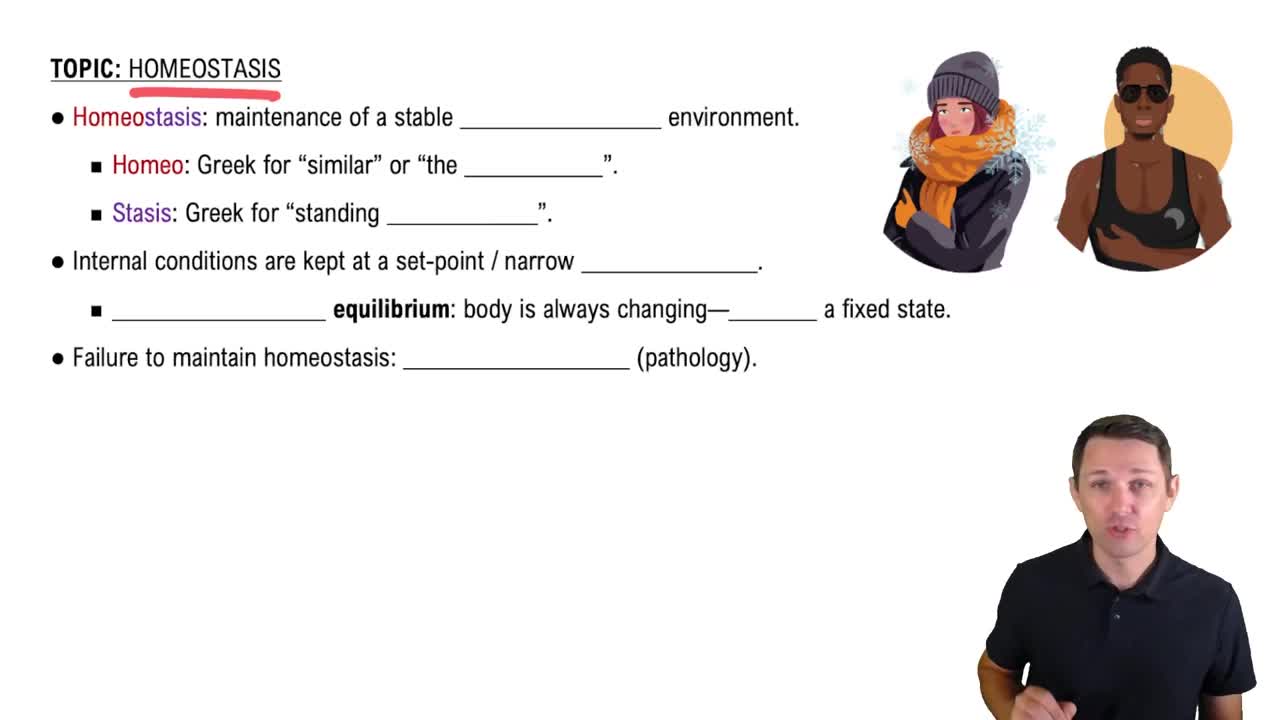
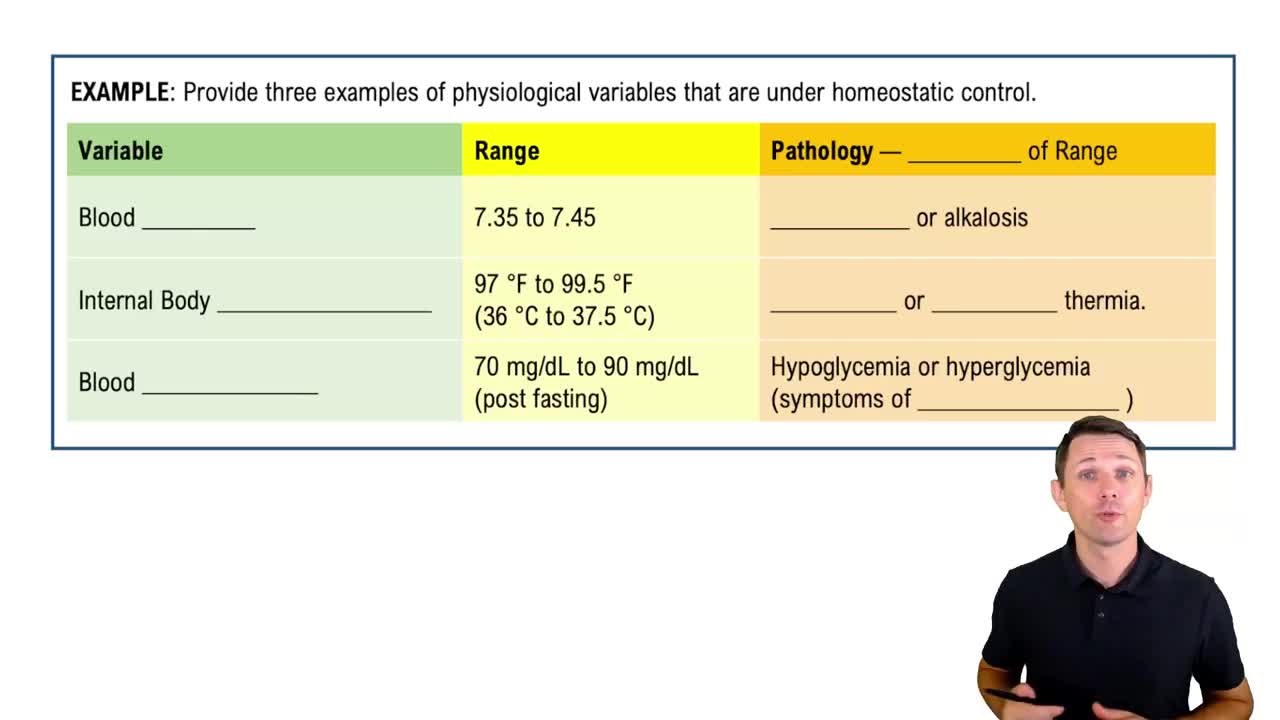
Homeostasis is the maintenance of a stable internal environment. Equilibrium is a state where there is no net change, often implying balance in chemical or electrical gradients.
Two main types: Intracellular fluid (ICF) and Extracellular fluid (ECF). ECF is divided into plasma and interstitial fluid.
Osmotic equilibrium: equal water concentration across compartments.
Chemical disequilibrium: different solute concentrations.
Electrical disequilibrium: unequal charge distribution across membranes.
The body is overall electrically neutral because positive and negative charges balance out globally, but local differences across membranes create electrical disequilibrium.
Osmosis is the movement of water across a semipermeable membrane from low to high solute concentration.
Osmotic pressure is the pressure required to stop osmosis.
Molarity measures moles of solute per liter of solution.
Osmolarity measures total solute particles per liter, more relevant for physiological effects.
Tonicity describes a solution's effect on cell volume.
Isotonic: no volume change.
Hypertonic: cell shrinks.
Hypotonic: cell swells.
Bulk flow is the movement of fluid driven by pressure gradients, e.g., blood flow in vessels or air flow in lungs.
Cell membranes allow some molecules to pass while restricting others, based on size, charge, and lipid solubility.
Lipophilic molecules dissolve in lipids and cross membranes easily (e.g., O2).
Lipophobic molecules do not dissolve in lipids and require transport proteins (e.g., ions).
Active transport requires energy to move molecules against gradients.
Passive transport moves molecules down gradients without energy.
Diffusion is movement of molecules from high to low concentration.
Rate affected by temperature, surface area, membrane thickness, molecule size, and concentration gradient.
Simple diffusion is direct passage through membrane.
Facilitated diffusion uses transport proteins to move molecules down gradients.
Channels, carriers, receptors, and enzymes.
Channels allow rapid passage of ions.
Carriers bind and change shape to transport molecules, slower than channels.
Voltage-gated, ligand-gated, and mechanically gated channels open or close in response to stimuli.
Uniport (one molecule), symport (two molecules same direction), antiport (two molecules opposite directions).
Primary active transport uses ATP directly.
Secondary active transport uses energy from ion gradients created by primary transport.
Specificity (bind specific molecules), competition (molecules compete for binding), saturation (limited transport rate).
Endocytosis, exocytosis, and transcytosis; all move large molecules or particles via vesicles.
Apical side faces lumen.
Basolateral side faces basement membrane and blood supply.
Absorption moves substances into the body.
Secretion moves substances out.
Transcellular transport crosses cells.
Paracellular transport passes between cells.
Tight junctions seal spaces between epithelial cells to prevent paracellular movement.
Electrical signals (e.g., nerve impulses) and chemical signals (e.g., hormones).
Local signaling (short distance, e.g., paracrine) and long-distance signaling (e.g., endocrine).
Gap junctions, contact-dependent signals, paracrine/autocrine signaling, and long-distance electrical/chemical signaling.
Neurotransmitters act quickly at synapses.
Neuromodulators modulate neuron activity.
Neurohormones travel in blood for longer-lasting effects.
Involve first messenger, receptor, second messenger cascade, protein targets, and cellular responses.