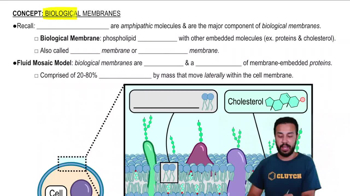
What is the basic structure of the plasma membrane according to the fluid mosaic model?
A phospholipid bilayer with hydrophilic heads facing outward and hydrophobic tails inward, embedded with integral and peripheral proteins, cholesterol, glycocalyx, and anchored by the cytoskeleton.
What are integral membrane proteins and their functions?
Proteins that span the plasma membrane with hydrophilic and hydrophobic regions; they function as channels, carriers, enzymes, receptors, and in cell adhesion.
What is the glycocalyx and its role?
A carbohydrate-rich 'sugar coating' on the outer plasma membrane surface that helps cells recognize each other and changes in cancer cells.
Name the three types of plasma membrane junctions and their functions.
Tight junctions prevent molecule passage between cells; desmosomes anchor cells to resist mechanical stress; gap junctions allow cytoplasmic molecule passage for communication.
What is diffusion and what factors influence its rate?
The movement of molecules from high to low concentration; influenced by concentration gradient slope, molecule size, and temperature.
What types of molecules can pass by simple diffusion through the plasma membrane?
Nonpolar, lipid-soluble molecules like O2, CO2, fats, urea, and alcohol.
Describe facilitated diffusion.
Passive transport of water-soluble molecules via specific carrier proteins or channels without ATP, moving down their concentration gradient.
What is osmosis and its importance in cells?
Unassisted diffusion of water across a semipermeable membrane from high to low water concentration, crucial for fluid homeostasis.
Define osmolarity and tonicity and how they differ.
Osmolarity is total solute particle concentration; tonicity is a solution's effect on cell shape by altering water content, depending on nonpenetrating solutes.
What happens to red blood cells in isotonic, hypertonic, and hypotonic solutions?
Isotonic: no change; hypertonic: cells shrink (crenate); hypotonic: cells swell and may lyse (burst).
Why does active transport require ATP?
Because substances are either too large, lipid-insoluble, or moving against their concentration gradients.
Describe the Na+/K+ ATPase pump and its function.
An antiport pump that moves 3 Na+ ions out and 2 K+ ions into the cell against their gradients, maintaining essential ion concentrations and cell responsiveness.
What is the difference between primary and secondary active transport?
Primary uses ATP directly (e.g., Na+/K+ pump); secondary uses energy from ion gradients created by primary transport to move other substances.
What are exocytosis and endocytosis?
Exocytosis is vesicle fusion with the plasma membrane to release substances outside the cell; endocytosis is vesicle formation to bring substances into the cell.
Name and describe three types of endocytosis.
Phagocytosis: engulfing large particles; pinocytosis: uptake of fluid and dissolved substances; receptor-mediated endocytosis: selective uptake of specific molecules.
What are the three functional regions of a neuron?
Receptive region (dendrites), conducting region (axon), and secretory region (axon terminals).
What is the role of dendrites in neurons?
Short, branched extensions that receive signals and conduct graded potentials toward the cell body.
Describe the axon and its importance.
A long process arising from the axon hillock that conducts action potentials away from the cell body; conduction speed increases with diameter.
What is retrograde and anterograde transport in axons?
Anterograde moves organelles and neurotransmitters from cell body to axon terminals; retrograde moves materials back for degradation or recycling.
How do viruses like rabies reach neuron cell bodies?
By retrograde transport along the axon from the site of infection to the neuron cell body.
 Indietro
 02:21