Skip to main content
Anatomy & Physiology
Il mio corso
Impara
Preparazione agli esami
AI Tutor
Guide di studio
Soluzioni per libri di testo
Flashcard
Esplora
Prova l'app
Il mio corso
Impara
Preparazione agli esami
AI Tutor
Guide di studio
Soluzioni per libri di testo
Flashcard
Esplora
Prova l'app
Indietro
Anatomy & Physiology: Muscle Structure and Function
Puoi toccare per girare la carta.
Endomysium
Puoi toccare per girare la carta.
👆
Endomysium
A thin layer of connective tissue that surrounds each individual muscle fiber.
Avanzamenti del tracciato
I pulsanti di controllo sono stati cambiati in modalità "navigazione".
1/26
Video consigliati
VideoThumbView.guidedCourse
6:31
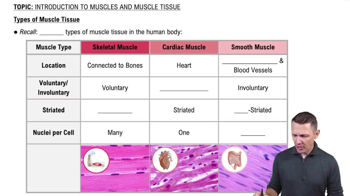
Types of Muscle Tissue
18772
views
494
rank
1
comments
VideoThumbView.guidedCourse
2:00
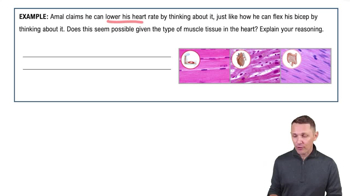
Introduction to Muscles and Muscle Tissue Example 1
16705
views
325
rank
VideoThumbView.guidedCourse
4:36
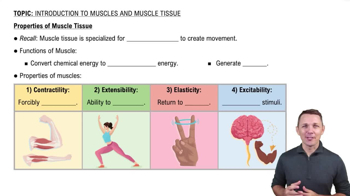
Properties of Muscle Tissue
25692
views
743
rank
2
comments
Termini in questo insieme (26)
Nascondere definizioni
Endomysium
A thin layer of connective tissue that surrounds each individual muscle fiber.
Sarcolemma
The plasma membrane of a muscle cell that encloses the muscle fiber.
Sarcomere
The basic contractile unit of a muscle fiber, defined by the area between two Z discs.
Myofibril
A long, cylindrical organelle within muscle fibers composed of repeating sarcomeres.
Z disc
The boundary structure that defines the ends of a sarcomere and anchors actin filaments.
Myosin
The thick filament protein responsible for muscle contraction by forming cross-bridges with actin.
Actin
The thin filament protein that interacts with myosin during muscle contraction.
Tropomyosin
A regulatory protein that blocks myosin-binding sites on actin filaments when the muscle is relaxed.
Troponin
A regulatory protein complex that binds calcium to initiate muscle contraction by moving tropomyosin.
Temporalis muscle
A muscle of the head involved in elevating and retracting the mandible for chewing.
Masseter muscle
A powerful muscle of mastication that elevates the mandible to close the jaw.
Sternocleidomastoid
A neck muscle that flexes and rotates the head.
Pectoralis major
A large chest muscle that adducts and medially rotates the arm.
Rectus abdominis
A paired muscle running vertically on the anterior abdominal wall, responsible for trunk flexion.
Deltoid muscle
The shoulder muscle responsible for arm abduction.
Biceps brachii
A muscle of the arm that flexes the elbow and supinates the forearm.
Gluteus maximus
The largest muscle of the buttocks, responsible for hip extension and external rotation.
Rectus femoris
A quadriceps muscle that extends the knee and flexes the hip.
Tibialis anterior
A muscle of the anterior lower leg that dorsiflexes and inverts the foot.
Calcaneal tendon
Also called the Achilles tendon; connects the calf muscles to the heel bone.
Muscle contraction initiation
Begins with an action potential triggering acetylcholine release at the neuromuscular junction.
Cross-bridge cycle
The process where myosin heads bind to actin, perform a power stroke, and release to shorten the muscle.
Acetylcholine clearance
The breakdown of acetylcholine by acetylcholinesterase to end muscle contraction.
Origin vs insertion
Origin is the fixed attachment of a muscle; insertion is the movable attachment.
Push vs pull in muscles
Skeletal muscles can only pull on bones to create movement; they cannot push.
Directional vocabulary in anatomy
Terms like medial, lateral, proximal, distal describe locations and directions in the body.
 IndietroIndietro
 6:31