 Indietro
Anatomy & Physiology: Muscle Tissue and Contraction
 6:31

Termini in questo insieme (30)
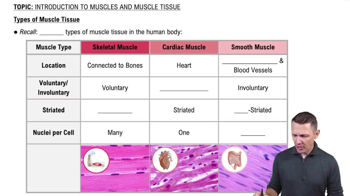
Three types: skeletal (striated, voluntary), cardiac (striated, involuntary), and smooth (nonstriated, involuntary).
Long, striated fibers, voluntary control, responsible for body movement, rapid contraction but tires easily.
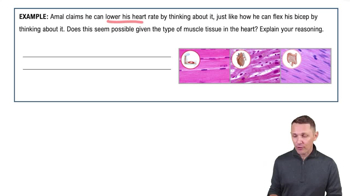
Found only in the heart, striated, involuntary, contracts without nervous stimulation, controlled by pacemaker cells.
Found in walls of hollow organs, nonstriated, involuntary, slow and sustained contractions, controls movement of substances through organs.
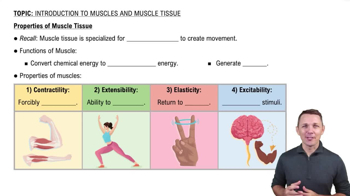
Excitability, contractility, extensibility, and elasticity.
Produce movement, maintain posture, stabilize joints, and generate heat.
Epimysium surrounds whole muscle, perimysium surrounds fascicles, endomysium surrounds individual fibers.
Direct: epimysium fused to bone periosteum; Indirect: connective tissue extends as tendon or aponeurosis attaching muscle to bone or fascia.
Contains glycosomes (glycogen stores) and myoglobin (oxygen-binding pigment).
Myofibrils are rodlike structures made of sarcomeres, the smallest contractile units between Z discs.
Alternating dark A bands and light I bands; A band contains H zone and M line; I band contains Z disc.
Thick filaments contain myosin; thin filaments contain actin, tropomyosin, and troponin.
Regulate contraction by blocking or exposing myosin-binding sites on actin in response to Ca2+.
Elastic filament that stabilizes thick filaments and allows muscle to recoil after stretching.
Axon terminal, synaptic cleft, and junctional folds with ACh receptors on muscle fiber.
Motor neuron releases ACh, which binds receptors causing end plate potential and triggers muscle action potential.
AP travels along sarcolemma and T tubules, triggering Ca2+ release from sarcoplasmic reticulum, initiating contraction.
Thin filaments slide past thick filaments, shortening sarcomeres without changing filament length.
Myosin heads bind actin, pivot, detach using ATP, and reattach to pull thin filaments during contraction.
Latent period (excitation-contraction coupling), contraction period (cross bridge activity), relaxation period (Ca2+ reuptake).
Increased stimulus frequency causes twitches to add, producing stronger contractions and tetanus.
Increasing stimulus strength activates more motor units, increasing contraction force.
Isotonic: muscle changes length; isometric: muscle tension increases without length change.
Direct phosphorylation by creatine phosphate, anaerobic glycolysis, and aerobic respiration.
Glucose broken down to lactic acid without oxygen, producing 2 ATP quickly but inefficiently.
Oxygen-dependent process producing ~32 ATP per glucose, slower but efficient for prolonged activity.
Ionic imbalances, increased inorganic phosphate, decreased ATP, and glycogen depletion impair contraction.
Slow oxidative (endurance), fast oxidative (intermediate), and fast glycolytic (powerful, fatigable).
Spindle-shaped, single nucleus, no striations, no troponin, uses calmodulin, slower contractions, involuntary.
Controlled by neural, hormonal, and local chemical signals; Ca2+ activates myosin via calmodulin and myosin kinase.