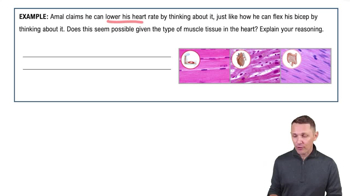
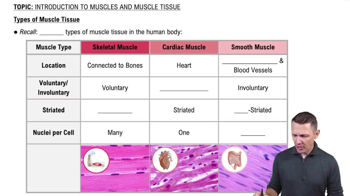
Skeletal muscle: voluntary, striated, multinucleate; Cardiac muscle: involuntary, striated with intercalated discs, uninucleate; Smooth muscle: involuntary, non-striated, uninucleate, found in hollow organs.
Functions of skeletal muscle
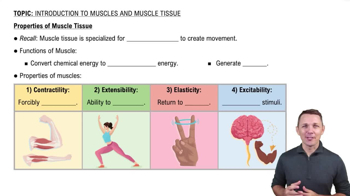
Skeletal muscles enable body movements, maintain posture, support soft tissues, guard entrances/exits, regulate body temperature, and store nutrient reserves.
Muscle fiber membrane is the sarcolemma, cytoplasm is sarcoplasm, and the specialized ER is the sarcoplasmic reticulum.
Myofibrils and myofilaments
Myofibrils run the length of muscle fibers and contain myofilaments: thick myosin and thin actin filaments arranged in sarcomeres.
Sarcomere structure
Sarcomeres are the basic contractile units, defined by Z lines, with A bands (thick filaments), I bands (thin filaments), and the M line in the center.
Origin vs. insertion of muscles
Origin: less movable attachment; Insertion: more movable attachment. Muscle contraction pulls insertion toward origin.
Muscle naming criteria
Muscles are named by location, shape, action, size, number of origins, origin/insertion sites, and fiber direction.
Muscle actions: flexion and extension
Flexion: decreases angle between bones; Extension: increases angle between bones, e.g., straightening the arm at the elbow.
Sliding filament theory
Muscle contraction occurs as actin and myosin filaments slide past each other, shortening the sarcomere without changing filament length.
Neuromuscular junction components
Includes motor neuron axon terminal, synaptic vesicles with acetylcholine (Ach), synaptic cleft, motor end plate with Ach receptors, and sarcolemma.
Events at the neuromuscular junction
AP arrives at axon terminal, triggers Ach release, Ach binds receptors on muscle fiber, ligand-gated channels open, causing muscle AP.
Role of calcium in muscle contraction
Calcium released from sarcoplasmic reticulum binds to troponin, causing tropomyosin to move and expose actin binding sites for myosin.
Muscle contraction vs. relaxation
Contraction is active, requires ATP and calcium; relaxation is passive, requires acetylcholinesterase to break down Ach.
Sources of ATP in muscle fibers
Initial ATP from creatine phosphate; most ATP from aerobic respiration; anaerobic respiration used during oxygen debt but less efficient.
Muscle tone is continuous resting tension; motor unit = motor neuron + muscle fibers it controls; summation and recruitment increase contraction strength.
Twitch vs. tetany
A twitch is a single muscle contraction; tetany is sustained contraction from rapid repeated stimuli.
Muscle atrophy vs. hypertrophy
Atrophy: loss of muscle size due to disuse; Hypertrophy: increase in muscle size from repeated exercise; fiber number remains constant.
Voltage-gated vs. ligand-gated ion channels
Voltage-gated channels open in response to membrane potential changes; ligand-gated channels open when specific molecules bind, e.g., Ach at NMJ.
 Indietro
 6:31