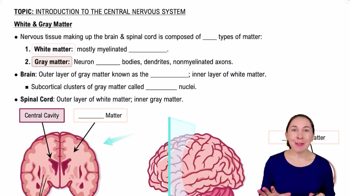
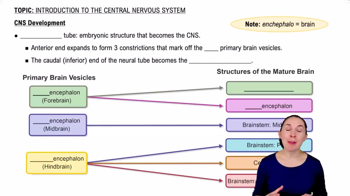
A fissure is a deep groove that separates major regions of the brain, such as the longitudinal fissure separating the right and left cerebral hemispheres.
Difference between gyrus, sulcus, and fissure
Gyrus: raised ridge or fold; Sulcus: shallow groove between gyri; Fissure: deep groove separating major brain regions.
What is a nerve plexus?
A nerve plexus is a network of interwoven spinal nerves that redistribute nerve fibers to different peripheral nerves.
Function of a nerve plexus
A plexus allows nerve fibers from multiple spinal nerves to mix, providing multiple pathways for motor and sensory innervation.
Location of the brachial plexus
The brachial plexus is formed by spinal nerves \(C5–T1\) and supplies the shoulder, arm, forearm, and hand.
Location of the lumbar plexus
The lumbar plexus is formed by spinal nerves \(L1–L4\) and supplies parts of the abdomen, pelvis, and anterior thigh.
Why are plexuses important?
Plexuses allow nerves from different spinal cord levels to combine, providing backup pathways and efficient distribution of nerve fibers.
First step in processing sensory information
A receptor detects a stimulus.
What carries sensory information toward the CNS?
A sensory (afferent) neuron carries information to the central nervous system.
What is the integration center?
The integration center is the CNS (brain or spinal cord) where incoming information is processed and a response is determined.
What carries the response away from the CNS?
A motor (efferent) neuron carries the response to an effector.
What is an effector?
An effector is a muscle or gland that performs the response directed by the nervous system.
Correct order of information processing
Stimulus → Receptor → Sensory (afferent) neuron → Integration center (CNS) → Motor (efferent) neuron → Effector → Response
Difference between myelinated and unmyelinated axons
Myelinated axons have a myelin sheath and conduct impulses faster than unmyelinated axons.
Why do myelinated axons conduct impulses faster?
Impulses jump from one Node of Ranvier to the next in a process called saltatory conduction.
What is saltatory conduction?
Rapid transmission of an action potential by jumping between Nodes of Ranvier.
How does conduction occur in unmyelinated axons?
The action potential travels continuously along the entire membrane, making conduction slower.
Which nerve fibers conduct impulses faster?
Myelinated nerve fibers conduct impulses faster than unmyelinated fibers.
What happens during depolarization?
Voltage-gated sodium (Na⁺) channels open, allowing sodium ions to enter the neuron.
What happens during repolarization?
Voltage-gated potassium (K⁺) channels open, allowing potassium ions to leave the neuron.
Which ion enters the neuron first during an action potential?
Sodium (Na⁺) enters first during depolarization.
Which ion leaves the neuron during repolarization?
Potassium (K⁺) leaves the neuron during repolarization.
Why is sodium important in an action potential?
Sodium entry causes the membrane to become less negative and more positive, producing depolarization.
Why is potassium important in an action potential?
Potassium exit restores the membrane toward its resting potential during repolarization.
What is an afferent pathway?
An afferent pathway carries sensory information toward the central nervous system.
What type of neuron is in the afferent pathway?
A sensory neuron is found in the afferent pathway.
What is an efferent pathway?
An efferent pathway carries motor commands away from the CNS to muscles or glands.
What type of neuron is in the efferent pathway?
A motor neuron is found in the efferent pathway.
How many pairs of cranial nerves are there?
There are twelve pairs of cranial nerves (CN I–XII).
Function of Cranial Nerve I (Olfactory)
Responsible for smell (sensory).
Function of Cranial Nerve II (Optic)
Responsible for vision (sensory).
Function of Cranial Nerve III (Oculomotor)
Controls most eye movements, raises eyelid, and constricts pupil (motor).
 Indietro
 0:50
0:50