Autonomic nerve branches connecting the anterior ramus of a spinal nerve to the sympathetic chain ganglion; white rami carry myelinated preganglionic sympathetic axons (T1-L2), gray rami carry unmyelinated postganglionic axons (all spinal levels).
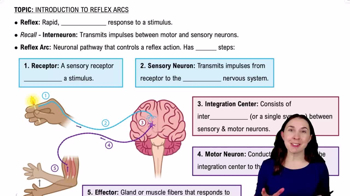
Typical reflex arc pathway
Sensory receptor → sensory (afferent) neuron → integration center in spinal cord gray matter → motor (efferent) neuron → effector organ (muscle or gland).
Location of ascending and descending tracts
Found exclusively in the white matter columns (posterior, anterior, lateral funiculi) of the spinal cord; ascending tracts carry sensory signals to the brain, descending tracts carry motor commands from the brain.
Subarachnoid space
The space between the arachnoid mater and pia mater that contains cerebrospinal fluid (CSF).
Composition of a spinal nerve
A mixed nerve formed by the fusion of the dorsal (sensory) root and ventral (motor) root exiting the intervertebral foramen.
Tendon reflex (Golgi tendon reflex)
A polysynaptic reflex that monitors muscle tension and prevents damage by causing relaxation of the contracting muscle.
Muscle spindles
Specialized stretch receptors within skeletal muscles that detect changes in muscle length and trigger the stretch reflex to maintain posture.
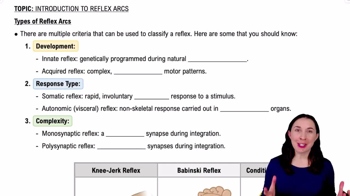
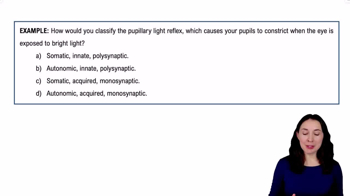
Reflex classification criteria
Classified by development (innate vs. acquired), processing site (spinal vs. cranial), motor response (somatic vs. autonomic), and circuit complexity (monosynaptic vs. polysynaptic).
Originates from cervical spinal segments C3, C4, and C5; innervates the diaphragm to control breathing.
Anterior rami innervation
Innervate the skin and muscles of the ventrolateral body wall and limbs, often forming nerve plexuses.
Denticulate ligaments
Paired extensions of pia mater that anchor the spinal cord laterally to the dura mater, preventing side-to-side movement.
Cervical and lumbar enlargements
Regions of spinal cord with increased gray matter for limb control: cervical for upper limbs, lumbar for lower limbs.
Gray commissure
Crossbar of gray matter surrounding the central canal connecting left and right spinal cord gray matter, containing decussating axons.
Components of white matter
Bundles of myelinated and unmyelinated axons organized into columns and tracts.
Components of gray matter
Neuronal cell bodies, dendrites, unmyelinated axons, neuroglia, and synapses.
Order of meninges from inner to outer
Pia mater → Arachnoid mater → Dura mater.
End of the spinal cord
Terminates at the conus medullaris between lumbar vertebrae L1 and L2.
Monosynaptic vs. polysynaptic reflex
Monosynaptic: single synapse between sensory and motor neuron (e.g., stretch reflex). Polysynaptic: multiple synapses with interneurons (e.g., withdrawal reflex).
Anterior root fibers
Contain motor (efferent) fibers transmitting commands from spinal cord to effectors.
Posterior root fibers
Contain sensory (afferent) fibers carrying signals from receptors to the spinal cord.
Hormone definition
Chemical messengers secreted by endocrine cells into blood to regulate specific physiological activities in distant target cells.
Anterior pituitary hormones
Six main hormones: TSH, ACTH, FSH, LH, GH, and Prolactin.
Posterior pituitary hormones
Antidiuretic Hormone (ADH) and Oxytocin (OXT), produced by hypothalamus and released by posterior pituitary.
Function of Growth Hormone (GH)
Stimulates protein synthesis, cell division, bone and muscle growth, lipolysis, glycogen breakdown, and tissue repair.
Role of antidiuretic hormone (ADH)
Increases kidney water reabsorption, reduces urine volume, conserves body water, and causes vasoconstriction to raise blood pressure.
Insulin and glucagon secretion triggers
Insulin released when blood glucose is high to promote uptake and storage; glucagon released when blood glucose is low to stimulate glucose release.
Cells secreting insulin and glucagon
Beta cells secrete insulin; alpha cells secrete glucagon in the pancreas.
All-or-none principle of action potentials
An action potential fires at full amplitude if threshold is reached; no action potential occurs if stimulus is below threshold.
 Indietro
 0:41