Skip to main content
Anatomy & Physiology
Il mio corso
Impara
Preparazione agli esami
AI Tutor
Guide di studio
Soluzioni per libri di testo
Flashcard
Esplora
Prova l'app
Il mio corso
Impara
Preparazione agli esami
AI Tutor
Guide di studio
Soluzioni per libri di testo
Flashcard
Esplora
Prova l'app
Indietro
Anatomy & Physiology: Nervous System Fundamentals
Puoi toccare per girare la carta.
What are the main parts of a neuron?
Puoi toccare per girare la carta.
👆
What are the main parts of a neuron?
The main parts are the cell body, dendrites, axon, and axon terminals.
Avanzamenti del tracciato
I pulsanti di controllo sono stati cambiati in modalità "navigazione".
1/28
Video consigliati
0:50
Introduction to the Central Nervous System Example 1
13297
views
248
rank
2
comments
2:41
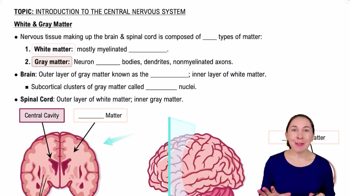
White & Gray Matter
13379
views
245
rank
3:34
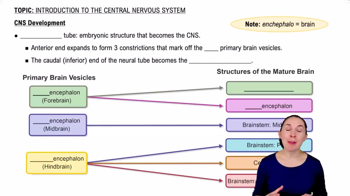
CNS Development
14032
views
279
rank
2
comments
Termini in questo insieme (28)
Nascondere definizioni
What are the main parts of a neuron?
The main parts are the cell body, dendrites, axon, and axon terminals.
What is the function of Schwann cells?
Schwann cells produce myelin in the peripheral nervous system to speed up nerve conduction.
Where are oligodendrocytes located and what is their role?
Oligodendrocytes are in the CNS and produce myelin to insulate axons.
What is the role of astrocytes?
Astrocytes support neurons, maintain the blood-brain barrier, and regulate the extracellular environment in the CNS.
What are ependymal cells responsible for?
Ependymal cells line the ventricles of the brain and produce cerebrospinal fluid.
Do neurons have the capacity to divide?
No, neurons generally do not divide and have a high metabolic rate.
What neurotransmitter is primarily involved in muscle stimulation?
Acetylcholine is the neurotransmitter that stimulates muscle contraction.
What is the difference between a nerve and a tract?
A nerve is a bundle of axons in the peripheral nervous system; a tract is a bundle of axons in the central nervous system.
What is a ganglion versus a nucleus in the nervous system?
A ganglion is a cluster of neuron cell bodies in the PNS; a nucleus is a cluster of neuron cell bodies in the CNS.
What is the function of the cerebellum?
The cerebellum coordinates voluntary movements, balance, and posture.
What distinguishes gray matter from white matter?
Gray matter contains neuron cell bodies; white matter contains myelinated axons.
What are the three layers of the meninges from outermost to innermost?
Dura mater, arachnoid mater, and pia mater.
What is the function of the hypothalamus?
The hypothalamus regulates homeostasis, including temperature, hunger, and hormone release.
What is the difference between a gyrus, sulcus, and fissure?
A gyrus is a ridge, a sulcus is a shallow groove, and a fissure is a deep groove in the brain.
What are the main components of the brainstem?
The midbrain, pons, and medulla oblongata.
What is the role of the pons?
The pons relays signals between the cerebrum and cerebellum and regulates breathing.
How does myelination affect nerve conduction?
Myelination increases conduction speed by allowing saltatory conduction along the axon.
What happens during an action potential at the membrane level?
Sodium channels open causing depolarization, followed by potassium channels opening causing repolarization.
What is the difference between afferent and efferent pathways?
Afferent pathways carry sensory information to the CNS; efferent pathways carry motor commands away from the CNS.
What is the function of proprioceptors?
Proprioceptors detect body position and movement.
What is a nociceptor?
A nociceptor is a sensory receptor that detects pain.
What is the order of events in a simple spinal reflex arc?
Stimulus → sensory neuron → integration center in spinal cord → motor neuron → effector muscle.
Why do we not constantly perceive pressure from clothing on our skin?
Sensory adaptation causes decreased sensitivity to constant stimuli over time.
What is the role of dopamine in the nervous system?
Dopamine regulates mood, reward, and motor control.
Where is speech primarily processed in the brain?
Speech is primarily processed in the frontal and temporal lobes.
What is the function of the midbrain?
The midbrain controls visual and auditory reflexes and motor coordination.
What is the brachial plexus?
A network of nerves that supplies the upper limb.
What distinguishes myelinated from non-myelinated nerve fibers?
Myelinated fibers conduct impulses faster due to saltatory conduction; non-myelinated fibers conduct more slowly.
 IndietroIndietro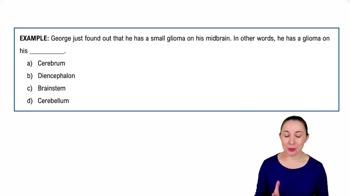
 0:50
0:50