 Indietro
Anatomy & Physiology: Nervous System Key Concepts
 03:50

Termini in questo insieme (26)
Continuous conduction is the propagation of an action potential along an unmyelinated axon, where the impulse moves step-by-step along every part of the membrane.
An effector is a muscle or gland that responds to signals from motor neurons to produce a physiological response.
Ependymal cells are glial cells that line the ventricles of the brain and the central canal of the spinal cord, involved in producing and circulating cerebrospinal fluid.
Ganglia are clusters of neuron cell bodies in the peripheral nervous system, while nuclei are clusters of neuron cell bodies in the central nervous system.
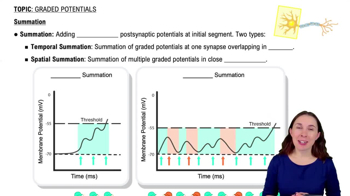
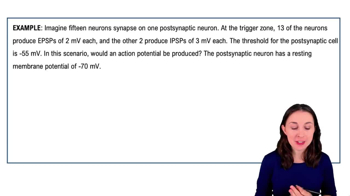
A graded potential is a change in membrane potential that varies in size and is localized, occurring in dendrites and cell bodies in response to stimuli.
The integrating center processes incoming sensory information and determines the appropriate response, often located in the CNS.
An interneuron connects sensory and motor neurons within the CNS and plays a role in processing information.
Microglial cells are immune cells of the CNS that act as phagocytes to remove debris and pathogens.
The motor (efferent) division of the PNS transmits impulses from the CNS to effectors like muscles and glands.
A motor (efferent) neuron carries impulses away from the CNS to effectors to cause a response.
Multipolar neurons have many dendrites and one axon; bipolar neurons have one dendrite and one axon; unipolar neurons have a single process that splits into two branches.
Nerves are bundles of axons in the PNS; tracts are bundles of axons in the CNS.
Neuroglia or glial cells support, protect, and nourish neurons in both the CNS and PNS.
The neurolemma is the outermost layer of Schwann cells that surrounds axons in the PNS and aids in nerve regeneration.
A neuro-glandular junction is the synapse where a neuron communicates with a gland to regulate secretion.
The neuromuscular junction is the synapse between a motor neuron and a skeletal muscle fiber, enabling muscle contraction.
A neuron is a nerve cell that transmits electrical signals; it consists of a cell body, dendrites, and an axon.
A neuro-neuro junction is a synapse between two neurons where neurotransmitters transmit signals.
The PNS includes all nerves and ganglia outside the CNS, connecting the CNS to limbs and organs.
Polarization refers to the difference in electrical charge across the neuron's membrane at rest, typically negative inside and positive outside.
The refractory period is the time after an action potential during which a neuron cannot fire another action potential or requires a stronger stimulus.
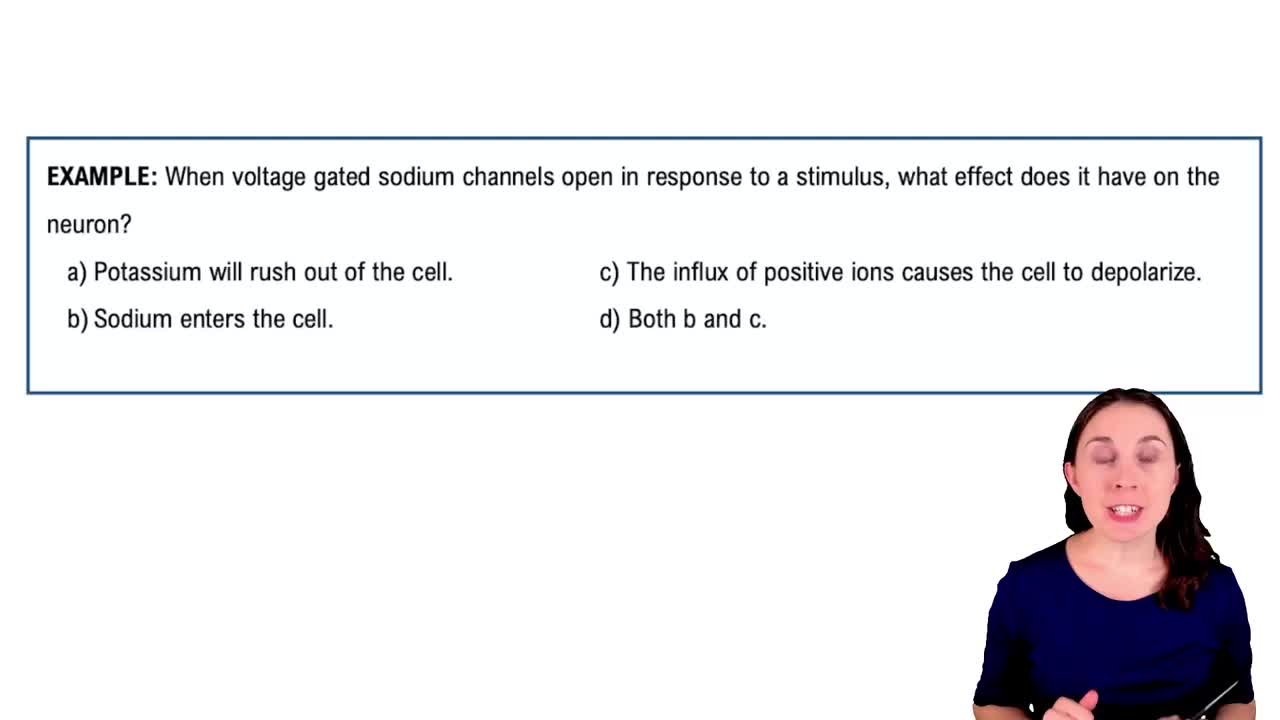
Na+ and K+ ions are essential for generating action potentials by moving across the membrane to change electrical charge.
Satellite cells surround neuron cell bodies in PNS ganglia and regulate the environment around neurons.
The sensory (afferent) division of the PNS transmits sensory information from receptors to the CNS.
A sensory (afferent) neuron carries impulses from sensory receptors toward the CNS.
White matter consists mainly of myelinated axons; gray matter contains neuron cell bodies, dendrites, and unmyelinated axons.