Skip to main content
Anatomy & Physiology
Il mio corso
Impara
Preparazione agli esami
AI Tutor
Guide di studio
Soluzioni per libri di testo
Flashcard
Esplora
Prova l'app
Il mio corso
Impara
Preparazione agli esami
AI Tutor
Guide di studio
Soluzioni per libri di testo
Flashcard
Esplora
Prova l'app
Indietro
Anatomy & Physiology of the Eyeball
Puoi toccare per girare la carta.
What are the three main layers of the eyeball?
Puoi toccare per girare la carta.
👆
What are the three main layers of the eyeball?
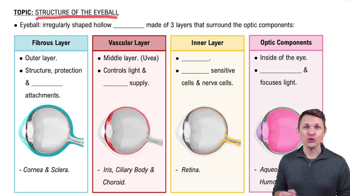
The eyeball has three main layers: the
fibrous layer
, the
vascular layer
, and the
inner layer
.
Avanzamenti del tracciato
I pulsanti di controllo sono stati cambiati in modalità "navigazione".
1/20
Video consigliati
VideoThumbView.guidedCourse
4:16
Structure of the Eyeball Example 1
6316
views
132
rank
1
comments
VideoThumbView.guidedCourse
5:21
Eyeball
7867
views
174
rank
2
comments
Termini in questo insieme (20)
Nascondere definizioni
What are the three main layers of the eyeball?
The eyeball has three main layers: the
fibrous layer
, the
vascular layer
, and the
inner layer
.
What structures compose the fibrous layer of the eyeball?
The fibrous layer consists of the
sclera
(white outer layer) and the
cornea
(transparent front part).
What is the primary function of the fibrous layer?
The fibrous layer provides
protection
and
structural support
to the eyeball.
What are the components of the vascular layer of the eyeball?
The vascular layer includes the
choroid
,
ciliary body
, and
iris
.
What role does the choroid play in the eye?
The choroid contains blood vessels that
nourish
the retina and absorb excess light to prevent scattering.
What is the function of the ciliary body?
The ciliary body controls the
shape of the lens
for focusing and produces aqueous humor.
What does the iris control in the eye?
The iris controls the
size of the pupil
, regulating the amount of light entering the eye.
What is the inner layer of the eyeball called?
The inner layer is the
retina
, which contains photoreceptor cells.
What types of photoreceptor cells are found in the retina?
The retina contains
rods
for low-light vision and
cones
for color and detailed vision.
What is the function of rods in the retina?
Rods are responsible for
vision in dim light
and detecting motion.
What is the function of cones in the retina?
Cones enable
color vision
and
visual acuity
in bright light.
How does the lens focus light on the retina?
The lens changes shape via the ciliary muscles to
refract light
and focus it precisely on the retina.
What is the role of the optic components of the eyeball?
Optic components, including the lens and cornea,
refract light
to focus images on the retina.
What is the significance of the pupil size?
Pupil size adjusts to control the
amount of light
entering the eye for optimal vision.
What fluid does the ciliary body produce?
The ciliary body produces
aqueous humor
, which nourishes the eye and maintains intraocular pressure.
What is the sclera's function in the eyeball?
The sclera provides
tough protection
and maintains the shape of the eyeball.
How do rods and cones differ in distribution on the retina?
Rods are more numerous in the
peripheral retina
, while cones are concentrated in the
central retina (fovea)
.
What happens to light after it passes through the lens?
Light is focused by the lens onto the
retina
, where photoreceptors convert it into neural signals.
Why is the choroid darkly pigmented?
The dark pigment in the choroid absorbs stray light to
reduce glare
and improve image clarity.
What is the function of the aqueous humor?
Aqueous humor maintains
intraocular pressure
, nourishes the cornea and lens, and removes waste.
 IndietroIndietro
 4:16